Trio Mercantile (TRIOMERC) Q1 FY27 Profit Falls 25% as Costs Swallow Revenue Surge
Trio Mercantile's revenue more than doubled year-on-year in Q1 FY27, but a sharp rise in expenses led to a 25% drop in net profit, highlighting margin pressure.
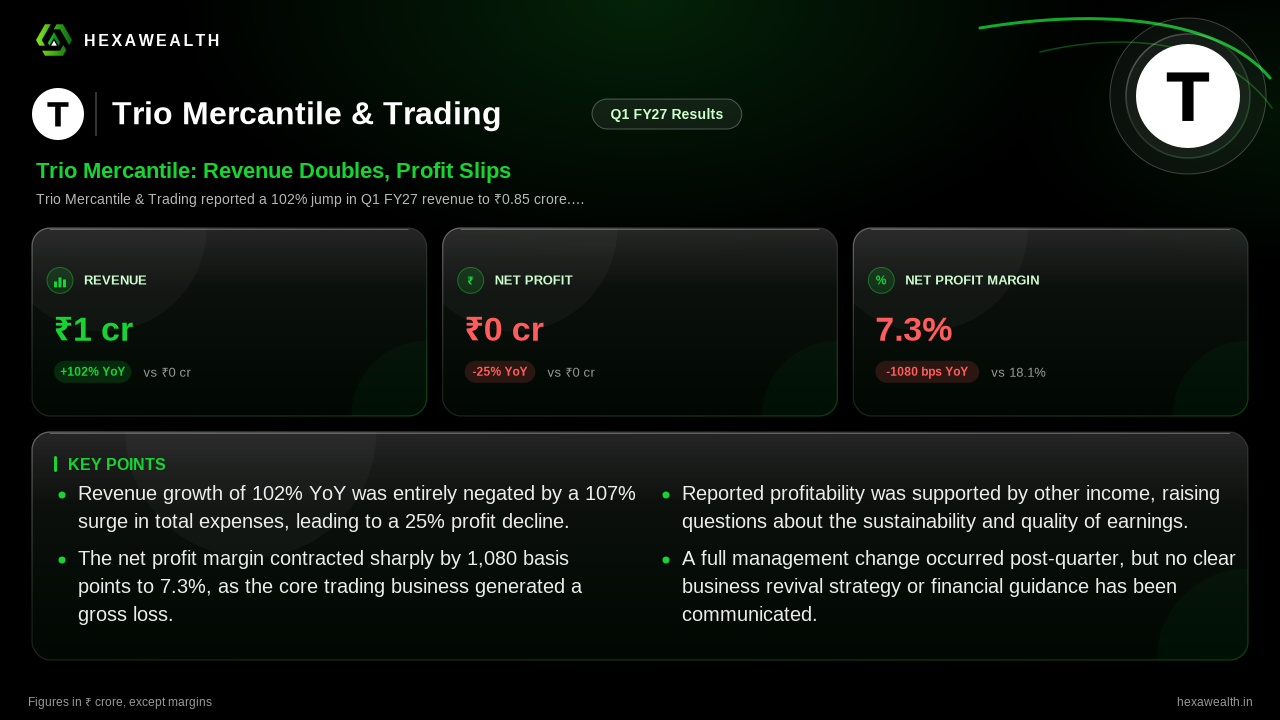
Trio Mercantile & Trading reported a 102% jump in Q1 FY27 revenue to ₹0.85 crore. However, net profit fell 25% to ₹0.06 crore as total expenses more than doubled, severely compressing margins in a competitive trading environment.
For a small trading company, growth is measured in both volume and the margin captured. Trio Mercantile & Trading delivered a surge in the first but saw the second evaporate in the June quarter, turning a headline revenue win into a story of profitability under pressure.
The numbers show a stark divergence. Revenue from operations jumped 102% year-on-year to ₹0.85 crore. Yet, net profit fell 25% to ₹0.06 crore. The net profit margin collapsed by 1,080 basis points to just 7.3%.
Revenue & profit
Revenue (₹ Cr)
Net Profit (₹ Cr)
- Revenue (₹ Cr), Q1 FY26: 0.42
- Revenue (₹ Cr), Q2 FY26: 0.44
- Revenue (₹ Cr), Q3 FY26: 0.63
- Revenue (₹ Cr), Q4 FY26: 1.27
- Revenue (₹ Cr), Q1 FY27: 0.85
- Net Profit (₹ Cr), Q1 FY26: 0.08
- Net Profit (₹ Cr), Q2 FY26: -0.04
- Net Profit (₹ Cr), Q3 FY26: -0.18
- Net Profit (₹ Cr), Q4 FY26: 0.08
- Net Profit (₹ Cr), Q1 FY27: 0.06
Revenue (₹ Cr)
- Revenue (₹ Cr), Q1 FY26: 0.42
- Revenue (₹ Cr), Q2 FY26: 0.44
- Revenue (₹ Cr), Q3 FY26: 0.63
- Revenue (₹ Cr), Q4 FY26: 1.27
- Revenue (₹ Cr), Q1 FY27: 0.85
Net Profit (₹ Cr)
- Net Profit (₹ Cr), Q1 FY26: 0.08
- Net Profit (₹ Cr), Q2 FY26: -0.04
- Net Profit (₹ Cr), Q3 FY26: -0.18
- Net Profit (₹ Cr), Q4 FY26: 0.08
- Net Profit (₹ Cr), Q1 FY27: 0.06
Net Profit Margin %
- Net Profit Margin %, Q1 FY26: 18.1
- Net Profit Margin %, Q2 FY26: -8.1
- Net Profit Margin %, Q3 FY26: -28.2
- Net Profit Margin %, Q4 FY26: 6.6
- Net Profit Margin %, Q1 FY27: 7.3
| Metric | CurrentQ1 FY27 | PreviousQ4 FY26 | Same quarter LYQ1 FY26 |
|---|---|---|---|
| Revenue (₹ Cr) | 0.85YoY +102% | 1.27 | 0.42 |
| Net Profit (₹ Cr) | 0.06YoY -25% | 0.08 | 0.08 |
| Net Profit Margin % | 7.3YoY -60% | 6.6 | 18.1 |
Why higher sales didn't help
The revenue growth was entirely offset by a faster rise in costs. According to Flash Finance, total expenses more than doubled year-on-year to ₹1.02 crore, driven largely by an ₹82.5 lakh purchase of stock-in-trade. This suggests the company traded at unfavourable spreads, a core risk in a low-margin business.
A new cost also emerged: interest expense. It surged to ₹0.03 crore from virtually nothing a year ago, reflecting new borrowings to fund operations. This added pressure to a bottom line already weakened by a widening gross loss, as noted by analysis from Univest.
A business propped up by other income
Critically, the reported net profit was supported by non-operating sources. Other income contributed ₹0.23 crore, over a quarter of total income. Flash Finance highlighted that quality of profit was a concern, with none of the pre-tax profit coming from the core trading business.
Live Chart
· TRIOMERC
(BSE)
ISIN: INE234G01022
This dependence makes earnings less predictable. The core trading operation, as per Univest, showed a negative gross profit, meaning the basic buy-sell activity was loss-making before other income and expenses.
A leadership reset with no clear roadmap
The quarter also saw a complete management overhaul. As reported by Flash Finance, the MD, CFO, and four board members resigned in July. A new Chairman and Managing Director, Kaushik Jagannath Joshi, was appointed.
While the board has approved altering its Memorandum of Association to diversify revenue streams, StockFin.ai notes management has provided no forward-looking guidance or operational targets. The strategic direction under new leadership remains undefined.
Key Points
- Revenue growth of 102% YoY was entirely negated by a 107% surge in total expenses, leading to a 25% profit decline.
- The net profit margin contracted sharply by 1,080 basis points to 7.3%, as the core trading business generated a gross loss.
- Reported profitability was supported by other income, raising questions about the sustainability and quality of earnings.
- A full management change occurred post-quarter, but no clear business revival strategy or financial guidance has been communicated.
Hexa Perspective
This quarter underscores the structural challenges of a pure-play, small-scale trading operation. Volume growth came at the cost of margin, a pattern that is unsustainable. The company's positive net profit is currently a function of other income, not operational prowess.
The recent management change introduces uncertainty but also a potential pivot point. Investors are left weighing the possibility of a strategic shift under new leadership against a history of volatile, thin-margin trading. Until the new team articulates and executes a credible plan for durable profitability, the business remains in a holding pattern.
Also read
Want this applied to your portfolio?
Talk to a HexaWealth advisor, or sync your mutual fund data for insights tailored to your holdings.