MAC Hotels (MACH) Q2 FY27 Profit Crashes 91% as Interest Costs Triple
The Goa-based hotelier saw revenue fall 17% year-on-year, but a near 300% surge in interest expense drove net profit down to just ₹0.04 crore.
MAC Hotels' Q2 FY27 was defined by a severe profitability squeeze. While revenue declined, a massive jump in interest costs and depreciation from expansion plans eroded margins, leading to a 91% profit drop.
For a single-property hotel operator in Goa, the September quarter is a test of resilience against seasonal monsoons and shifting tourist flows. MAC Hotels' Resort Park Avenue faced both, with revenue falling 17% from last year. The real story, however, was a profit collapse of over 90%, as fixed costs from a recent capital raise and expansion plans overwhelmed a shrinking top line.
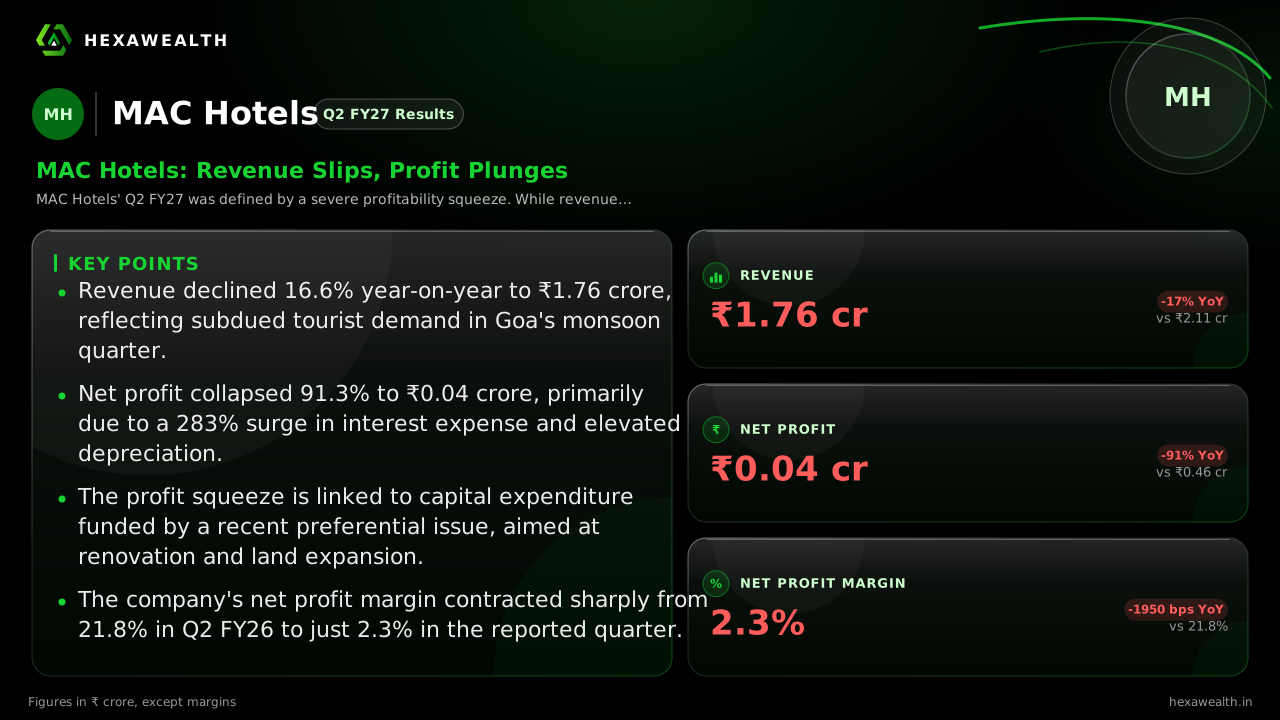
The numbers show a business under dual pressure. Revenue of ₹1.76 crore was down 17% year-on-year and 29% sequentially. Net profit shrank to just ₹0.04 crore, a 91% plunge from Q2 FY26. The net profit margin, once a healthy 21.8%, contracted to a thin 2.3%.
Revenue & profit
Revenue (₹ Cr)
Profit (₹ Cr)
- Revenue (₹ Cr), Q2 FY25: 1.23
- Revenue (₹ Cr), Q4 FY25: 2.48
- Revenue (₹ Cr), Q2 FY26: 2.11
- Revenue (₹ Cr), Q4 FY26: 2.47
- Revenue (₹ Cr), Q2 FY27: 1.76
- Profit (₹ Cr), Q2 FY25: 0.25
- Profit (₹ Cr), Q4 FY25: 0.03
- Profit (₹ Cr), Q2 FY26: 0.46
- Profit (₹ Cr), Q4 FY26: -0.13
- Profit (₹ Cr), Q2 FY27: 0.04
Revenue (₹ Cr)
- Revenue (₹ Cr), Q2 FY25: 1.23
- Revenue (₹ Cr), Q4 FY25: 2.48
- Revenue (₹ Cr), Q2 FY26: 2.11
- Revenue (₹ Cr), Q4 FY26: 2.47
- Revenue (₹ Cr), Q2 FY27: 1.76
Profit (₹ Cr)
- Profit (₹ Cr), Q2 FY25: 0.25
- Profit (₹ Cr), Q4 FY25: 0.03
- Profit (₹ Cr), Q2 FY26: 0.46
- Profit (₹ Cr), Q4 FY26: -0.13
- Profit (₹ Cr), Q2 FY27: 0.04
| Metric | CurrentQ2 FY27 | Same quarter LYQ2 FY26 |
|---|---|---|
| Revenue (₹ Cr) | 1.76YoY -17% | 2.11 |
| Profit (₹ Cr) | 0.04YoY -91% | 0.46 |
| Net Margin (%) | 2.3YoY -89% | 21.8 |
The Cost Squeeze That Erased Gains
The drastic profit fall stems from costs rising faster than sales could fall. Total expenses fell 35% quarter-on-quarter, but were still 17% higher than the year-ago period. The critical pressure points were finance and depreciation. Interest expense surged 283% year-on-year to ₹0.23 crore, as reported by mcapital.in. Depreciation also inched up 4% to ₹0.74 crore.
This cost inflation is linked to the company's growth plans. In May 2026, MAC Hotels raised ₹8.42 crore through a preferential issue for working capital, land purchase, and strategic investment. The remaining expansion, including warrant money of ₹15.5 crore, is earmarked for ongoing renovation and land plans. While funding future growth, this has increased the near-term burden of depreciation and likely contributed to higher interest costs on associated borrowing.
A Goa Market in Transition
The revenue decline occurred against a mixed local backdrop. While industry reports from PhillipCapital and others pointed to resilient domestic demand nationally, Goa's tourist footfall was nearly flat for the first nine months of 2026, as per the Times of India. The state saw 76.9 lakh arrivals, a mere 0.76% increase, with international arrivals declining sharply. For a leisure destination, this stagnation during the monsoon quarter likely pressured occupancy and room rates.
Live Chart
· MACH
(BSE)
ISIN: INE004Z01011
The company's board confirmed there was no deviation in the use of the ₹8.42 crore raised, according to an InvestyWise report. With the capital allocated and renovation plans underway, the focus shifts to whether these investments can drive a recovery in the traditionally stronger second half of the fiscal year.
Key Points
- Revenue declined 16.6% year-on-year to ₹1.76 crore, reflecting subdued tourist demand in Goa's monsoon quarter.
- Net profit collapsed 91.3% to ₹0.04 crore, primarily due to a 283% surge in interest expense and elevated depreciation.
- The profit squeeze is linked to capital expenditure funded by a recent preferential issue, aimed at renovation and land expansion.
- The company's net profit margin contracted sharply from 21.8% in Q2 FY26 to just 2.3% in the reported quarter.
Hexa Perspective
The quarter underscores the vulnerability of a small, single-asset operator to both cyclical demand and fixed-cost inflation. The strategic bet on expansion using fresh equity is clear, but it arrives at a time when operating leverage is negative.
The path forward hinges on two factors: a material improvement in Goa's tourist arrivals, particularly in the peak season, and the successful monetization of the renovation and land bank plans. Until revenue growth resumes strongly, the high depreciation and interest costs will keep profitability under severe pressure. Investors are essentially funding a turnaround that has yet to appear in the operating numbers.
Also read
Want this applied to your portfolio?
Talk to a HexaWealth advisor, or sync your mutual fund data for insights tailored to your holdings.