Seamec (SEAMECLTD) Q2 FY27's Q2 Profit Dips on Monsoon Seasonality Despite Structural Tailwinds
The offshore services firm saw a sequential drop in revenue and profit, a typical monsoon quarter effect, but the underlying demand and fleet expansion story remains intact.
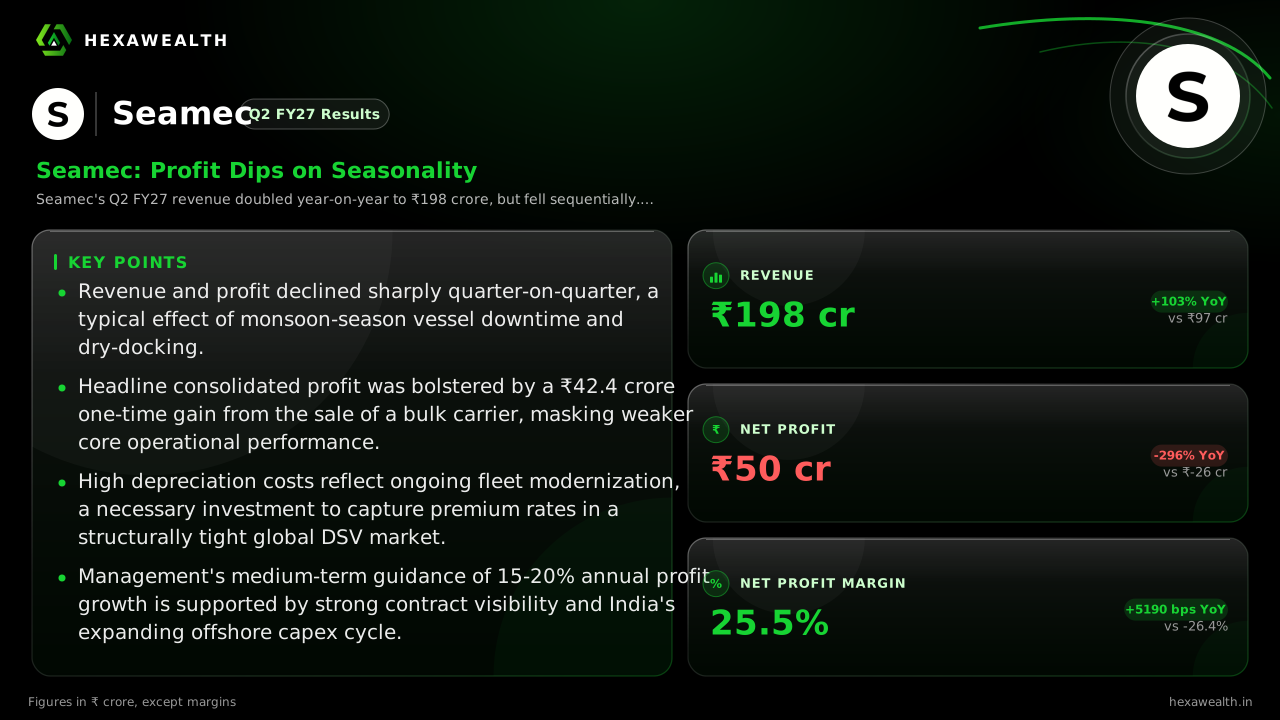
Seamec's Q2 FY27 revenue doubled year-on-year to ₹198 crore, but fell sequentially. Profit dipped 38% QoQ, impacted by seasonal vessel downtime and higher costs, though a one-time gain lifted the headline number.
For Seamec, the offshore services cycle is a story of two speeds. The structural demand for its diving support vessels is robust, but quarterly earnings are still hostage to India's monsoon season. The September quarter results capture that tension perfectly, with a headline profit that masks a sharp operational slowdown.
The numbers show a company in transition. Revenue more than doubled year-on-year to ₹198.1 crore, a staggering recovery from a loss-making base. Yet it fell 33% from the previous quarter. Profit followed a similar path, dropping 38% sequentially to ₹50.5 crore. A glance at the last five quarters reveals the volatility built into this business.
Revenue & profit
Revenue (₹ Cr)
Profit (₹ Cr)
| Metric | CurrentQ2 FY27 | PreviousQ1 FY27 | Same quarter LYQ2 FY26 |
|---|---|---|---|
| Revenue (₹ Cr) | 198.13YoY +103% | 296.92 | 97.42 |
| Profit (₹ Cr) | 50.48YoY +296% | 81.34 | -25.73 |
| PAT Margin (%) | 25.5YoY +197% | 27.4 | -26.4 |
Why the quarter softened
The sequential dip was no surprise. Management, in its AlphaStreet earnings call, explicitly warned against judging Seamec on a quarterly basis due to monsoon volatility. Rough seas force vessel dry-docking and reduce operational days, a pattern that played out this quarter. Employee costs also rose 11.5% sequentially as crew expenses are largely fixed, even when revenue dips.
A critical detail is the ₹42.4 crore exceptional gain from the sale of the bulk carrier Seamec Gallant, as reported by Flash Finance. This one-off item significantly flattered the consolidated net profit. The standalone operational picture was far weaker, with profit at just ₹4.2 crore.
The costs of growing a fleet
Growth in this capital-intensive business comes with a price tag. Depreciation hit ₹52.2 crore, up 37% from a year ago, as new vessels like Seamec Agastya were added to the fleet. CFO Ashok Verma indicated on the call that annual depreciation could run between ₹200-220 crore as the company integrates its latest acquisition, Seamec Anant.
This heavy reinvestment is a deliberate trade-off. The company is shedding older, cyclical assets to focus on a modern fleet of diving support vessels (DSVs) that command premium rates. The global DSV market is incredibly tight, with only about 65-70 high-spec vessels operating worldwide, as noted in the earnings call.
A multi-year runway for growth
The outlook beyond the seasonal blip is what investors are banking on. Management guided for 15% revenue and 18-20% profit growth annually over the next four to five years. This is underpinned by India's massive offshore exploration push, including the ₹84,084 crore Samudra Manthan scheme.
Order visibility is strong. The company secured a 1,225-day charter for Seamec Anant and redeployed Seamec II on a new $19 million contract, minimizing idle time. With most vessels on long-term charters, primarily with anchor client ONGC, revenue visibility for the coming years is high.
Key Points
- Revenue and profit declined sharply quarter-on-quarter, a typical effect of monsoon-season vessel downtime and dry-docking.
- Headline consolidated profit was bolstered by a ₹42.4 crore one-time gain from the sale of a bulk carrier, masking weaker core operational performance.
- High depreciation costs reflect ongoing fleet modernization, a necessary investment to capture premium rates in a structurally tight global DSV market.
- Management's medium-term guidance of 15-20% annual profit growth is supported by strong contract visibility and India's expanding offshore capex cycle.
Hexa Perspective
This quarter underscores the classic Seamec investment case: lumpy quarterly earnings against a powerful multi-year uptrend. The monsoon dip is a known, recurring drag, but it does not alter the fundamental supply-demand imbalance favoring vessel owners. The company's strategic shift to a younger, more specialized fleet should improve utilization and pricing power over time. The key watchpoint is execution. The promised 40% EBITDA margin in a 'stable state' hinges on seamless deployment of new vessels like Anant and avoiding costly technical downtime. If achieved, the current valuation discount to the industry could narrow as quarterly volatility smooths out.
Also read
Want this applied to your portfolio?
Talk to a HexaWealth advisor, or sync your mutual fund data for insights tailored to your holdings.