Sammaan Capital (SAMMAANCAP) Q1 FY27 Profit Dips 27% as Strategic Transition Weighs on Revenue
The NBFC's first quarter under new ownership shows a 31% revenue drop and a 27% profit decline, even as asset quality remains strong and funding costs start to fall.
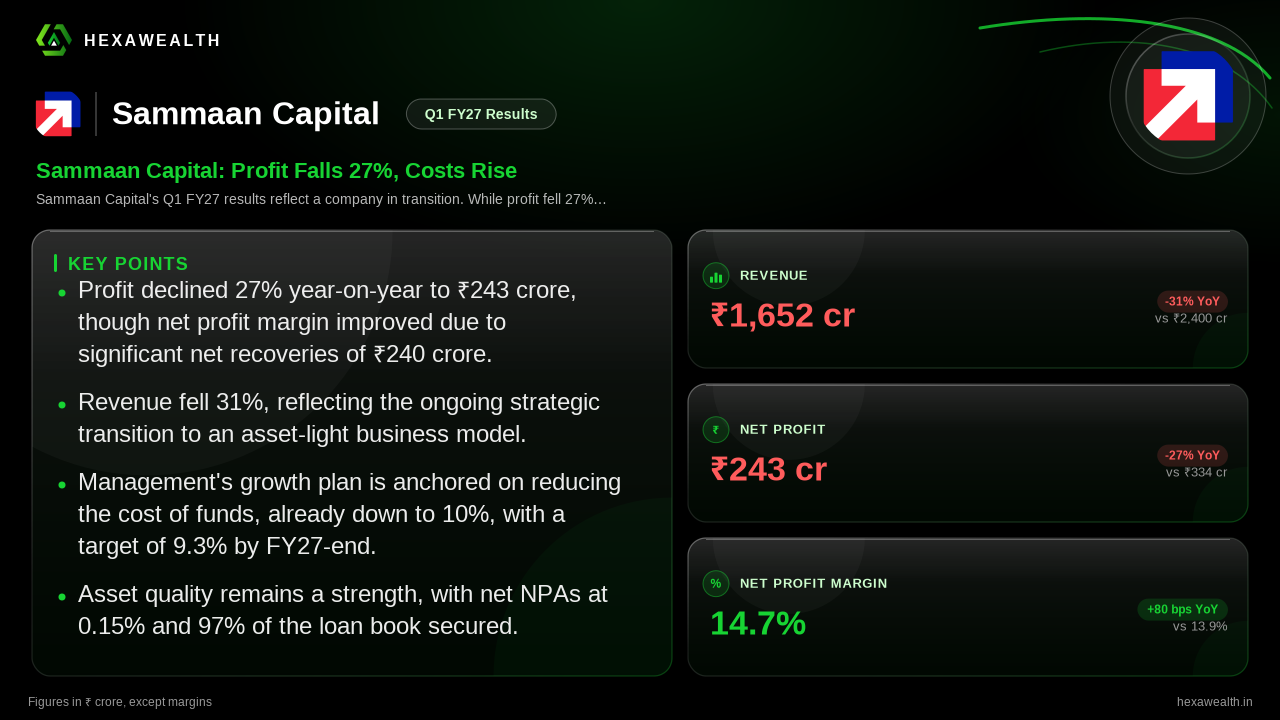
Sammaan Capital's Q1 FY27 results reflect a company in transition. While profit fell 27% year-on-year, a sharp reduction in provisions and strong recoveries helped margins improve. The focus is now on executing an ambitious growth roadmap.
For Sammaan Capital, the first quarter under its new promoter was about steadying the ship after a storm. The reported numbers show a business still shrinking its core income but finding its footing through lower provisions and a clear path to cheaper funding.
The quarter delivered a net profit of ₹243 crore, down 27% from a year ago. Revenue fell a sharper 31% to ₹1,652 crore. The sequential improvement from a massive loss last quarter is stark, but the year-on-year comparison shows the ongoing strategic pivot.
Revenue & profit
Revenue (₹ Cr)
Profit (₹ Cr)
- Revenue (₹ Cr), Q1 FY26 (Jun 2025): 2,400.33
- Revenue (₹ Cr), Q2 FY26 (Sep 2025): 2,250.60
- Revenue (₹ Cr), Q3 FY26 (Dec 2025): 2,157.54
- Revenue (₹ Cr), Q4 FY26 (Mar 2026): 1,357.66
- Revenue (₹ Cr), Q1 FY27 (Jun 2026): 1,651.93
- Profit (₹ Cr), Q1 FY26 (Jun 2025): 334.30
- Profit (₹ Cr), Q2 FY26 (Sep 2025): 308.47
- Profit (₹ Cr), Q3 FY26 (Dec 2025): 314.08
- Profit (₹ Cr), Q4 FY26 (Mar 2026): -8,101.41
- Profit (₹ Cr), Q1 FY27 (Jun 2026): 243.30
Revenue (₹ Cr)
- Revenue (₹ Cr), Q1 FY26 (Jun 2025): 2,400.33
- Revenue (₹ Cr), Q2 FY26 (Sep 2025): 2,250.60
- Revenue (₹ Cr), Q3 FY26 (Dec 2025): 2,157.54
- Revenue (₹ Cr), Q4 FY26 (Mar 2026): 1,357.66
- Revenue (₹ Cr), Q1 FY27 (Jun 2026): 1,651.93
Profit (₹ Cr)
- Profit (₹ Cr), Q1 FY26 (Jun 2025): 334.30
- Profit (₹ Cr), Q2 FY26 (Sep 2025): 308.47
- Profit (₹ Cr), Q3 FY26 (Dec 2025): 314.08
- Profit (₹ Cr), Q4 FY26 (Mar 2026): -8,101.41
- Profit (₹ Cr), Q1 FY27 (Jun 2026): 243.30
Net Profit Margin (%)
- Net Profit Margin (%), Q1 FY26 (Jun 2025): 13.9
- Net Profit Margin (%), Q2 FY26 (Sep 2025): 13.7
- Net Profit Margin (%), Q3 FY26 (Dec 2025): 14.6
- Net Profit Margin (%), Q4 FY26 (Mar 2026): —
- Net Profit Margin (%), Q1 FY27 (Jun 2026): 14.7
| Metric | CurrentQ1 FY27 (Jun 2026) | PreviousQ4 FY26 (Mar 2026) |
|---|---|---|
| Revenue (₹ Cr) | 1,651.93 | 1,357.66 |
| Profit (₹ Cr) | 243.30 | -8,101.41 |
| Net Profit Margin (%) | 14.7 | — |
The Squeeze on Core Income
The steep revenue decline stems from a deliberate shift to an asset-light model, as noted in reports from in.investing.com. This transition has shrunk the balance sheet, reducing interest income. Meanwhile, interest expense rose 12% year-on-year, keeping pressure on the core lending margin.
Yet profitability held up better than the top line. The net profit margin expanded 80 basis points to 14.7%. This was driven by a massive swing in provisions; the company reported a net recovery of ₹240 crore, according to its earnings call summary on Yahoo Finance. This clean-up from legacy issues provided crucial earnings support.
A Liability-Led Turnaround Plan
Management's entire strategy now hinges on lowering the cost of funds. The quarter saw it decline to 10% from 10.5%, with a target of 9.3% by year-end. Investing.com reports that rating upgrades to AA+ domestically are the key catalyst for this expected decline.
Live Chart
· SAMMAANCAP
(BSE)
ISIN: INE148I01020
The guidance is exceptionally detailed. For FY27, disbursements are targeted at ₹30,000 crore, with the mix shifting toward new products like personal loans. The cost-to-income ratio is guided at around 50% this year, aiming to fall to 30-35% by FY29.
The Market's Measured View
The stock rose a modest 0.6% on results day, suggesting investors are awaiting proof of execution. Analysts on the earnings call, per Yahoo Finance, flagged concerns about elevated costs, intense competition, and the ambitious nature of long-term return targets. The company's high debt-to-equity ratio of 2.93 remains a structural challenge.
Key Points
- Profit declined 27% year-on-year to ₹243 crore, though net profit margin improved due to significant net recoveries of ₹240 crore.
- Revenue fell 31%, reflecting the ongoing strategic transition to an asset-light business model.
- Management's growth plan is anchored on reducing the cost of funds, already down to 10%, with a target of 9.3% by FY27-end.
- Asset quality remains a strength, with net NPAs at 0.15% and 97% of the loan book secured.
Hexa Perspective
This quarter is a baseline. The severe provisioning of prior quarters is past, and the new promoter's influence is visible in rating upgrades. The story for the next year is simple: can the guided 70-basis-point drop in funding costs materialize and offset the revenue shrinkage from the asset-light shift? The high leverage and negative ROE underscore the fragility. Success depends entirely on executing the liability transformation faster than the core income declines. For now, the market is pricing in the promise, not the proof.
Also read
Want this applied to your portfolio?
Talk to a HexaWealth advisor, or sync your mutual fund data for insights tailored to your holdings.