Dev Accelerator is adding more space in its most important market. The company disclosed a new capacity addition of 125,551 square feet in Bangalore, a move that directly supports its aggressive growth strategy after a quarter where revenue surged 55%.
The expansion, scheduled for completion by February 2027, requires an investment of up to ₹31.65 crore. According to the NSE filing, this will be financed through internal accruals or debt. The company’s existing portfolio totals 1.26 million square feet and was running at an 88% utilization rate.
This addition comes as demand for flexible workspace is booming. According to a Cushman & Wakefield report in The Economic Times, Bengaluru led India's flex market in the first half of 2026, accounting for 30% of total seat uptake. The report also notes that Global Capability Centers (GCCs) are a major demand driver, a segment Dev Accelerator has been targeting.
Funding the Growth
The capital for this project adds to the company’s substantial funding plans. Its board has already approved raising up to ₹300 crore, as noted in the latest quarterly article. Financing costs are a key watchpoint; a report by The Hindu BusinessLine notes that short-term corporate borrowing costs in India have moved higher, with AAA-rated 2-year bond yields at 8.25%.
Key Points
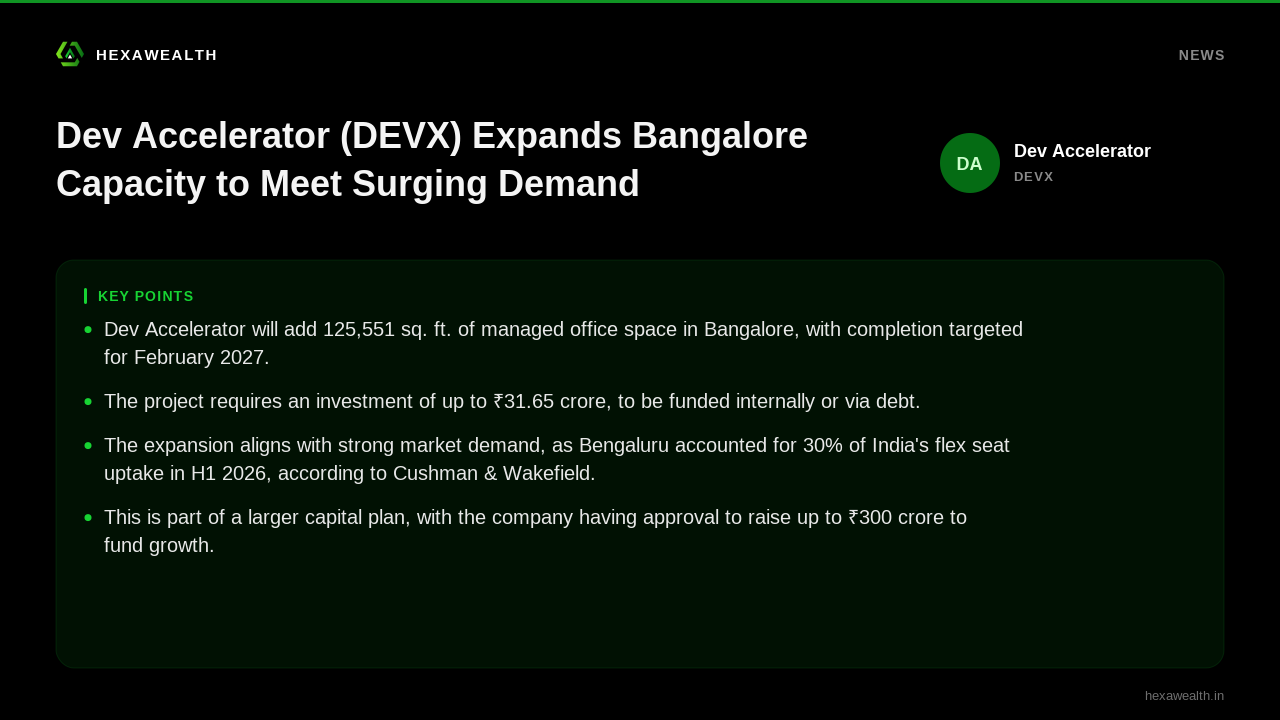
- Dev Accelerator will add 125,551 sq. ft. of managed office space in Bangalore, with completion targeted for February 2027.
- The project requires an investment of up to ₹31.65 crore, to be funded internally or via debt.
- The expansion aligns with strong market demand, as Bengaluru accounted for 30% of India's flex seat uptake in H1 2026, according to Cushman & Wakefield.
- This is part of a larger capital plan, with the company having approval to raise up to ₹300 crore to fund growth.
Hexa Perspective
This filing confirms Dev Accelerator is executing its capital-intensive expansion plan in a favorable market. The risk is not demand—Bengaluru's flex market is hot—but funding and execution. The company must fill this new space quickly at profitable rates to service the debt it is taking on.
The thesis hinges on maintaining high occupancy and managing interest costs, which are rising in the broader market. If the company can convert this new capacity into revenue as efficiently as it did last quarter, the growth story remains intact. If not, the leverage built to fund this expansion will become a heavier burden.