Sammaan Capital (SAMMAANCAP) Q2 FY27 Profit Rises Despite Revenue Drop as Costs Fall
The NBFC's Q2 profit edged up 1.3% year-on-year, supported by a sharp fall in total expenses, while revenue declined nearly 18%.
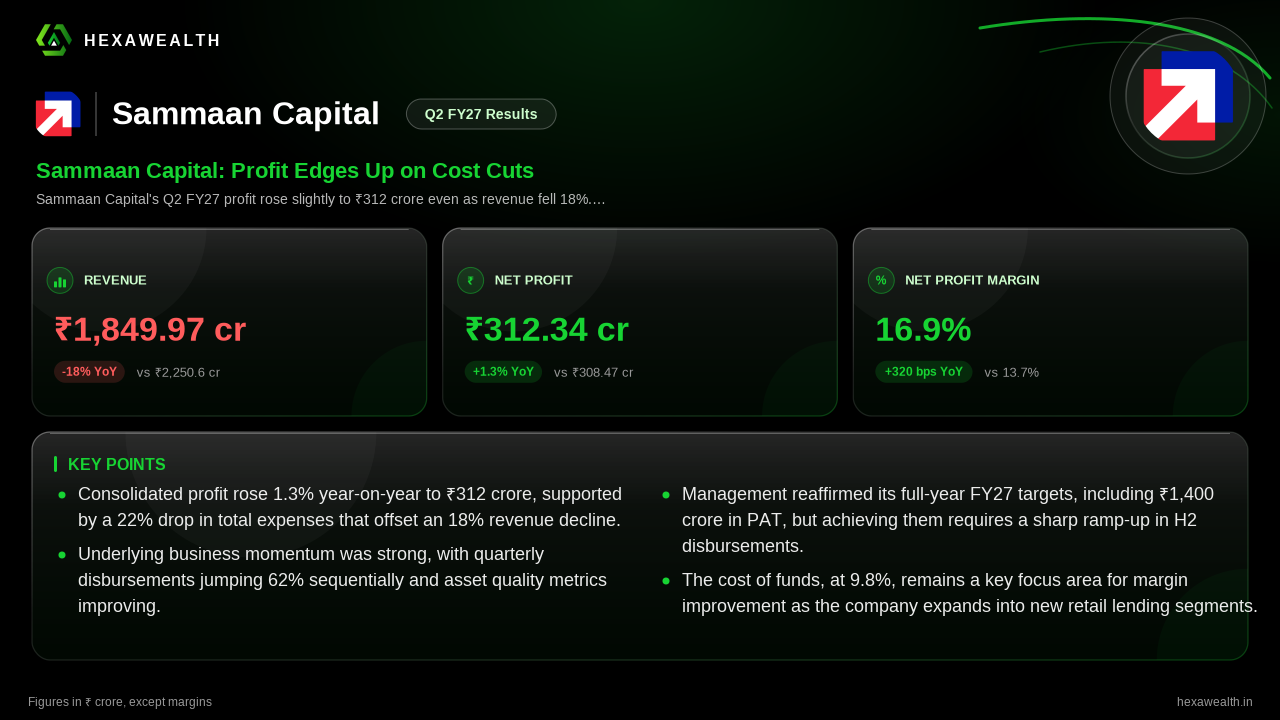
Sammaan Capital's Q2 FY27 profit rose slightly to ₹312 crore even as revenue fell 18%. The gain was driven by a 22% drop in total expenses, while asset quality improved and disbursements jumped 62% sequentially.
For Sammaan Capital, the September quarter was a story of stabilization before growth. The NBFC, now backed by Abu Dhabi's IHC, reported a slight profit increase despite a significant revenue decline, a sign of its ongoing balance sheet clean-up.
Revenue fell 18% year-on-year to ₹1,850 crore, but net profit edged up 1.3% to ₹312 crore. The bottom line held up because total expenses dropped by a sharper 22%. The net profit margin expanded by 320 basis points to 16.9%.
Revenue & profit
Revenue (₹ Cr)
Profit (₹ Cr)
- Revenue (₹ Cr), Q2 FY26: 2,250.60
- Revenue (₹ Cr), Q3 FY26: 2,157.54
- Revenue (₹ Cr), Q4 FY26: 1,357.66
- Revenue (₹ Cr), Q1 FY27: 1,651.93
- Revenue (₹ Cr), Q2 FY27: 1,849.97
- Profit (₹ Cr), Q2 FY26: 308.47
- Profit (₹ Cr), Q3 FY26: 314.08
- Profit (₹ Cr), Q4 FY26: -8,101.41
- Profit (₹ Cr), Q1 FY27: 243.30
- Profit (₹ Cr), Q2 FY27: 312.34
Revenue (₹ Cr)
- Revenue (₹ Cr), Q2 FY26: 2,250.60
- Revenue (₹ Cr), Q3 FY26: 2,157.54
- Revenue (₹ Cr), Q4 FY26: 1,357.66
- Revenue (₹ Cr), Q1 FY27: 1,651.93
- Revenue (₹ Cr), Q2 FY27: 1,849.97
Profit (₹ Cr)
- Profit (₹ Cr), Q2 FY26: 308.47
- Profit (₹ Cr), Q3 FY26: 314.08
- Profit (₹ Cr), Q4 FY26: -8,101.41
- Profit (₹ Cr), Q1 FY27: 243.30
- Profit (₹ Cr), Q2 FY27: 312.34
Net Profit Margin (%)
- Net Profit Margin (%), Q2 FY26: 13.7
- Net Profit Margin (%), Q3 FY26: 14.6
- Net Profit Margin (%), Q4 FY26: –
- Net Profit Margin (%), Q1 FY27: 14.7
- Net Profit Margin (%), Q2 FY27: 16.9
| Metric | CurrentQ2 FY27 | PreviousQ1 FY27 | Same quarter LYQ2 FY26 |
|---|---|---|---|
| Revenue (₹ Cr) | 1,849.97YoY -18% | 1,651.93 | 2,250.60 |
| Profit (₹ Cr) | 312.34YoY +1.3% | 243.30 | 308.47 |
| Net Profit Margin (%) | 16.9YoY +23% | 14.7 | 13.7 |
The Cost-Cut Story
The headline profit increase was driven by a steep fall in total expenses, which dropped over ₹400 crore from a year ago. According to The Economic Times, this was partly due to the normalization of one-off income. A year ago, the company booked a large 'net gain on derecognition of financial instruments' linked to asset sales, which did not repeat.
This created a high base for revenue. Core interest income also fell, as reported by Business Standard, despite the loan book growing. Employee costs, however, rose 21% year-on-year as the company invested in its expansion.
A Strong Operational Pulse
Beneath the consolidated revenue decline, the business showed clear signs of life. Disbursements surged 62% quarter-on-quarter to ₹6,278 crore, as per the company's release. Assets under management grew 5% sequentially to ₹59,188 crore.
Live Chart
· SAMMAANCAP
(BSE)
ISIN: INE148I01020
Asset quality strengthened, with gross NPAs improving to 0.15% from 0.21% in the prior quarter. Management, cited by guidance.fyi, said it is transitioning from stabilization to growth, targeting ₹1,400 crore in full-year profit.
The Funding and Growth Challenge
The path forward hinges on funding costs and execution. The cost of funds was 9.8%, with a target of 9.3% by year-end. On the earnings call, management noted the liquidity environment is tight but expressed confidence that spreads could hold as it raises lending rates.
To meet its ambitious targets, the company must nearly double disbursements in the second half. It is also launching new products like gold loans, with a soft launch planned this quarter.
Key Points
- Consolidated profit rose 1.3% year-on-year to ₹312 crore, supported by a 22% drop in total expenses that offset an 18% revenue decline.
- Underlying business momentum was strong, with quarterly disbursements jumping 62% sequentially and asset quality metrics improving.
- Management reaffirmed its full-year FY27 targets, including ₹1,400 crore in PAT, but achieving them requires a sharp ramp-up in H2 disbursements.
- The cost of funds, at 9.8%, remains a key focus area for margin improvement as the company expands into new retail lending segments.
Hexa Perspective
The quarter confirms Sammaan Capital's painful transition is yielding a cleaner, retail-focused book. Profitability is returning, but the revenue decline underscores the legacy drag as high-margin, one-off income normalizes.
The real test is whether the 62% sequential disbursement growth is sustainable and can offset the persistent revenue pressure. With funding costs still elevated and a heavy reliance on H2 execution, the full-year profit target of ₹1,400 crore appears ambitious but within reach if the operational momentum holds.
Also read
Want this applied to your portfolio?
Talk to a HexaWealth advisor, or sync your mutual fund data for insights tailored to your holdings.