Rapicut Carbides (RAPICUT) Q2 FY27 Profit Plunges 73% as Revenue Volatility Bites
The tungsten carbide maker's Q2 profit fell sharply from a record Q1, raising questions about the sustainability of its recent growth amid lumpy orders.
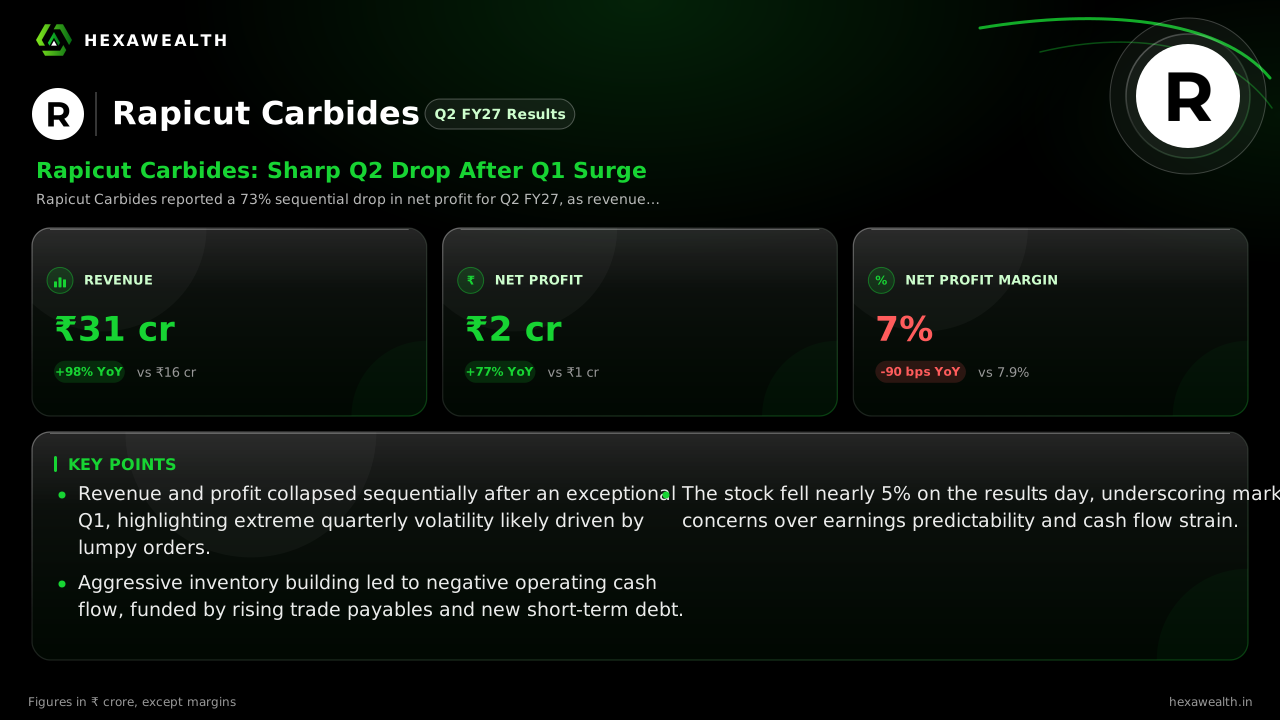
Rapicut Carbides reported a 73% sequential drop in net profit for Q2 FY27, as revenue contracted over 60%. While year-on-year comparisons remain strong, the extreme volatility points to a reliance on lumpy, project-based orders.
For a company like Rapicut Carbides, a single quarter can tell two very different stories. The tungsten carbide products maker followed a record-breaking first quarter with a sharp contraction, revealing a business model highly dependent on the timing of bulk orders.
The numbers show a dramatic swing. Revenue fell 62% sequentially to ₹31.4 crore, pulling net profit down 73% to ₹2.2 crore. Year-on-year comparisons still look robust, with revenue nearly doubling, but this masks the underlying volatility. The half-year picture is stronger, yet Q1 contributed over 70% of that H1 revenue.
Revenue & profit
Revenue (₹ Cr)
Net Profit (₹ Cr)
| Metric | CurrentQ2 FY27 (Sep '26) | PreviousQ1 FY27 (Jun '26) |
|---|---|---|
| Revenue (₹ Cr) | 31.38 | 82.04 |
| Net Profit (₹ Cr) | 2.21 | 8.17 |
| PAT Margin (%) | 7.0 | 10.0 |
Why the growth story hit a wall
Research from MarketsMojo suggests the extreme quarterly swing points to lumpy order execution rather than steady demand. The company’s revenue appears tied to project-based or bulk purchases, making its performance highly unpredictable from one quarter to the next. This pattern makes forecasting earnings exceptionally difficult.
The profit drop was sharper than the revenue fall, with net margin shrinking 300 basis points. While operating margins held relatively steady year-on-year, a more than doubling of interest expense weighed on the bottom line. This reflects a shift in funding for a massive inventory build-up.
The cash flow conundrum
A report from ScanX Trade highlights a critical divergence. While revenue soared year-on-year, operating cash flow for the first half was deeply negative at ₹11.7 crore. Cash was consumed to build inventory, which ballooned by over ₹35 crore. Suppliers and new short-term borrowings are financing this aggressive working capital expansion, raising questions about liquidity sustainability.
The market reaction was clear. The stock closed nearly 5% lower on the results date, reflecting investor skepticism about growth sustainability. With minimal institutional coverage, the stock remains a high-risk, sentiment-driven play.
Key Points
- Revenue and profit collapsed sequentially after an exceptional Q1, highlighting extreme quarterly volatility likely driven by lumpy orders.
- Aggressive inventory building led to negative operating cash flow, funded by rising trade payables and new short-term debt.
- The stock fell nearly 5% on the results day, underscoring market concerns over earnings predictability and cash flow strain.
Hexa Perspective
The quarter exposes the core tension in Rapicut’s turnaround. The company can generate profitable spikes, but its financials lack the visibility and stability that justify a premium. The inventory build suggests preparation for future orders, but it has come at a high cash cost.
Investors are now weighing whether the H1 performance represents a sustainable recovery or merely the timing of a few large contracts. The next two quarters are critical. Consistent revenue above ₹40 crore and a return to positive cash flow are needed to shift the narrative from a speculative bet to a credible growth story.
Also read
Want this applied to your portfolio?
Talk to a HexaWealth advisor, or sync your mutual fund data for insights tailored to your holdings.