Prashant India (PRSNTIN) Q2 FY27 Reports Zero Revenue as Asset Sale Windfall Ends
The September quarter saw no operating income, with a net loss of ₹8 lakh as the company's wind power and textile divisions remain shut.
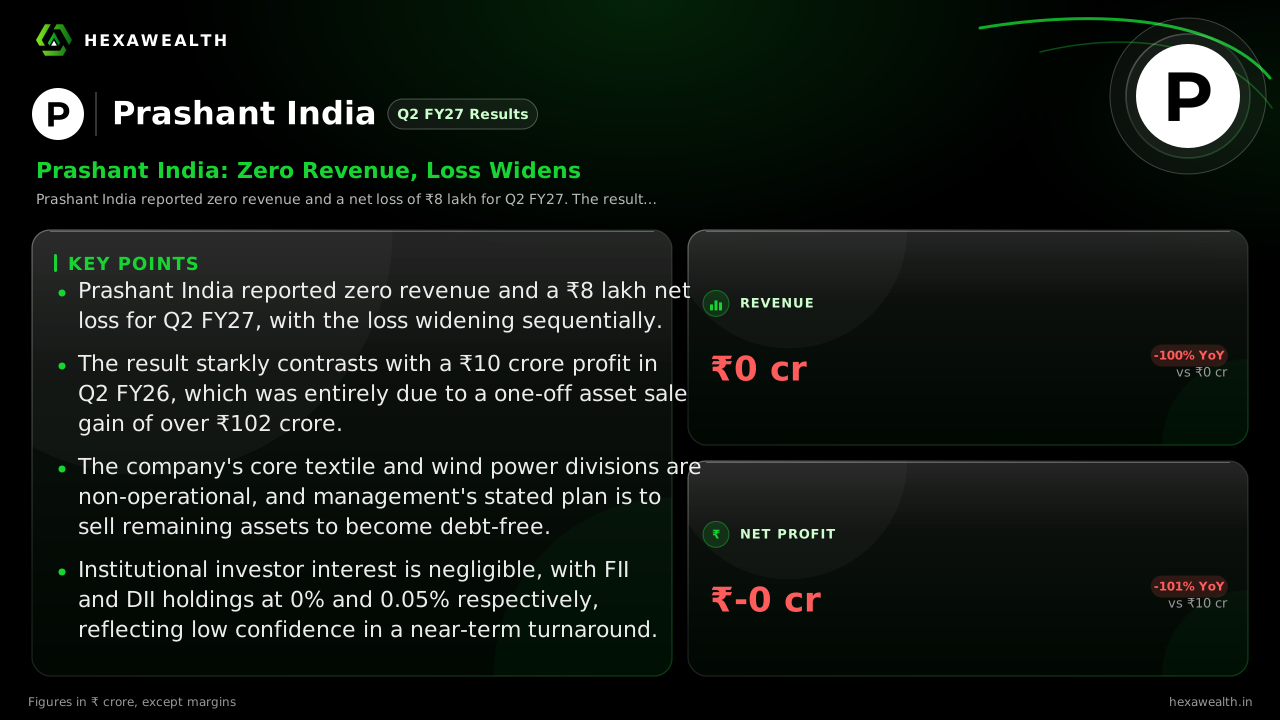
Prashant India reported zero revenue and a net loss of ₹8 lakh for Q2 FY27. The result exposes its operational weakness after last year's profit was driven by a one-off asset sale gain of over ₹102 crore.
For Prashant India, the September quarter was about what was no longer there. The company has been selling off its assets to become debt-free, leaving its core textile and wind power businesses shuttered. This quarter, with no exceptional gains to offset fixed costs, the underlying operational weakness was laid bare.
The numbers tell a stark story. Revenue was zero, down 100% from a year ago. The net loss stood at ₹8 lakh, a 27% wider deficit from the June quarter. This follows a ₹10 crore profit in the same period last year, which was entirely due to a one-off gain.
Revenue & profit
Revenue (₹ Cr)
Net Profit (₹ Cr)
| Metric | CurrentQ2 FY27 (Sep 2026) | PreviousQ1 FY27 (Jun 2026) |
|---|---|---|
| Revenue (₹ Cr) | 0.00 | 0.00 |
| Net Profit (₹ Cr) | -0.08 | -0.11 |
The One-Off That Masked Reality
The ₹10 crore profit a year ago was a mirage. According to a report from ScanX, it was driven by an exceptional gain of ₹10.2 crore from selling assets. The company's textile division has been non-operational since July 2023, and its wind power division was also discontinued last year. The recent profit was from liquidation, not operations.
A Company in Wind-Down Mode
Management's focus, as noted in its FY26 annual report, is on becoming debt-free by disposing of remaining assets. It plans to lease the wind power division's land and explore new opportunities only after debt resolution. For now, expenses like employee costs are funded by dwindling cash reserves, which fell to ₹33 lakh from ₹80 lakh at the end of FY26.
Key Points
- Prashant India reported zero revenue and a ₹8 lakh net loss for Q2 FY27, with the loss widening sequentially.
- The result starkly contrasts with a ₹10 crore profit in Q2 FY26, which was entirely due to a one-off asset sale gain of over ₹102 crore.
- The company's core textile and wind power divisions are non-operational, and management's stated plan is to sell remaining assets to become debt-free.
- Institutional investor interest is negligible, with FII and DII holdings at 0% and 0.05% respectively, reflecting low confidence in a near-term turnaround.
Hexa Perspective
The quarter confirms Prashant India is a company in wind-down, not turnaround, mode. Its financials are now a pure reflection of fixed costs against a near-zero revenue base, with cash reserves depleting to cover them. The path forward hinges entirely on asset monetization and debt settlement, a process with uncertain timing. Until a new business plan emerges post-debt resolution, the stock remains a speculative play on asset value realization, not operational revival.
Also read
Want this applied to your portfolio?
Talk to a HexaWealth advisor, or sync your mutual fund data for insights tailored to your holdings.