Paramount Dye Tec (PARAMOUNT) Q2 FY27 Profit Falls 36% Despite 25% Revenue Jump
The recycled yarn maker posted a 25% YoY sales increase, but a sharp rise in costs led to a 36% profit drop and a margin squeeze.
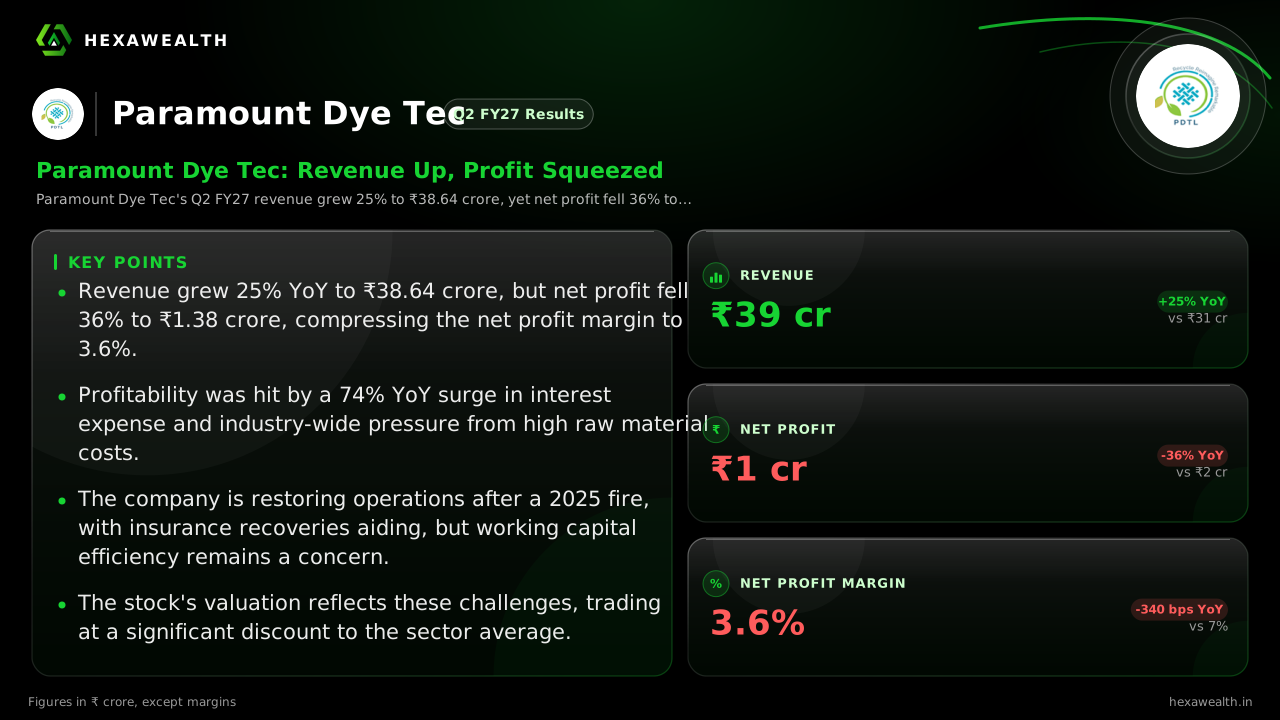
Paramount Dye Tec's Q2 FY27 revenue grew 25% to ₹38.64 crore, yet net profit fell 36% to ₹1.38 crore. Higher interest and input costs compressed margins, highlighting the pressure on textile processors.
For a textile recycler like Paramount Dye Tec, a strong top line is built on managing the volatile spread between waste fiber costs and finished yarn prices. The September quarter delivered sales growth but saw that crucial margin vanish under rising expenses.
Revenue rose 25% year-on-year to ₹38.64 crore. Yet, net profit fell 36% to ₹1.38 crore, pulling the net profit margin down to 3.6% from 7.0% a year ago. The company returned to profit after a near-break-even March quarter.
Revenue & profit
Revenue (₹ Cr)
Profit (₹ Cr)
- Revenue (₹ Cr), Q2 FY25 (Sep 2024): 18.10
- Revenue (₹ Cr), Q4 FY25 (Mar 2025): 45.03
- Revenue (₹ Cr), Q2 FY26 (Sep 2025): 30.90
- Revenue (₹ Cr), Q4 FY26 (Mar 2026): 42.89
- Revenue (₹ Cr), Q2 FY27 (Sep 2026): 38.64
- Profit (₹ Cr), Q2 FY25 (Sep 2024): 2.02
- Profit (₹ Cr), Q4 FY25 (Mar 2025): 4.91
- Profit (₹ Cr), Q2 FY26 (Sep 2025): 2.16
- Profit (₹ Cr), Q4 FY26 (Mar 2026): -0.02
- Profit (₹ Cr), Q2 FY27 (Sep 2026): 1.38
Revenue (₹ Cr)
- Revenue (₹ Cr), Q2 FY25 (Sep 2024): 18.10
- Revenue (₹ Cr), Q4 FY25 (Mar 2025): 45.03
- Revenue (₹ Cr), Q2 FY26 (Sep 2025): 30.90
- Revenue (₹ Cr), Q4 FY26 (Mar 2026): 42.89
- Revenue (₹ Cr), Q2 FY27 (Sep 2026): 38.64
Profit (₹ Cr)
- Profit (₹ Cr), Q2 FY25 (Sep 2024): 2.02
- Profit (₹ Cr), Q4 FY25 (Mar 2025): 4.91
- Profit (₹ Cr), Q2 FY26 (Sep 2025): 2.16
- Profit (₹ Cr), Q4 FY26 (Mar 2026): -0.02
- Profit (₹ Cr), Q2 FY27 (Sep 2026): 1.38
Net Profit Margin (%)
- Net Profit Margin (%), Q2 FY25 (Sep 2024): 11.2
- Net Profit Margin (%), Q4 FY25 (Mar 2025): 10.9
- Net Profit Margin (%), Q2 FY26 (Sep 2025): 7.0
- Net Profit Margin (%), Q4 FY26 (Mar 2026): -0.1
- Net Profit Margin (%), Q2 FY27 (Sep 2026): 3.6
| Metric | CurrentQ2 FY27 (Sep 2026) | PreviousQ4 FY26 (Mar 2026) |
|---|---|---|
| Revenue (₹ Cr) | 38.64 | 42.89 |
| Profit (₹ Cr) | 1.38 | -0.02 |
| Net Profit Margin (%) | 3.6 | -0.1 |
Where the profit went
A 73.9% surge in interest expense and a near-doubling of employee costs quarter-on-quarter ate into earnings. The interest jump, according to Newboard, followed higher borrowings, which stood at ₹16.7 crore at the end of FY26.
Simultaneously, the broader industry faced elevated raw material costs. Reports on peers like Filatex India and Banswara Syntex noted margin pressure from high polyester and petrochemical feedstock prices linked to West Asia tensions.
A business under repair
The company is still recovering from an August 2025 fire that damaged its yarn unit. It booked a ₹4.5 crore exceptional loss in FY26, as noted by ScanX. Recent insurance receipts of over ₹15 crore are aiding the restoration.
Live Chart
· PARAMOUNT
(BSE)
ISIN: INE0TG801013
Operational strain is visible in working capital. FY26 cash from operations was negative ₹21.75 crore, with debtor and inventory days stretching to 91 and 213 days, respectively, per Newboard. This ties up capital needed for a planned capacity expansion.
The path ahead
Management's immediate task is stabilizing operations post-fire while navigating input cost volatility. The company's strategy to add summer yarns and expand capacity, as mentioned in its red herring prospectus, aims to reduce seasonal dependence.
Yet, with receivables high and input prices uncertain, converting sales into cash profit remains a challenge. The stock, down 31% over the past year, trades at a P/E of 13.3x, a discount to the industry average of 35.2x.
Key Points
- Revenue grew 25% YoY to ₹38.64 crore, but net profit fell 36% to ₹1.38 crore, compressing the net profit margin to 3.6%.
- Profitability was hit by a 74% YoY surge in interest expense and industry-wide pressure from high raw material costs.
- The company is restoring operations after a 2025 fire, with insurance recoveries aiding, but working capital efficiency remains a concern.
- The stock's valuation reflects these challenges, trading at a significant discount to the sector average.
Hexa Perspective
The quarter reveals a business caught between recovery and cost pressure. Sales growth is positive, but it is not yet profitable growth. The margin squeeze from higher interest and inputs is the immediate reality.
For the trend to improve, Paramount needs its restored and expanded capacity to generate higher-margin sales, not just more revenue. Until working capital cycles shorten and input costs stabilize, earnings will remain vulnerable despite a rising top line.
Also read
Want this applied to your portfolio?
Talk to a HexaWealth advisor, or sync your mutual fund data for insights tailored to your holdings.