Mathew Easow (MATHEWE) Q1 FY27 Profit Stalls as Surging Interest Costs Bite
A 39% sequential revenue surge was entirely consumed by a 75% year-on-year jump in interest costs, leaving profit flat and margins under pressure.
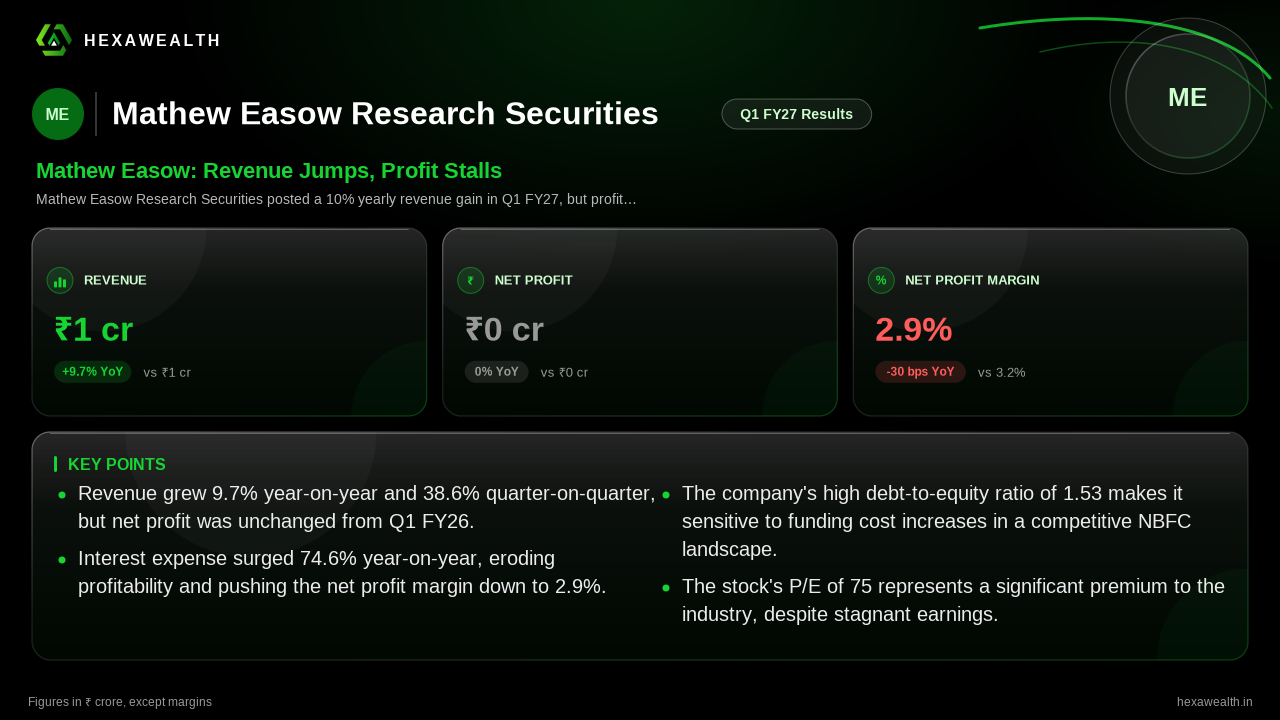
Mathew Easow Research Securities posted a 10% yearly revenue gain in Q1 FY27, but profit remained flat. A sharp 75% rise in interest expense devoured the top-line growth, squeezing the net profit margin to 2.9%.
For a small financial services firm, the quarter's test is whether trading gains can outrun the cost of funding them. Mathew Easow Research Securities saw its revenue jump 38.6% from the previous quarter, yet profit fell by a third. The gap tells a story of growth that never reached the bottom line.
The numbers show a business caught between two forces. Revenue rose to ₹0.79 crore, up 9.7% from a year ago. But profit stayed flat at ₹0.02 crore, identical to Q1 FY26. The net profit margin thinned to 2.9%, down 160 basis points from the March quarter.
Revenue & profit
Revenue (₹ Cr)
Profit (₹ Cr)
- Revenue (₹ Cr), Q1 FY26: 0.72
- Revenue (₹ Cr), Q2 FY26: 0.83
- Revenue (₹ Cr), Q3 FY26: 0.72
- Revenue (₹ Cr), Q4 FY26: 0.57
- Revenue (₹ Cr), Q1 FY27: 0.79
- Profit (₹ Cr), Q1 FY26: 0.02
- Profit (₹ Cr), Q2 FY26: 0.02
- Profit (₹ Cr), Q3 FY26: 0.01
- Profit (₹ Cr), Q4 FY26: 0.03
- Profit (₹ Cr), Q1 FY27: 0.02
Revenue (₹ Cr)
- Revenue (₹ Cr), Q1 FY26: 0.72
- Revenue (₹ Cr), Q2 FY26: 0.83
- Revenue (₹ Cr), Q3 FY26: 0.72
- Revenue (₹ Cr), Q4 FY26: 0.57
- Revenue (₹ Cr), Q1 FY27: 0.79
Profit (₹ Cr)
- Profit (₹ Cr), Q1 FY26: 0.02
- Profit (₹ Cr), Q2 FY26: 0.02
- Profit (₹ Cr), Q3 FY26: 0.01
- Profit (₹ Cr), Q4 FY26: 0.03
- Profit (₹ Cr), Q1 FY27: 0.02
Net Profit Margin (%)
- Net Profit Margin (%), Q1 FY26: 3.2
- Net Profit Margin (%), Q2 FY26: 2.9
- Net Profit Margin (%), Q3 FY26: 1.3
- Net Profit Margin (%), Q4 FY26: 4.5
- Net Profit Margin (%), Q1 FY27: 2.9
| Metric | CurrentQ1 FY27 | PreviousQ4 FY26 | Same quarter LYQ1 FY26 |
|---|---|---|---|
| Revenue (₹ Cr) | 0.79YoY +9.7% | 0.57 | 0.72 |
| Profit (₹ Cr) | 0.02YoY 0% | 0.03 | 0.02 |
| Net Profit Margin (%) | 2.9YoY -9.4% | 4.5 | 3.2 |
The Interest Cost That Ate the Growth
The primary culprit was a 74.6% year-on-year surge in interest expense, which hit ₹0.50 crore. According to research from sharescart.com, smaller NBFCs like Mathew Easow often face higher funding costs and are vulnerable to interest rate volatility. This expense alone consumed over 63% of total revenue, up from 40% a year ago.
While employee costs fell, the operating efficiency gain was entirely offset by this financial burden. The result was a profit before tax that declined 6.1% sequentially, despite the strong revenue recovery from a soft Q4.
A Crowded Field and a High Valuation
The company operates with a debt-to-equity ratio of 1.53, as noted by Investing.com. This leveraged structure amplifies the pain when borrowing costs rise. The stock trades at a price-to-earnings multiple of 75, a 241% premium to the industry average, according to the payload.
Live Chart
· MATHEWE
(BSE)
ISIN: INE963B01019
This valuation appears disconnected from the fundamental pressure. With no analyst rating changes reported post-results and negligible institutional ownership, the market seems to be taking a wait-and-see approach. The shareholding pattern shows promoters hold 31.28%, with retail investors owning the rest.
Key Points
- Revenue grew 9.7% year-on-year and 38.6% quarter-on-quarter, but net profit was unchanged from Q1 FY26.
- Interest expense surged 74.6% year-on-year, eroding profitability and pushing the net profit margin down to 2.9%.
- The company's high debt-to-equity ratio of 1.53 makes it sensitive to funding cost increases in a competitive NBFC landscape.
- The stock's P/E of 75 represents a significant premium to the industry, despite stagnant earnings.
Hexa Perspective
The quarter underscores a fundamental challenge for capital-intensive financial services players: revenue volatility paired with rigid funding costs. For Mathew Easow, the recent revenue bounce is positive, but it merely returned to levels seen in Q2 and Q3 of last fiscal.
The sustainability of this recovery hinges on the company's ability to manage its cost of funds. Until interest expenses stabilize or revenue growth accelerates meaningfully beyond current levels, profitability is likely to remain under significant pressure. Investors are left weighing a premium valuation against these persistent margin headwinds.
Also read
Mathew Easow: Flat Profit, Rising Costs
Market Pulse, 28 Nov 2026: Flows and Inflation Pressures in a Tightening Phase
RBI green light for corporate bond futures to deepen AAA liquidity divide
Market News Today, 28 Nov 2026: SEBI opens physical commodity delivery to FPIs from June 2027
String Metaverse: Hypergrowth, Valuation Gap
Want this applied to your portfolio?
Talk to a HexaWealth advisor, or sync your mutual fund data for insights tailored to your holdings.