Mathew Easow (MATHEWE) Q2 FY27 Profit Stalls as Interest Costs Soar
Mathew Easow's Q2 FY27 saw flat net profit despite a revenue uptick, as a sharp 60% jump in finance costs squeezed margins.
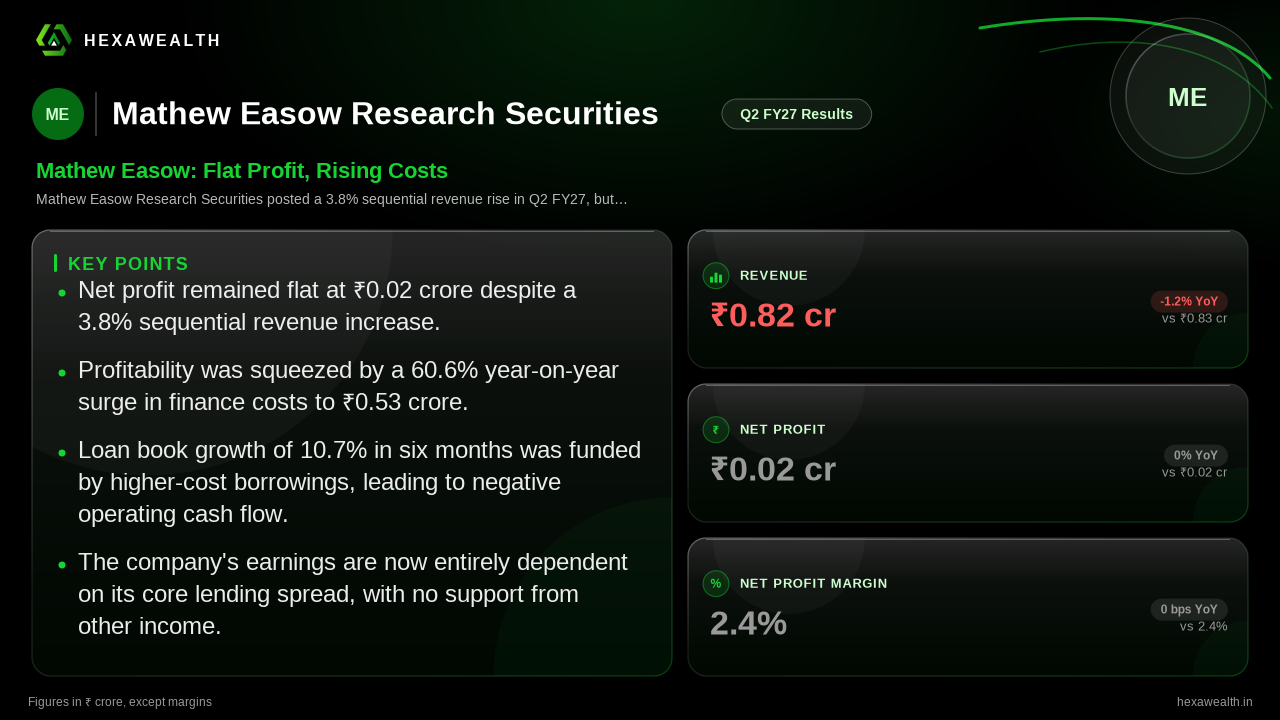
Mathew Easow Research Securities posted a 3.8% sequential revenue rise in Q2 FY27, but net profit remained flat. A 60.6% surge in interest expense consumed gains, highlighting margin pressure from higher borrowing costs.
For a small NBFC like Mathew Easow Research Securities, the core business is the spread between interest earned and paid. The September quarter showed that spread narrowing under pressure, leaving profitability static even as the loan book grew.
Revenue inched up 3.8% sequentially to ₹0.82 crore, while net profit held at ₹0.02 crore. The trailing-twelve-month net profit margin stands at 2.8%, but the quarterly figure slipped 10 basis points from the June quarter.
Revenue & profit
Revenue (₹ Cr)
Profit (₹ Cr)
- Revenue (₹ Cr), Q2 FY26 (Sep 2025): 0.83
- Revenue (₹ Cr), Q3 FY26 (Dec 2025): 0.72
- Revenue (₹ Cr), Q4 FY26 (Mar 2026): 0.57
- Revenue (₹ Cr), Q1 FY27 (Jun 2026): 0.79
- Revenue (₹ Cr), Q2 FY27 (Sep 2026): 0.82
- Profit (₹ Cr), Q2 FY26 (Sep 2025): 0.02
- Profit (₹ Cr), Q3 FY26 (Dec 2025): 0.01
- Profit (₹ Cr), Q4 FY26 (Mar 2026): 0.03
- Profit (₹ Cr), Q1 FY27 (Jun 2026): 0.02
- Profit (₹ Cr), Q2 FY27 (Sep 2026): 0.02
Revenue (₹ Cr)
- Revenue (₹ Cr), Q2 FY26 (Sep 2025): 0.83
- Revenue (₹ Cr), Q3 FY26 (Dec 2025): 0.72
- Revenue (₹ Cr), Q4 FY26 (Mar 2026): 0.57
- Revenue (₹ Cr), Q1 FY27 (Jun 2026): 0.79
- Revenue (₹ Cr), Q2 FY27 (Sep 2026): 0.82
Profit (₹ Cr)
- Profit (₹ Cr), Q2 FY26 (Sep 2025): 0.02
- Profit (₹ Cr), Q3 FY26 (Dec 2025): 0.01
- Profit (₹ Cr), Q4 FY26 (Mar 2026): 0.03
- Profit (₹ Cr), Q1 FY27 (Jun 2026): 0.02
- Profit (₹ Cr), Q2 FY27 (Sep 2026): 0.02
Net Profit Margin (%)
- Net Profit Margin (%), Q2 FY26 (Sep 2025): 2.4
- Net Profit Margin (%), Q3 FY26 (Dec 2025): 1.4
- Net Profit Margin (%), Q4 FY26 (Mar 2026): 5.3
- Net Profit Margin (%), Q1 FY27 (Jun 2026): 2.5
- Net Profit Margin (%), Q2 FY27 (Sep 2026): 2.4
| Metric | CurrentQ2 FY27 (Sep 2026) | PreviousQ1 FY27 (Jun 2026) |
|---|---|---|
| Revenue (₹ Cr) | 0.82 | 0.79 |
| Profit (₹ Cr) | 0.02 | 0.02 |
| Net Profit Margin (%) | 2.4 | 2.5 |
The Interest Cost Squeeze
The primary driver behind the stagnant profit was a surge in borrowing costs. According to MarketPing, finance costs jumped 60.6% year-on-year to ₹0.53 crore. This consumed the benefit of a 55.6% rise in EBITDA, which was driven by lower other expenses.
The company's loan book grew to ₹39.59 crore as of September 30, from ₹35.77 crore at March-end, as noted by Reports Radar. This 10.7% expansion was funded by a ₹4.10 crore increase in short-term borrowings, which came at a significantly higher cost.
A Strained Balance Sheet
The funding strategy has increased leverage and strained cash flow. The half-year saw an operating cash outflow of ₹2.48 crore, per MarketPing, as money was tied up in growing loans and advances. The debt-to-equity ratio remains elevated at 1.53.
Live Chart
· MATHEWE
(BSE)
ISIN: INE963B01019
With no other income from share sales or dividends this quarter—a source that contributed ₹11.12 lakh a year ago—the entire profit base relies on this pressured interest spread. The market's initial reaction was a muted 2.9% gain on the results day.
Key Points
- Net profit remained flat at ₹0.02 crore despite a 3.8% sequential revenue increase.
- Profitability was squeezed by a 60.6% year-on-year surge in finance costs to ₹0.53 crore.
- Loan book growth of 10.7% in six months was funded by higher-cost borrowings, leading to negative operating cash flow.
- The company's earnings are now entirely dependent on its core lending spread, with no support from other income.
Hexa Perspective
The quarter underscores a fundamental challenge: growth is costing more than it earns. The loan book expansion is positive, but the cost of funds is rising faster than the yield, compressing net interest income. With a leveraged balance sheet and negative operating cash flow, the company's ability to sustain this growth without further margin erosion is limited. Investors are left weighing the potential of a larger asset base against the clear and present pressure from rising interest expenses, with little buffer from other business lines.
Also read
Want this applied to your portfolio?
Talk to a HexaWealth advisor, or sync your mutual fund data for insights tailored to your holdings.