Jain Irrigation (JISLJALEQS) Q2 FY27 Profit Recovers to ₹18 Crore as Growth Trails Guidance
The agri-business firm swung to a consolidated profit in Q2 FY27, but its 10.1% revenue growth fell short of its own ambitious annual target amid drought and high costs.
Jain Irrigation Systems posted a consolidated net profit of ₹18 crore in Q2 FY27, a sharp recovery from the previous quarter's loss. However, revenue growth of 10.1% lagged the company's full-year guidance, pressured by drought and polymer prices.
For Jain Irrigation, the September quarter was about bouncing back from a weak start while navigating a drought and cost pressures. The company swung to a consolidated profit, but its revenue growth fell short of the ambitious path it set for itself.
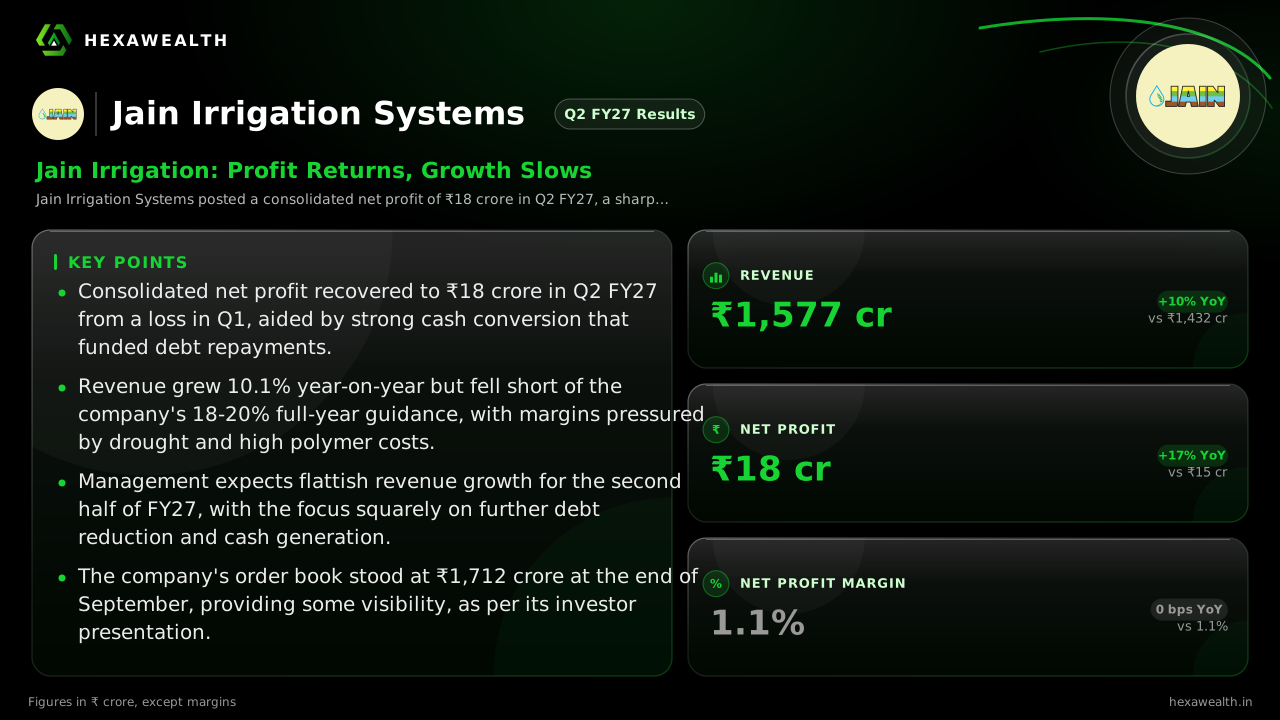
The numbers show a sequential recovery. Revenue rose 4.5% from the June quarter to ₹1,576.7 crore, while net profit swung from a loss of ₹17.8 crore to a profit of ₹18 crore. Year-on-year, revenue grew 10.1% and profit was up 17.4%.
Revenue & profit
Revenue (₹ Cr)
Profit (₹ Cr)
Metric
CurrentQ2 FY27
PreviousQ1 FY27
Same quarter LYQ2 FY26
Revenue (₹ Cr)
1,576.7YoY +10%
1,508.4
1,432.3
Profit (₹ Cr)
18.0YoY +18%
-17.8
15.3
Net Margin
1.1%YoY 0%
-1.2%
1.1%
A Profit Swing Built on Cash
The return to profit was powered by a sharp improvement in cash generation, not just sales. According to the earnings call covered by Investing.com, the company converted 99% of its ₹208 crore EBITDA into cash. That cash funded ₹230 crore of debt repayments due in the half year.
Profit growth outpaced revenue due to a tax credit of ₹0.09 crore, as noted by Stockwatch. A deferred tax benefit offset the current tax expense. The core profit before tax grew a modest 0.7% year-on-year.
The Growth That Missed the Mark
Despite the profit, the quarter's 10.1% revenue growth missed the company's own full-year guidance. Management had earlier targeted 18-20% revenue and earnings growth for FY27, with EBITDA margins improving to 14-14.5%, as per Stockwatch.
The quarter's EBITDA margin was 13.2%, down from 13.9% a year ago. Management cited a difficult backdrop in its presentation. Drought in western and southern India hurt demand, while high polymer prices squeezed margins, especially in the domestic plastics business.
A Cautious Road Ahead
The outlook for the next six months is guarded. On the earnings call, management guided for flattish revenue growth in the second half of FY27. The company sees potential upside only if polymer prices ease and delayed farmer purchases return.
The immediate focus remains on debt reduction and cash flow. Another ₹220-250 crore of debt repayments are due in March 2027. Management expects to meet these through receivables collection, operating cash, and potential land monetization.
Key Points
Consolidated net profit recovered to ₹18 crore in Q2 FY27 from a loss in Q1, aided by strong cash conversion that funded debt repayments.
Revenue grew 10.1% year-on-year but fell short of the company's 18-20% full-year guidance, with margins pressured by drought and high polymer costs.
Management expects flattish revenue growth for the second half of FY27, with the focus squarely on further debt reduction and cash generation.
The company's order book stood at ₹1,712 crore at the end of September, providing some visibility, as per its investor presentation.
“
Hexa Perspective
The quarter confirms Jain Irrigation is in a balancing act. Operational recovery is real, evidenced by the swing to profit and excellent cash conversion. Yet, the top-line momentum is not strong enough to hit its own targets, pinned down by external factors largely outside its control.
The next few quarters hinge on two variables: the easing of polymer costs and the pace of receivables recovery to meet the looming March debt maturity. The company's guidance for a flat second half suggests it is preparing for these pressures to persist, prioritizing financial stability over aggressive growth for now.
Talk to a HexaWealth advisor, or sync your mutual fund data for insights tailored to your holdings.
Frequently asked questions
What were Jain Irrigation's Q2 FY27 results?
For the September 2026 quarter, Jain Irrigation reported a consolidated revenue of ₹1,576.7 crore, a 10.1% increase year-on-year. Net profit stood at ₹18 crore, a 17.4% rise from the same quarter last year and a sharp recovery from the ₹17.8 crore loss in Q1 FY27.
Why did Jain Irrigation's Q2 FY27 profit turn positive from a loss in Q1?
Jain Irrigation's profit turned positive in Q2 FY27 primarily due to a strong recovery in cash generation. According to the earnings call, the company converted 99% of its EBITDA into cash, which helped fund operations and debt repayments. A tax credit also contributed to the net profit figure.
What was Jain Irrigation's management guidance for FY27?
Management had previously guided for 18-20% revenue and earnings growth for FY27, with EBITDA margins improving to 14-14.5%. The Q2 FY27 revenue growth of 10.1% and EBITDA margin of 13.2% were below this trajectory, leading to a more cautious outlook for the second half.
Why did Jain Irrigation's tax expense become a credit in Q2 FY27?
Jain Irrigation's tax line showed a net credit of ₹0.09 crore in Q2 FY27 because a deferred tax benefit of ₹9.84 crore offset a current tax expense of ₹9.75 crore. This was a key reason the net profit growth outpaced the profit before tax growth.
What caused the QoQ increase in Jain Irrigation's interest costs in Q2 FY27?
Interest costs rose 7.9% sequentially to ₹119.33 crore in Q2 FY27. This included ₹21.53 crore of non-cash interest from unwinding adjustments on certain debt instruments, as noted in the filing. The underlying cash interest cost remains a significant burden.
What is the status of Jain Irrigation's debt reduction plan?
The company is actively reducing debt, having repaid ₹230 crore of obligations in the first half of FY27. Another ₹220-250 crore is due in March 2027. Management plans to meet this through improved receivables collection, operating cash flow, and potential asset monetization.
What is the demand outlook for Jain Irrigation's micro-irrigation systems?
The near-term outlook is challenged. Management cited drought in key Indian markets and high polymer prices as major headwinds, leading to a guidance for flattish revenue growth in H2 FY27. Long-term structural demand from water scarcity and value-added agriculture remains positive.
What is Jain Irrigation's order book position?
As of September 30, 2026, Jain Irrigation's consolidated order book stood at ₹1,712 crore, according to its investor presentation. The Food/Agri segment constituted the largest portion at ₹1,277 crore, while the India order book was ₹577 crore.
What are Jain Irrigation's key capex plans for FY27?
Key growth capital expenditure includes about ₹30-40 crore for a tomato processing joint venture, expected in Q4 if the deal closes, and approximately ₹100 crore for a beverage business expansion, mostly required between March and June 2027. Major biochar investment is anticipated in FY28.
Did Jain Irrigation's Q2 FY27 results beat analyst estimates?
No specific analyst consensus estimates were identified for the quarter. However, the company's own results fell short of its earlier full-year guidance of 18-20% revenue growth, with Q2 achieving 10.1% growth.
Jain Irrigation Q2 profit drop
Jain Irrigation did not experience a profit drop in Q2 FY27. Its consolidated net profit was ₹18.01 crore, which is a 17.4% increase from the ₹15.34 crore profit in Q2 FY26 and a major recovery from the ₹17.8 crore loss in Q1 FY27.
Jain Irrigation Systems September quarter profit
Jain Irrigation Systems reported a consolidated net profit of ₹18.01 crore for the September 2026 quarter (Q2 FY27). This compares to a profit of ₹15.34 crore in the same quarter last year and a loss of ₹17.8 crore in the preceding June 2026 quarter.
Why did Jain Irrigation profits plunge despite higher sales?
This scenario did not occur in Q2 FY27. Jain Irrigation's profits increased alongside higher sales. Profit rose 17.4% year-on-year to ₹18 crore, while sales grew 10.1% to ₹1,576.7 crore. The previous quarter's loss was due to significantly weaker sales and demand.