Gautam Exim (GEL) Q2 FY26 Profit Halves as Interest Costs Bite into Thin Margins
The raw material trader saw a 15% drop in revenue and a 50% fall in profit, as rising interest expenses squeezed an already narrow margin.
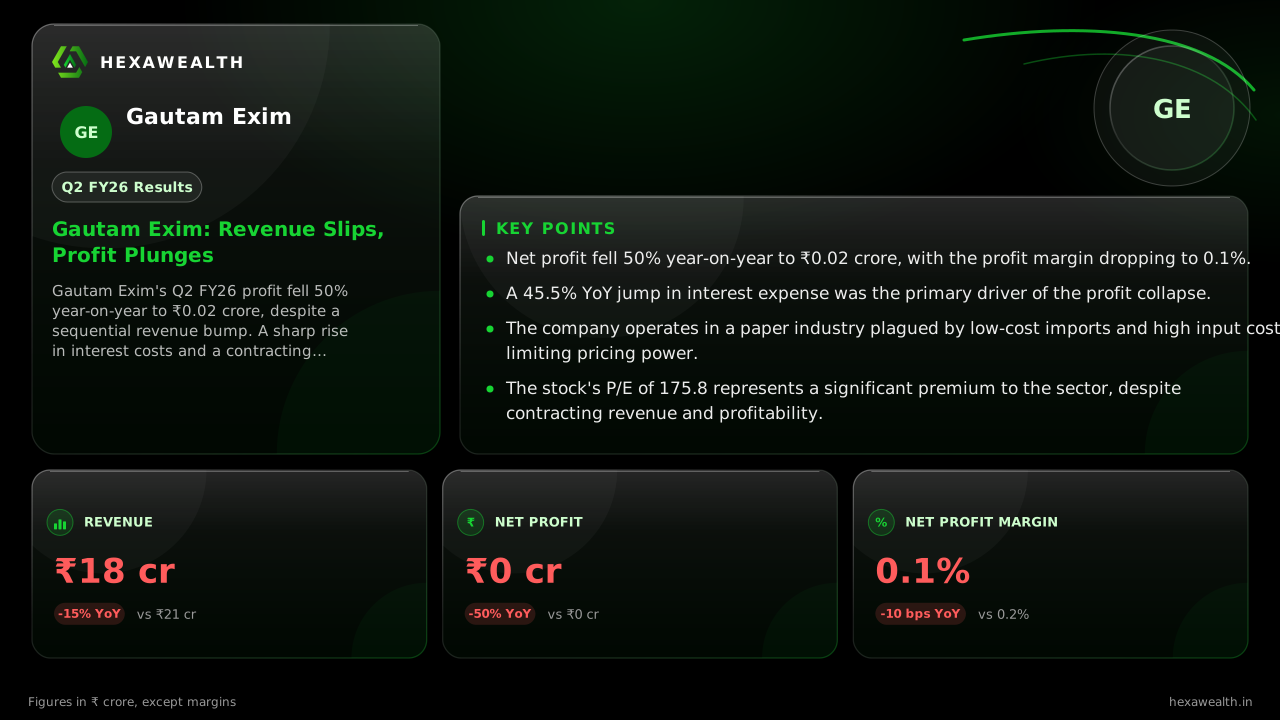
Gautam Exim's Q2 FY26 profit fell 50% year-on-year to ₹0.02 crore, despite a sequential revenue bump. A sharp rise in interest costs and a contracting top line highlight the pressures on the import-dependent distributor.
For a distributor like Gautam Exim, the story is told in the gap between what it sells and what it keeps. The September quarter saw that gap narrow to a sliver, as rising costs met a shrinking business.
Revenue fell 15.3% from a year ago to ₹17.86 crore, though it rose 20.4% from the prior quarter's low base. Net profit, however, halved year-on-year to just ₹0.02 crore. The net profit margin collapsed to 0.1%, down 50 basis points sequentially.
Revenue & profit
Revenue (₹ Cr)
Profit (₹ Cr)
- Revenue (₹ Cr), Q2 FY24 (Sep 2023): 104.61
- Revenue (₹ Cr), Q4 FY24 (Mar 2024): 63.95
- Revenue (₹ Cr), Q2 FY25 (Sep 2024): 21.08
- Revenue (₹ Cr), Q4 FY25 (Mar 2025): 14.84
- Revenue (₹ Cr), Q2 FY26 (Sep 2025): 17.86
- Profit (₹ Cr), Q2 FY24 (Sep 2023): 0.16
- Profit (₹ Cr), Q4 FY24 (Mar 2024): -0.02
- Profit (₹ Cr), Q2 FY25 (Sep 2024): 0.04
- Profit (₹ Cr), Q4 FY25 (Mar 2025): 0.09
- Profit (₹ Cr), Q2 FY26 (Sep 2025): 0.02
Revenue (₹ Cr)
- Revenue (₹ Cr), Q2 FY24 (Sep 2023): 104.61
- Revenue (₹ Cr), Q4 FY24 (Mar 2024): 63.95
- Revenue (₹ Cr), Q2 FY25 (Sep 2024): 21.08
- Revenue (₹ Cr), Q4 FY25 (Mar 2025): 14.84
- Revenue (₹ Cr), Q2 FY26 (Sep 2025): 17.86
Profit (₹ Cr)
- Profit (₹ Cr), Q2 FY24 (Sep 2023): 0.16
- Profit (₹ Cr), Q4 FY24 (Mar 2024): -0.02
- Profit (₹ Cr), Q2 FY25 (Sep 2024): 0.04
- Profit (₹ Cr), Q4 FY25 (Mar 2025): 0.09
- Profit (₹ Cr), Q2 FY26 (Sep 2025): 0.02
Net Profit Margin
- Net Profit Margin, Q2 FY24 (Sep 2023): 0.2%
- Net Profit Margin, Q4 FY24 (Mar 2024): -0.0%
- Net Profit Margin, Q2 FY25 (Sep 2024): 0.2%
- Net Profit Margin, Q4 FY25 (Mar 2025): 0.6%
- Net Profit Margin, Q2 FY26 (Sep 2025): 0.1%
| Metric | CurrentQ2 FY26 (Sep 2025) | PreviousQ4 FY25 (Mar 2025) |
|---|---|---|
| Revenue (₹ Cr) | 17.86 | 14.84 |
| Profit (₹ Cr) | 0.02 | 0.09 |
| Net Profit Margin | 0.1% | 0.6% |
The cost that erased the gain
The sequential revenue increase was entirely consumed by a steeper rise in expenses. Interest costs surged 68.4% quarter-on-quarter and 45.5% year-on-year to ₹0.32 crore. This spike, noted in filings reviewed by MarketsMojo, turned a modest operating profit into a wafer-thin bottom line.
A market working against it
Gautam Exim's core business of importing waste paper and pulp operates in a tough environment. According to CareEdge Ratings, low-cost imports and high input costs are weighing on the entire paper industry. Realisations for writing and printing paper have fallen 6-7%, pressuring the mills Gautam Exim supplies.
Furthermore, a report by Waste Recycling Mag notes Indian mills depend on imports for 50-60% of their waste paper due to poor local collection. This structural dependency is now coupled with global supply chain stress and rising freight costs, squeezing traders on both sides.
Live Chart
· GEL
(BSE)
ISIN: INE721X01023
A valuation disconnect
The operational strain contrasts sharply with the stock's valuation. At 175.8 times earnings, it trades at a 212% premium to the industry average P/E of 56.3, as per the payload data. This lofty multiple persists even as the business has shrunk dramatically from its ₹100-crore quarterly revenue run-rate just two years ago.
Key Points
- Net profit fell 50% year-on-year to ₹0.02 crore, with the profit margin dropping to 0.1%.
- A 45.5% YoY jump in interest expense was the primary driver of the profit collapse.
- The company operates in a paper industry plagued by low-cost imports and high input costs, limiting pricing power.
- The stock's P/E of 175.8 represents a significant premium to the sector, despite contracting revenue and profitability.
Hexa Perspective
The quarter underscores the vulnerability of a pure-play distributor in a volatile, capital-intensive supply chain. Profitability is being erased not by operational inefficiency but by financing costs and external market pressures that are largely beyond management's control.
The path forward hinges on a recovery in paper industry realisations and stabilisation of global freight and borrowing costs—neither of which appears imminent. Until then, the business risks remaining trapped in a cycle of thin margins on a declining revenue base, making its premium valuation difficult to justify.
Also read
Want this applied to your portfolio?
Talk to a HexaWealth advisor, or sync your mutual fund data for insights tailored to your holdings.