Gautam Exim (GEL) Q2 FY27's Q2 Profit Plunges 90% Despite 49% Sales Surge
The paper raw materials trader saw a sharp sequential revenue recovery, but costs rose even faster, erasing nearly all profitability.
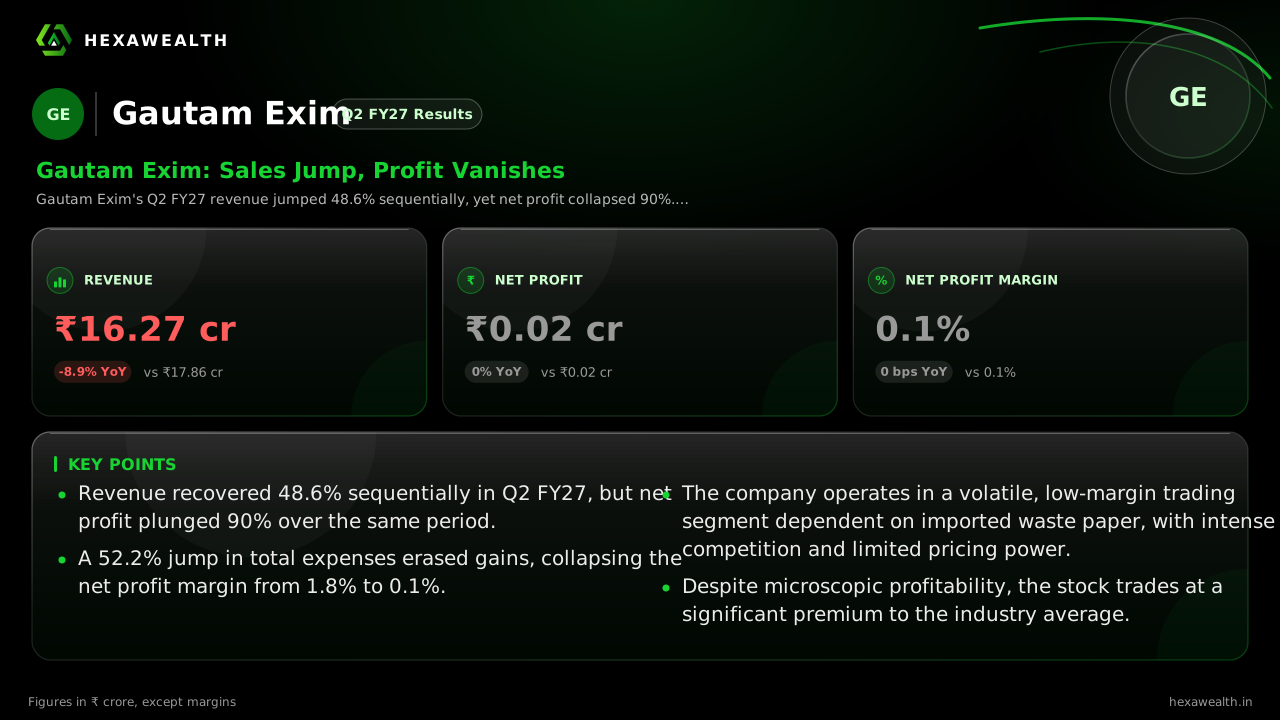
Gautam Exim's Q2 FY27 revenue jumped 48.6% sequentially, yet net profit collapsed 90%. The quarter reveals a severe margin squeeze as expenses outpaced sales growth, leaving the company with a wafer-thin net profit margin of just 0.1%.
For a trader of imported waste paper and pulp, volume is the lifeblood. Gautam Exim's September quarter delivered a sharp 49% sequential jump in sales, but the cost of that growth was a near-total evaporation of profit.
The numbers tell a story of expansion without reward. Revenue rose to ₹16.27 crore from a low ₹10.95 crore in the prior quarter. Yet net profit collapsed to just ₹0.02 crore, down 90% sequentially. The net profit margin, which was 1.8% last quarter, shrank to a mere 0.1%.
Revenue & profit
Revenue (₹ Cr)
Profit (₹ Cr)
- Revenue (₹ Cr), Q2 FY25: 21.08
- Revenue (₹ Cr), Q4 FY25: 14.84
- Revenue (₹ Cr), Q2 FY26: 17.86
- Revenue (₹ Cr), Q4 FY26: 10.95
- Revenue (₹ Cr), Q2 FY27: 16.27
- Profit (₹ Cr), Q2 FY25: 0.04
- Profit (₹ Cr), Q4 FY25: 0.09
- Profit (₹ Cr), Q2 FY26: 0.02
- Profit (₹ Cr), Q4 FY26: 0.20
- Profit (₹ Cr), Q2 FY27: 0.02
Revenue (₹ Cr)
- Revenue (₹ Cr), Q2 FY25: 21.08
- Revenue (₹ Cr), Q4 FY25: 14.84
- Revenue (₹ Cr), Q2 FY26: 17.86
- Revenue (₹ Cr), Q4 FY26: 10.95
- Revenue (₹ Cr), Q2 FY27: 16.27
Profit (₹ Cr)
- Profit (₹ Cr), Q2 FY25: 0.04
- Profit (₹ Cr), Q4 FY25: 0.09
- Profit (₹ Cr), Q2 FY26: 0.02
- Profit (₹ Cr), Q4 FY26: 0.20
- Profit (₹ Cr), Q2 FY27: 0.02
Net Profit Margin (%)
- Net Profit Margin (%), Q2 FY25: 0.2
- Net Profit Margin (%), Q4 FY25: 0.6
- Net Profit Margin (%), Q2 FY26: 0.1
- Net Profit Margin (%), Q4 FY26: 1.8
- Net Profit Margin (%), Q2 FY27: 0.1
| Metric | CurrentQ2 FY27 | Same quarter LYQ2 FY26 |
|---|---|---|
| Revenue (₹ Cr) | 16.27YoY -8.9% | 17.86 |
| Profit (₹ Cr) | 0.02YoY 0% | 0.02 |
| Net Profit Margin (%) | 0.1YoY 0% | 0.1 |
The cost squeeze that ate the growth
Total expenses surged 52.2% quarter-on-quarter, outpacing the 48.6% revenue growth. This indicates the company likely faced higher procurement or logistics costs that it could not fully pass on to customers. A report from Stockwatch.live on another distributor highlighted how tariff headwinds and cost inflation can compress earnings faster than a company can adjust prices.
While interest costs fell sharply year-on-year, that relief was not enough to offset the operating margin pressure. The business appears caught in a classic trading trap: chasing volume at the expense of profitability.
A business built on thin ice
Gautam Exim operates in a fragmented, competitive industry where traders often lack pricing power. An industry note from September 2026, cited by Waste Recycling Mag, explained that Indian paper mills import 50-60% of their waste paper due to poor local collection. This dependence creates volatility, with geopolitical tensions and soaring freight costs disrupting supply chains and squeezing importer margins.
Live Chart
· GEL
(BSE)
ISIN: INE721X01023
The company's valuation reflects these challenges starkly. It trades at a P/E of 183.3, a 226% premium to its industry, despite an annualized return on equity of just 1.64%. This disconnect suggests the market is pricing in little from current operations.
Key Points
- Revenue recovered 48.6% sequentially in Q2 FY27, but net profit plunged 90% over the same period.
- A 52.2% jump in total expenses erased gains, collapsing the net profit margin from 1.8% to 0.1%.
- The company operates in a volatile, low-margin trading segment dependent on imported waste paper, with intense competition and limited pricing power.
- Despite microscopic profitability, the stock trades at a significant premium to the industry average.
Hexa Perspective
The quarter underscores the fragility of Gautam Exim's trading model. Growth is possible, but it comes at a high cost when procurement or logistics markets turn against it. The margin collapse suggests the company prioritized sales volume over profitable sales, a risky strategy in a thin-margin business.
For this performance to improve, either industry-wide cost pressures must ease, or Gautam Exim must demonstrate an ability to secure and maintain better pricing with its customers. Until then, the business remains vulnerable to having its modest profits wiped out by the next swing in input costs.
Also read
Want this applied to your portfolio?
Talk to a HexaWealth advisor, or sync your mutual fund data for insights tailored to your holdings.