Exicom (EXICOM) Q2 FY27 Revenue Jumps 38% as EV Charging Crosses ₹100 Crore Milestone
Exicom's Q2 FY27 saw revenue surge 38% sequentially, with its EV charging business hitting a ₹100 crore quarterly revenue for the first time, though consolidated losses persist.
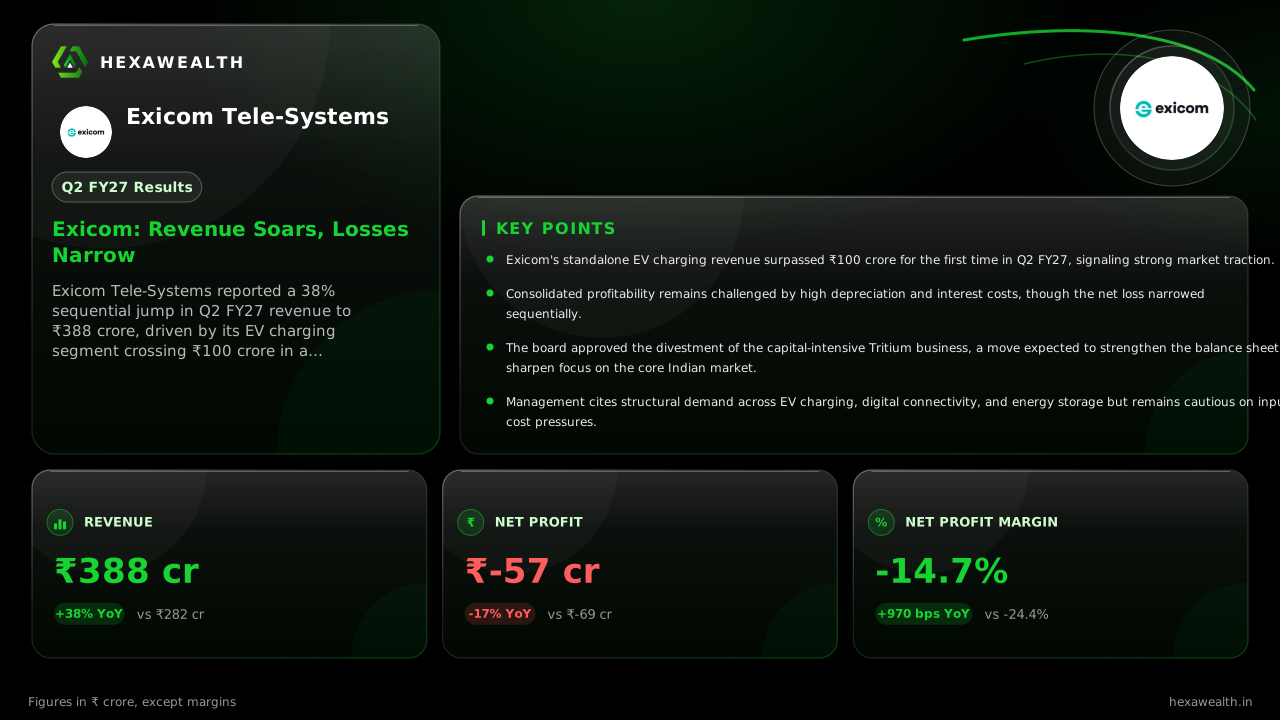
Exicom Tele-Systems reported a 38% sequential jump in Q2 FY27 revenue to ₹388 crore, driven by its EV charging segment crossing ₹100 crore in a quarter. While losses narrowed, the company announced a strategic divestment to sharpen its focus on the Indian market.
Exicom Tele-Systems is riding India's electric vehicle wave, but the financial ride remains bumpy. The company's second quarter showed strong top-line momentum, yet the bottom line is still weighed down by a capital-intensive international unit it now plans to shed.
Revenue for the September 2026 quarter reached ₹388 crore, a sharp 38% increase from the previous quarter and up 38% year-on-year. The net loss, however, stood at ₹57 crore. While this is an improvement from the ₹74 crore loss in Q1, it remains a significant drag. The company's standalone Indian business, which excludes its global Tritium unit, tells a healthier story with a profit after tax of ₹7.8 crore, according to its earnings release.
Revenue & profit
Revenue (₹ Cr)
Profit (₹ Cr)
Net Profit Margin (%)
| Metric | CurrentQ2 FY27 | PreviousQ1 FY27 | Same quarter LYQ2 FY26 |
|---|---|---|---|
| Revenue (₹ Cr) | 388.0YoY +38% | 331.1 | 281.7 |
| Profit (₹ Cr) | -57.0YoY +17% | -73.6 | -68.8 |
| Net Profit Margin (%) | -14.7YoY +40% | -22.2 | -24.4 |
The EV Engine Hits a Milestone
The standout performance came from the domestic EV charging segment, which crossed the ₹100 crore revenue mark in a quarter for the first time. As reported by AutocarPro, production of AC chargers jumped 2.5 times and DC chargers doubled from the prior quarter. This surge is backed by a robust order book and partnerships with 7 of India's top 10 EV makers.
Why the Losses Persist
Despite the Indian unit's profitability, the consolidated numbers stay in the red. A 59% year-on-year jump in depreciation to ₹43 crore, linked to recent capacity expansion, is a key pressure point. Furthermore, the company's global DC fast-charging business, Tritium, remains capital-intensive. In a decisive move, Exicom's board approved the divestment of Tritium at an indicative valuation of $85 million, as per its official release.
CEO Anant Nahata stated the move would allow the company to concentrate financial resources on its core Indian EV charging and export operations. He noted, as quoted by ETAuto, that the company is watching volatile energy markets and cost pressures closely but sees structural demand ahead.
The Road to a Cleaner Balance Sheet
The Tritium sale is more than a strategic refocus—it's a financial reset. The company indicated this transaction could make it debt-free in the near future. This is critical for a firm whose interest expense rose 28% year-on-year to ₹17 crore. With the deal, capital can be redirected to high-growth areas like energy storage and critical power, where it recently secured an order for 5,000 DC systems from a tier-one telecom operator.
Key Points
- Exicom's standalone EV charging revenue surpassed ₹100 crore for the first time in Q2 FY27, signaling strong market traction.
- Consolidated profitability remains challenged by high depreciation and interest costs, though the net loss narrowed sequentially.
- The board approved the divestment of the capital-intensive Tritium business, a move expected to strengthen the balance sheet and sharpen focus on the core Indian market.
- Management cites structural demand across EV charging, digital connectivity, and energy storage but remains cautious on input cost pressures.
Hexa Perspective
Exicom's quarter illustrates the classic growth-versus-profitability tension in a capital-heavy infrastructure play. The Indian engine is firing, with EV charging demonstrating scalable demand. However, the path to sustained consolidated profitability hinges on executing the Tritium divestment cleanly and redeploying capital without missing the domestic growth cycle. The next few quarters will test whether the improved standalone margins can offset the lingering fixed-cost drag from past expansions. Investors are betting on the structural EV story, but the financial proof will be in the delivery of a debt-free, focused entity post-divestment.
Also read
Want this applied to your portfolio?
Talk to a HexaWealth advisor, or sync your mutual fund data for insights tailored to your holdings.