Earkart (EARKART) Q2 FY27 Profit Drops 37% as Surging Costs Swallow Revenue Growth
Earkart's September quarter revenue grew 39% year-on-year, but net profit fell sharply as material costs more than doubled, compressing margins.
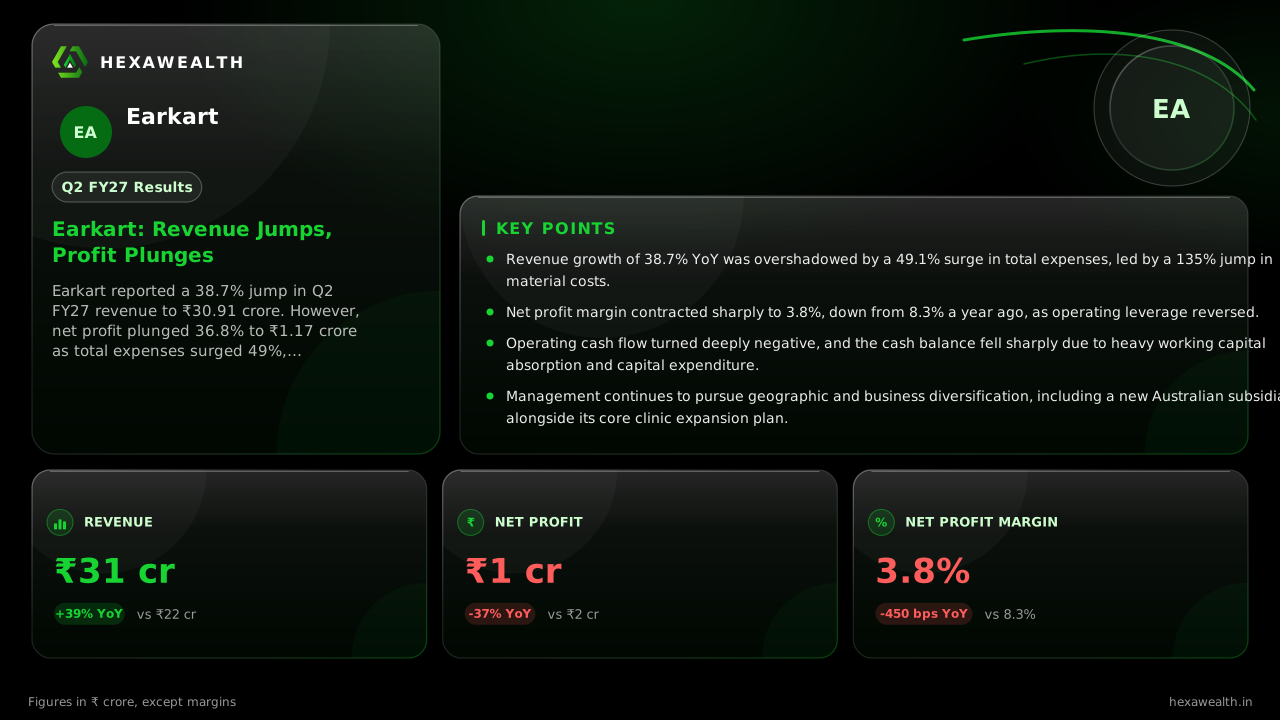
Earkart reported a 38.7% jump in Q2 FY27 revenue to ₹30.91 crore. However, net profit plunged 36.8% to ₹1.17 crore as total expenses surged 49%, driven by a sharp rise in material costs and depreciation.
For a hearing-care company scaling its clinic network, the September quarter was about balancing growth with the cost of building it. Earkart delivered the growth, with revenue up 39% year-on-year, but the cost of that expansion arrived all at once, sending profit down sharply.
The numbers show a business in a heavy investment phase. Revenue reached ₹30.91 crore, but net profit fell to ₹1.17 crore. The net profit margin compressed to 3.8%, down 450 basis points from last year and nearly 600 points from the prior quarter.
Revenue & profit
Revenue (₹ Cr)
Net Profit (₹ Cr)
Net Profit Margin (%)
| Metric | CurrentQ2 FY27 | Same quarter LYQ2 FY26 |
|---|---|---|
| Revenue (₹ Cr) | 30.91YoY +39% | 22.29 |
| Net Profit (₹ Cr) | 1.17YoY -37% | 1.85 |
| Net Profit Margin (%) | 3.8YoY -54% | 8.3 |
Where the growth dollars went
A 135% surge in the cost of materials consumed was the primary driver, as reported by ScanX. This far outpaced the 39% revenue growth, suggesting either input cost inflation or a shift towards a lower-margin product mix. Employee costs also rose 56%, while depreciation jumped 152% year-on-year due to clinic installations.
This spending is tied to an ambitious physical expansion. Management has targeted 500-550 clinic installations by FY27, according to an Arthneeti transcript. The quarterly depreciation spike reflects the capitalisation of these assets, a cash cost that precedes the revenue they are meant to generate.
The cash trade-off
Aggressive expansion has strained liquidity. ScanX reported operating cash flow was negative ₹9.92 crore for the half-year, depleting the cash balance from ₹21.69 crore in March to ₹2.28 crore in September. Working capital swelled as trade receivables and inventory climbed significantly.
Concurrently, the company is diversifying beyond healthcare. Its board approved incorporating a wholly-owned subsidiary in Australia for education services, as noted by StockWatch. This move signals a strategic pivot but also draws focus and resources from the core business during a period of margin stress.
Key Points
- Revenue growth of 38.7% YoY was overshadowed by a 49.1% surge in total expenses, led by a 135% jump in material costs.
- Net profit margin contracted sharply to 3.8%, down from 8.3% a year ago, as operating leverage reversed.
- Operating cash flow turned deeply negative, and the cash balance fell sharply due to heavy working capital absorption and capital expenditure.
- Management continues to pursue geographic and business diversification, including a new Australian subsidiary, alongside its core clinic expansion plan.
Hexa Perspective
This quarter frames Earkart’s central challenge: it is paying today for growth it expects tomorrow. The margin compression is severe and directly linked to clinic roll-out costs and input inflation. The model’s viability hinges on these new installations ramping up to generate sufficient revenue to cover their own high fixed costs and improve mix.
The cash burn raises the stakes. For the expansion thesis to hold, the company must soon demonstrate that its investments are translating into sustainable, higher-margin sales rather than just higher costs. Until then, the tension between top-line ambition and bottom-line reality will define its quarters.
Also read
Want this applied to your portfolio?
Talk to a HexaWealth advisor, or sync your mutual fund data for insights tailored to your holdings.