Dhyaani Tradeventtures (DHYAANITR) Q2 FY27 Profit Jumps 265% as Costs Fall Faster Than Sales
The commodity trader's Q2 FY27 profit soared despite a sharp revenue drop, as total expenses fell even more dramatically year-on-year.
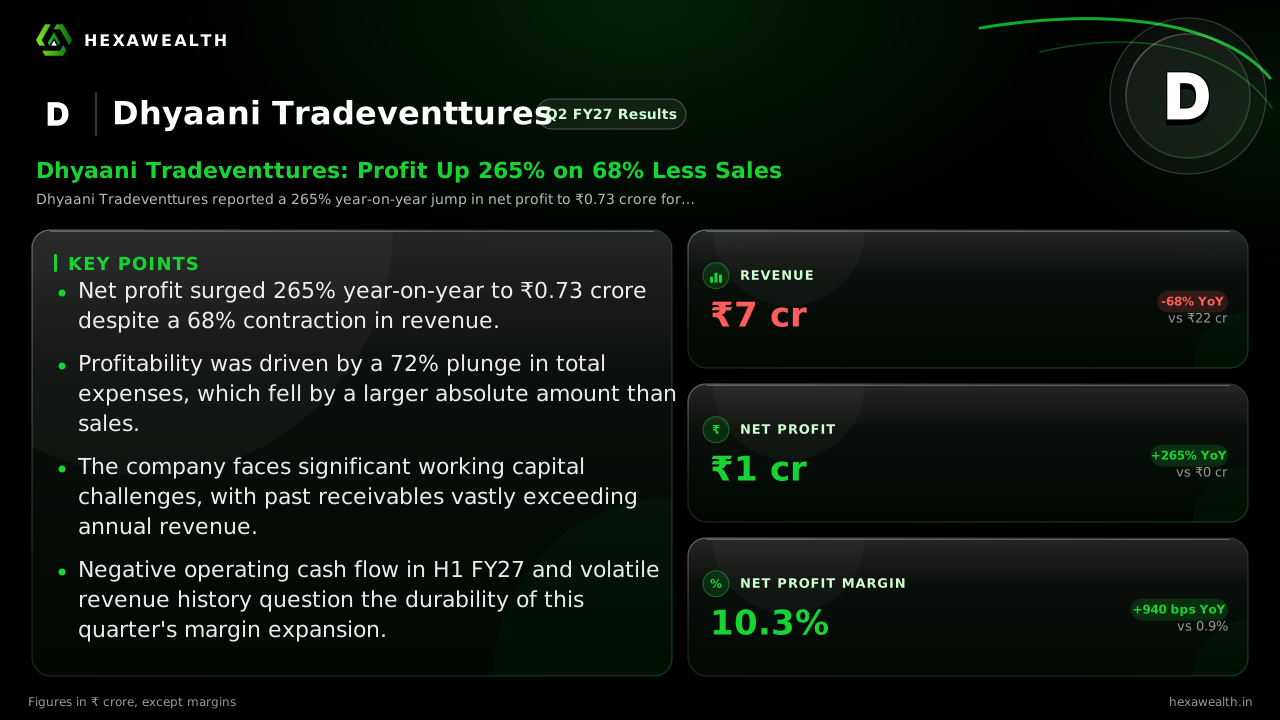
Dhyaani Tradeventtures reported a 265% year-on-year jump in net profit to ₹0.73 crore for Q2 FY27, even as revenue fell 68% to ₹7.09 crore. The profit surge was driven by a 72% reduction in total expenses, which outpaced the decline in sales.
For a pure-play commodity trader like Dhyaani Tradeventtures, the gap between purchase and sale price is everything. This quarter, that gap widened dramatically not from higher sales, but from a collapse in total expenses that far outpaced a steep revenue fall.
Revenue for the September 2026 quarter was ₹7.09 crore, down 68% from the same period last year. Yet net profit more than tripled to ₹0.73 crore, lifting the net profit margin to 10.3% from just 0.9% a year ago. The story is in the cost line.
Revenue & profit
Revenue (₹ Cr)
Net Profit (₹ Cr)
| Metric | CurrentQ2 FY27 | Same quarter LYQ2 FY26 |
|---|---|---|
| Revenue (₹ Cr) | 7.09YoY -68% | 22.41 |
| Net Profit (₹ Cr) | 0.73YoY +265% | 0.20 |
| PAT Margin (%) | 10.3YoY +1044% | 0.9 |
Why costs fell faster than sales
Total expenses dropped 72% year-on-year to ₹6.12 crore, a larger rupee reduction than the fall in revenue. According to an analysis by Multibagg.ai, this expense cut of over ₹16 crore exceeded the revenue decline by nearly ₹0.7 crore, directly boosting profit. The filing shows lower employee, finance, and depreciation costs, though it offers no narrative for the scale of the drop.
This points to a drastically smaller scale of trading operations compared to the year-ago period. The company is an Ahmedabad-based trader of farm commodities with no factory, as noted by Newboard.in. Its revenue has historically been volatile, swinging between services and commodities.
The sustainability question
Such a profit leap on shrinking sales is not a model for growth. The trailing-twelve-month net profit margin is 2.3%, well below the quarter's 10.3%, indicating this spike may be an outlier. Furthermore, Flash Finance reports the company generated negative operating cash flow of ₹1.0 crore in the first half of FY27.
Persistent working capital challenges, highlighted by Newboard.in, add strain. In FY26, trade receivables were more than twice annual revenue, with a significant portion overdue by over six months. This ties up capital and pressures liquidity.
Key Points
- Net profit surged 265% year-on-year to ₹0.73 crore despite a 68% contraction in revenue.
- Profitability was driven by a 72% plunge in total expenses, which fell by a larger absolute amount than sales.
- The company faces significant working capital challenges, with past receivables vastly exceeding annual revenue.
- Negative operating cash flow in H1 FY27 and volatile revenue history question the durability of this quarter's margin expansion.
Hexa Perspective
This quarter is a story of extreme cost compression, not operational strength. The profit jump is arithmetic, stemming from expenses falling faster than a declining top line. For the margin to hold, the company needs a steady, profitable scale of operations—something its volatile commodity trading history and strained receivables have not yet shown. Investors are left weighing a high trailing P/E of 305.8 against a balance sheet with minimal debt but poor cash conversion. The path forward depends on stabilizing revenue while managing the working capital cycle that currently constrains it.
Also read
Want this applied to your portfolio?
Talk to a HexaWealth advisor, or sync your mutual fund data for insights tailored to your holdings.