Dhvija Finance (DHVIJAFIN) Q2 FY27 Profit Jumps 10x as Loan Book Expands 50%
The small-ticket NBFC's revenue soared over 550% year-on-year, but a sharp rise in expenses trimmed the profit margin from the previous quarter.
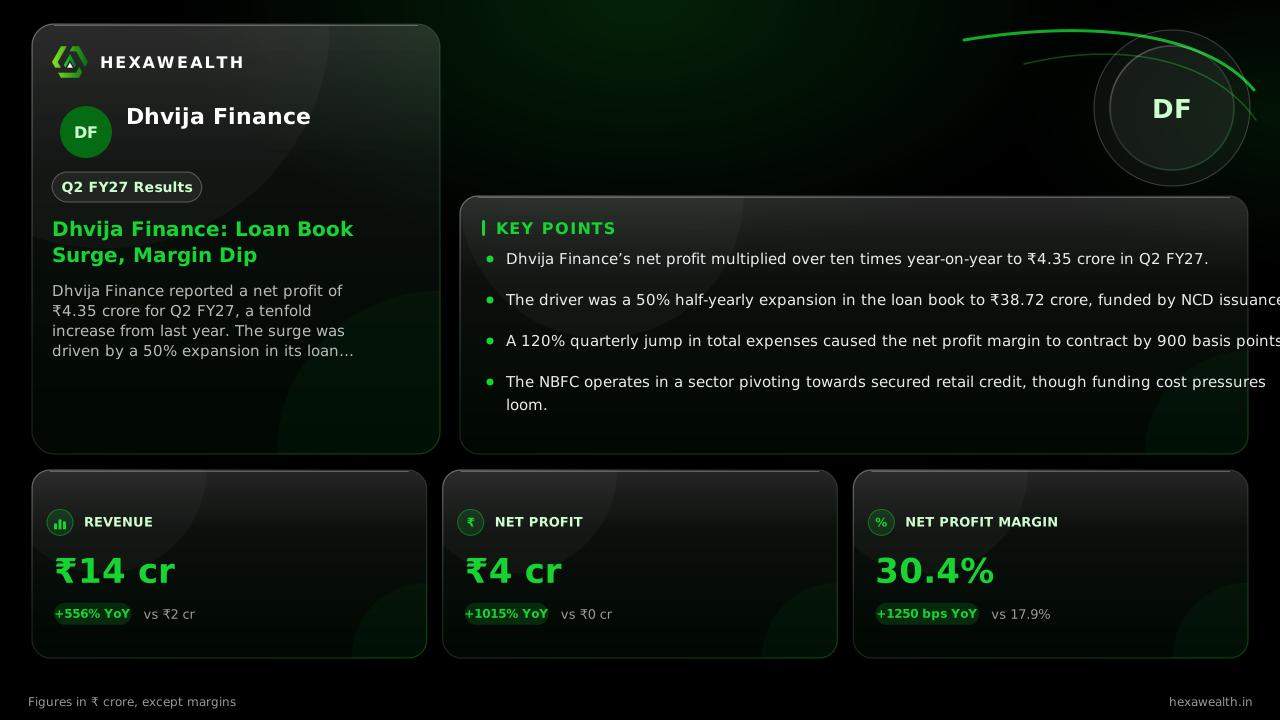
Dhvija Finance reported a net profit of ₹4.35 crore for Q2 FY27, a tenfold increase from last year. The surge was driven by a 50% expansion in its loan book, though operating costs rose faster than revenue, squeezing the quarterly margin.
For a small NBFC, scaling the loan book is the primary engine of growth. Dhvija Finance’s September quarter shows that engine firing, with profit after tax multiplying more than ten times from a year ago. The catch is that costs to drive that growth are rising even faster, pulling profitability down from the prior quarter’s peak.
The numbers tell a story of explosive growth from a small base, followed by a margin reset. Revenue reached ₹14.31 crore, up 556% from a year ago and 78% from the June quarter. Profit followed to ₹4.35 crore, a 1015% annual jump. Yet the net profit margin, while up sharply year-on-year, fell 900 basis points sequentially to 30.4%.
Revenue & profit
Revenue (₹ Cr)
Profit (₹ Cr)
Net Profit Margin (%)
| Metric | CurrentQ2 FY27 | PreviousQ1 FY27 | Same quarter LYQ2 FY26 |
|---|---|---|---|
| Revenue (₹ Cr) | 14.31YoY +556% | 8.02 | 2.18 |
| Profit (₹ Cr) | 4.35YoY +1015% | 3.16 | 0.39 |
| Net Profit Margin (%) | 30.4YoY +70% | 39.4 | 17.9 |
The loan book driving the surge
The growth is rooted in a rapidly expanding balance sheet. According to a report by Multibagg.ai, Dhvija Finance’s loans and advances grew 50% in just six months, reaching ₹38.72 crore by September 2026. This was funded partly by a ₹10 crore private placement of non-convertible debentures. Interest income, the core revenue stream, rose to ₹16.62 crore for the half-year.
Why margins contracted quarter-on-quarter
While the top line leapt, total expenses surged 120% from the previous quarter. This outpaced revenue growth and explains the margin compression. The company is likely investing in the operational backbone—people, systems, and risk management—to support its expanding loan portfolio. A smooth CFO transition was also noted, with Manoj Kumar appointed days before the results.
The outlook in a shifting market
The broader environment for small NBFCs is evolving. The RBI notes a sector-wide shift towards secured retail lending like vehicle and gold loans, away from microfinance. For a lender like Dhvija, which uses fintech partnerships to source EV and salary-advance loans, this trend could be supportive. However, analysts at JM Financial warn that rising funding costs may pressure margins industry-wide in the coming year.
Key Points
- Dhvija Finance’s net profit multiplied over ten times year-on-year to ₹4.35 crore in Q2 FY27.
- The driver was a 50% half-yearly expansion in the loan book to ₹38.72 crore, funded by NCD issuance.
- A 120% quarterly jump in total expenses caused the net profit margin to contract by 900 basis points.
- The NBFC operates in a sector pivoting towards secured retail credit, though funding cost pressures loom.
Hexa Perspective
This quarter confirms Dhvija Finance is in a high-growth phase, successfully deploying capital to build its loan book. The margin dip is a natural cost of that scaling, not an immediate red flag. The sustainability of this model now hinges on two factors: maintaining asset quality as the book grows and managing the cost of funds in a rising rate environment. With zero institutional holding, the stock’s journey will depend on the company’s ability to convert this operational momentum into consistent, high-quality earnings.
Also read
Want this applied to your portfolio?
Talk to a HexaWealth advisor, or sync your mutual fund data for insights tailored to your holdings.