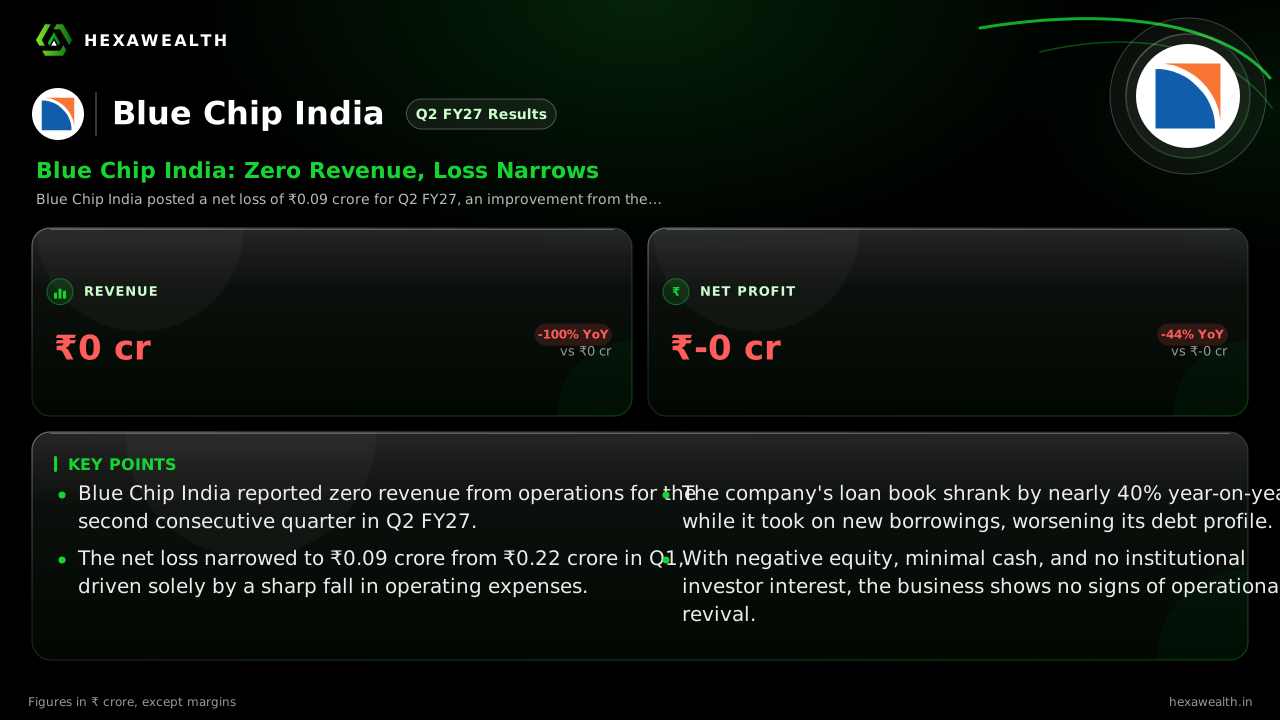
Blue Chip India (BLUECHIP)'s Loss Narrows to ₹9 Lakh on Zero Revenue in Q2 FY27
The Kolkata-based NBFC reported its second consecutive quarter of zero revenue, with a reduced net loss of ₹0.09 crore, as expenses fell sharply from the prior quarter.
Blue Chip India posted a net loss of ₹0.09 crore for Q2 FY27, an improvement from the previous quarter's loss of ₹0.22 crore. The company reported zero revenue from operations for the second straight quarter, with total income from other sources at just ₹0.01 crore.
For a non-banking finance company, the absence of lending revenue signals a business in deep freeze. Blue Chip India's September quarter confirmed that state, reporting zero revenue for a second straight period while its net loss narrowed to ₹0.09 crore as expenses fell.
The numbers show a company with no operational income, surviving on minimal other income. Its net loss improved 59% sequentially from a ₹0.22 crore loss in Q1, but was 44% wider than the year-ago loss of ₹0.16 crore.
Revenue & profit
Revenue (₹ Cr)
Net Profit (₹ Cr)
Metric
CurrentQ2 FY27 (Sep '26)
PreviousQ1 FY27 (Jun '26)
Revenue (₹ Cr)
0.00
0.00
Net Profit (₹ Cr)
-0.09
-0.22
Source: Company filings. Figures in ₹ crore.
The Shrinking Asset Base
The marginal profit improvement came entirely from cost-cutting, not business revival. Total expenses fell 51% quarter-on-quarter to ₹0.11 crore, according to MarketsMojo. Employee costs also dropped 28% sequentially.
Meanwhile, the core lending business has evaporated. ScanX Trade reports the loan book shrank nearly 40% year-on-year to ₹0.89 crore. Total assets have contracted sharply while new borrowings of nearly ₹3 crore appeared on the balance sheet.
A Balance Sheet Under Strain
This creates a precarious liquidity position. The company's current ratio is just 0.03, with current liabilities of ₹4.22 crore overwhelming current assets of ₹0.37 crore, per MarketsMojo. Cash balances are minimal at about ₹0.02 crore.
With no revenue, negative shareholder equity, and a petition for capital reduction pending at the NCLT, the company faces existential questions. Its auditors, Agarwal Sanganeria & Co., issued a qualified review report concerning inventory valuation.
No Guidance, No Catalyst
Management has provided no forward-looking commentary or strategic roadmap. StockFin.ai notes the recent AGM focused solely on governance, with no discussion of business outlook. Institutional investors remain entirely absent.
The stock, down 55% over the past year, reflects this distress. MarketsMojo assigns the company a 'Strong Sell' rating, calling it a value trap with no visible turnaround catalyst.
Key Points
Blue Chip India reported zero revenue from operations for the second consecutive quarter in Q2 FY27.
The net loss narrowed to ₹0.09 crore from ₹0.22 crore in Q1, driven solely by a sharp fall in operating expenses.
The company's loan book shrank by nearly 40% year-on-year while it took on new borrowings, worsening its debt profile.
With negative equity, minimal cash, and no institutional investor interest, the business shows no signs of operational revival.
“
Hexa Perspective
The quarter underscores a company in operational stasis. The narrowed loss is a function of reduced expenses, not a resumption of lending. With assets shrinking and liabilities mounting, the financial position is deteriorating.
The complete lack of management guidance or strategic initiative suggests this inertia is likely to persist. For any recovery, the company must first demonstrate its ability to generate revenue from its stated NBFC business—a capability it has not shown for multiple quarters.
Talk to a HexaWealth advisor, or sync your mutual fund data for insights tailored to your holdings.
Frequently asked questions
What were Blue Chip India's Q2 FY27 results?
Blue Chip India reported a net loss of ₹0.09 crore for the quarter ended September 2026 (Q2 FY27). Revenue from operations was zero for the second consecutive quarter. The loss narrowed from ₹0.22 crore in Q1 FY27 but was wider than the ₹0.16 crore loss in Q2 FY26.
Why did Blue Chip India report zero revenue in Q2 FY27?
Blue Chip India reported zero revenue because its core lending business has effectively stalled. Analysis by MarketsMojo indicates the company's operational capabilities have eroded significantly, with no meaningful loan disbursements or other revenue-generating activity during the quarter.
What caused the 59.1% QoQ improvement in profit for Blue Chip India in Q2 FY27 despite zero revenue?
The improvement in Blue Chip India's Q2 profit was due to a sharp reduction in operating expenses, not business growth. Total expenses fell 51.4% quarter-on-quarter to ₹0.11 crore, as reported by MarketsMojo, leading to a narrower net loss of ₹0.09 crore compared to ₹0.22 crore in Q1.
What is the current asset quality and loan book status of Blue Chip India?
Blue Chip India's loan book has deteriorated sharply. According to ScanX Trade, loans and advances declined nearly 40% year-on-year to ₹0.89 crore as of September 2026. Total assets also contracted significantly during the same period.
Why does Blue Chip India have a current ratio of 0.03?
Blue Chip India's current ratio of 0.03 indicates severe liquidity stress. MarketsMojo reports current liabilities of ₹4.22 crore significantly exceed current assets of ₹0.37 crore, raising serious concerns about the company's ability to meet short-term obligations.
What guidance did Blue Chip India management provide for Q2 FY27?
Blue Chip India's management provided no forward guidance or strategic commentary with the Q2 FY27 results. An analysis by StockFin.ai notes that recent disclosures have focused solely on governance updates, with no discussion of business outlook or recovery plans.
Is Blue Chip India undertaking any corporate restructuring?
There is no announced strategic restructuring. However, ScanX Trade notes a petition for reduction of paid-up share capital is pending before the NCLT, Kolkata Bench. The company has also taken on significant new borrowings while its asset base shrinks.
Are there any auditor qualifications for Blue Chip India's Q2 results?
Yes. The statutory auditors, Agarwal Sanganeria & Co., issued a qualified limited review report. As noted by News.tulsian.ai, they highlighted that inventory of unquoted shares was valued at cost instead of the lower of cost or fair value, due to unavailability of fair value information.
How did Blue Chip India's stock price react to the Q2 FY27 results?
The stock has been in a sustained downtrend, reflecting the business deterioration. MarketsMojo reports the stock was down 55.3% over the past year as of November 13, 2026, significantly underperforming the broader market, and trades at its 52-week low.
What is the institutional holding in Blue Chip India?
Institutional holding in Blue Chip India is zero. Analysis by MarketsMojo and StockFin.ai shows no participation from FIIs, mutual funds, or other DIIs. The shareholder base is dominated by retail investors, with promoters holding a steady 11.25% stake.
Blue Chip India Q2 FY27 results August 2026
Blue Chip India announced its Q2 FY27 results for the quarter ended September 2026 on November 13, 2026. The company reported a net loss of ₹0.09 crore with zero revenue from operations, marking the second consecutive quarter with no sales.
Blue Chip India Q2 net profit
Blue Chip India's Q2 FY27 net profit was a loss of ₹0.09 crore (₹9 lakh). This compares to a net loss of ₹0.22 crore in Q1 FY27 and a net loss of ₹0.16 crore in the same quarter last year (Q2 FY26).
Why did Blue Chip India profits plunge despite higher sales?
This scenario does not apply. Blue Chip India had zero sales in Q2 FY27, so there were no 'higher sales' to contrast with profits. The company's loss narrowed compared to the previous quarter solely due to lower operating expenses.