Shree Tirupati Balajee (BALAJEE) Q2 FY27 Profit Stalls Despite a 25% Revenue Surge
The packaging firm's sales hit an eight-quarter high, but soaring raw material costs kept profit growth flat and squeezed margins sequentially.
Shree Tirupati Balajee Agro Trading posted its highest revenue in two years for Q2 FY27, rising 23% year-on-year. However, net profit grew just 2% from the previous quarter as input costs surged, highlighting a margin squeeze.
For Shree Tirupati Balajee Agro Trading, a maker of industrial bulk bags, the September quarter delivered a clear split story. Sales volume pushed revenue to its highest level in eight quarters, but the profit gain was minimal as soaring raw material costs absorbed most of the top-line increase.
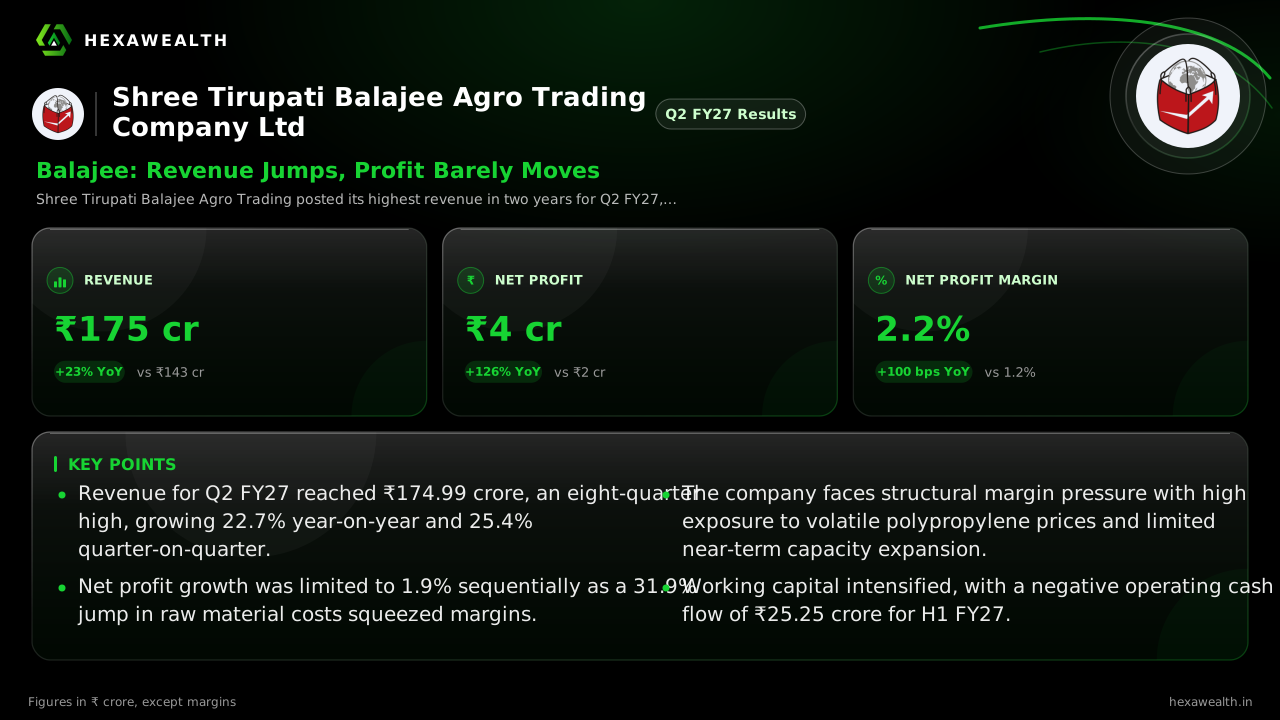
The numbers show the tension. Consolidated revenue rose 22.7% year-on-year to ₹174.99 crore, and jumped 25.4% from the June quarter. Yet, net profit grew a mere 1.9% sequentially to ₹3.82 crore. The net profit margin improved year-on-year but slipped 50 basis points from the prior quarter.
Revenue & profit
Revenue (₹ Cr)
Net Profit (₹ Cr)
Net Profit Margin
| Metric | CurrentQ2 FY27 | PreviousQ1 FY27 | Same quarter LYQ2 FY26 |
|---|---|---|---|
| Revenue (₹ Cr) | 174.99YoY +23% | 139.56 | 142.65 |
| Net Profit (₹ Cr) | 3.82YoY +126% | 3.75 | 1.69 |
| Net Profit Margin | 2.2%YoY +83% | 2.7% | 1.2% |
Why the profit didn't follow sales
A 31.9% year-on-year surge in the cost of materials, reaching ₹136.30 crore, was the primary culprit, as reported by MarketPing. This increase significantly outpaced revenue growth, compressing margins. Other income also fell sharply by 74.7%, providing no offset to the cost pressure.
The company's main subsidiary, Shree Tirupati Balajee FIBC Limited, operates from a single plant with about 12,000 tonnes of annual capacity. Research from Newboard suggests there is no major capacity expansion planned, limiting the ability to drive operating leverage to counter cost inflation in the near term.
The outlook in a tight market
The global FIBC market is projected to grow at over 5% annually, with Asia-Pacific as a key driver. However, the industry's economics are challenging. Polypropylene resin can constitute over half of a sack's cost, leaving converters like Balajee with little pricing power against global commodity swings.
This quarter's working capital build-up hints at further strain. Inventories and trade receivables rose, while operating cash flow for the half-year was negative ₹25.25 crore, according to MarketPing. With a debt-to-equity ratio of 0.75 and a thin interest cover, managing cash flow will be critical if input costs remain elevated.
Key Points
- Revenue for Q2 FY27 reached ₹174.99 crore, an eight-quarter high, growing 22.7% year-on-year and 25.4% quarter-on-quarter.
- Net profit growth was limited to 1.9% sequentially as a 31.9% jump in raw material costs squeezed margins.
- The company faces structural margin pressure with high exposure to volatile polypropylene prices and limited near-term capacity expansion.
- Working capital intensified, with a negative operating cash flow of ₹25.25 crore for H1 FY27.
Hexa Perspective
The quarter reveals a business hitting its stride on volumes but struggling to convert that into earnings. The margin squeeze from input costs is the central theme, and its duration hinges on resin price trends Balajee cannot control.
With net profit margin still a thin 2.2% and interest cover low, the balance sheet offers little buffer. The path to sustained profitability requires either a favourable shift in input costs or a successful move into higher-value, specialty products where pricing power is stronger.
Also read
Want this applied to your portfolio?
Talk to a HexaWealth advisor, or sync your mutual fund data for insights tailored to your holdings.