Sati Poly Plast (SATIPOLY) Q2 FY27 Profit Jumps 150% Even as Revenue Falls 26%
The flexible packaging firm's Q2 FY27 profit surged on a low base and cost control, but a sharp revenue drop and rising employee expenses signal underlying pressure.
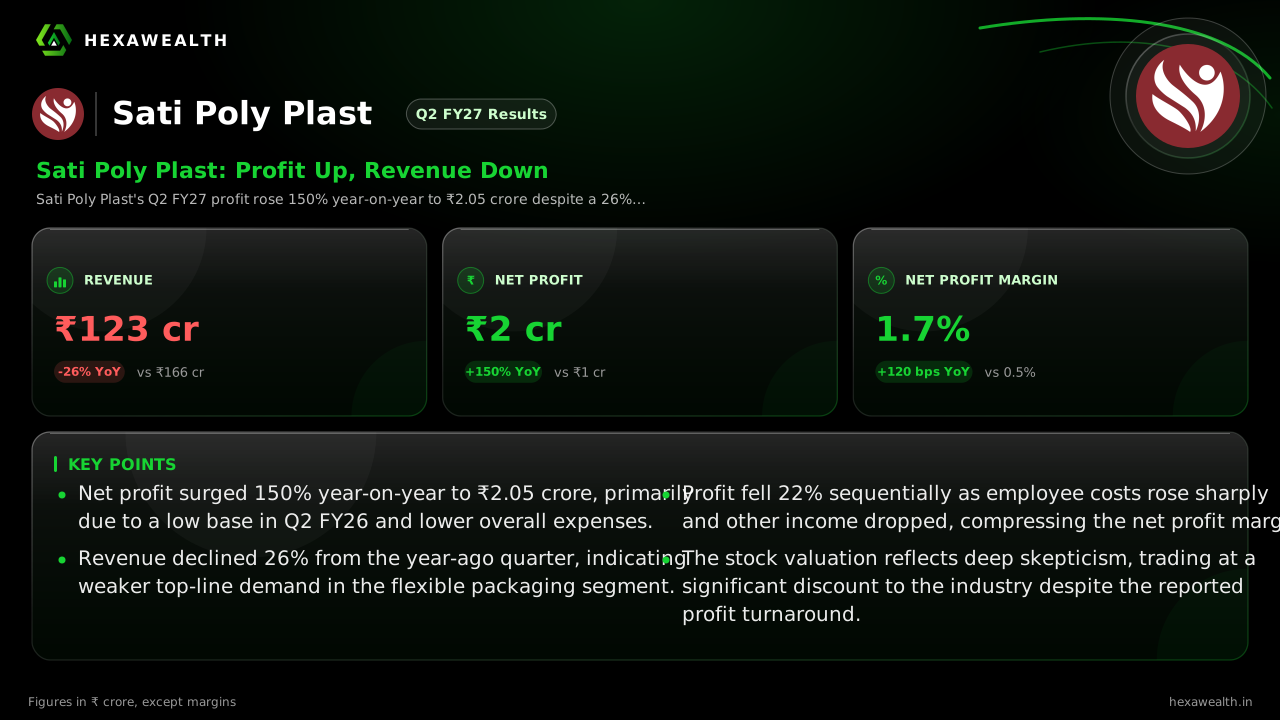
Sati Poly Plast's Q2 FY27 profit rose 150% year-on-year to ₹2.05 crore despite a 26% revenue decline. The improvement came from a low base and lower expenses, but sequential profit fell as costs rose.
For a flexible packaging company, revenue is the pulse of demand from food and consumer goods clients. Sati Poly Plast's September quarter showed that pulse weakening, with sales down sharply from last year's high, but profitability managed a stark improvement from a very low base.
The numbers tell a story of two diverging trends. Revenue fell 26% year-on-year to ₹122.5 crore. Yet, net profit more than doubled, rising 150% to ₹2.05 crore. Sequentially, sales improved 15% from the June quarter, but profit dropped 22%.
Revenue & profit
Revenue (₹ Cr)
Profit (₹ Cr)
Net Profit Margin
| Metric | CurrentQ2 FY27 (Sep 2026) | PreviousQ4 FY26 (Mar 2026) |
|---|---|---|
| Revenue (₹ Cr) | 122.54 | 106.90 |
| Profit (₹ Cr) | 2.05 | 2.63 |
| Net Profit Margin | 1.7% | 2.5% |
Why profit rose on lower sales
The profit jump is largely a base effect. The year-ago quarter's profit was a thin ₹0.82 crore on much higher revenue, reflecting poor cost absorption. This year, total expenses fell 28% in line with lower sales, and interest costs eased slightly. A report from DocStoX notes the annual net profit swung from a loss to a profit, highlighting this turnaround narrative.
The costs that squeezed margins sequentially
While the annual comparison looks strong, the quarter-on-quarter picture reveals pressure. Profit fell even as revenue rose because expenses grew faster. Employee costs nearly doubled sequentially, and other income, which had provided a lift in the prior quarter, collapsed by 92%. This pushed the net profit margin down 80 basis points to 1.7%.
The demand puzzle and valuation gap
The sharp annual revenue decline suggests softer demand or client losses. The broader packaging sector, however, is seen as structurally growing. An IndexBox report suggests India's packaging demand may grow 7-10% annually, driven by food and e-commerce, though input cost volatility remains a key challenge. The stock trades at a P/E of 5.1, an 82% discount to the industry average, as the share price has halved over the past year.
Key Points
- Net profit surged 150% year-on-year to ₹2.05 crore, primarily due to a low base in Q2 FY26 and lower overall expenses.
- Revenue declined 26% from the year-ago quarter, indicating weaker top-line demand in the flexible packaging segment.
- Profit fell 22% sequentially as employee costs rose sharply and other income dropped, compressing the net profit margin.
- The stock valuation reflects deep skepticism, trading at a significant discount to the industry despite the reported profit turnaround.
Hexa Perspective
The quarter presents a mixed recovery. Profitability is healing from the losses of FY25, but the path is narrow. The improvement is not yet driven by operating leverage from growing sales, but by cost cuts against a diminished revenue base. For the trend to sustain, revenue must stabilize and begin to grow. The company's recent board approval for machinery loans, noted by Alfafinder, suggests an intent to bolster operations, but the immediate trigger will be demand visibility in its core client industries.
Also read
Want this applied to your portfolio?
Talk to a HexaWealth advisor, or sync your mutual fund data for insights tailored to your holdings.