AG Universal (AGUL) Q2 FY27 Profit Dives as Revenue Growth Stalls
AG Universal's Q2 FY27 saw a small revenue gain but a sharp swing to a loss, as a delayed tobacco cycle and weak ingredients demand squeezed margins.
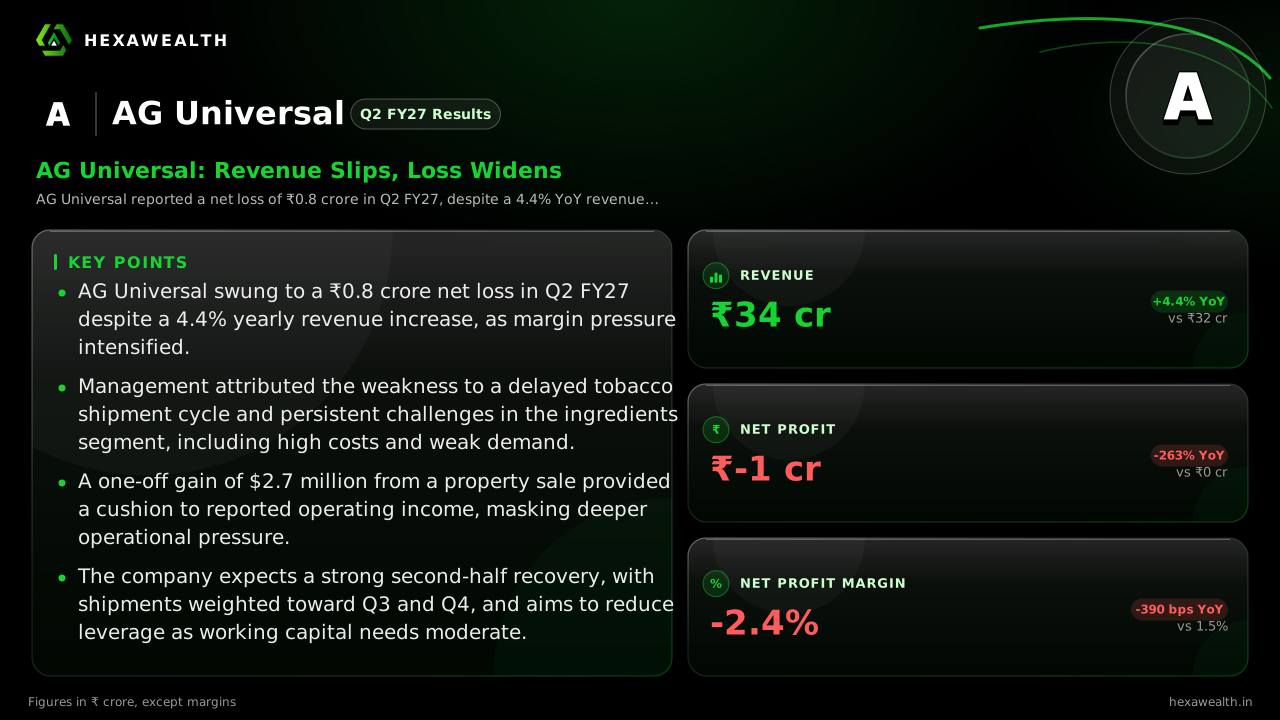
AG Universal reported a net loss of ₹0.8 crore in Q2 FY27, despite a 4.4% YoY revenue rise to ₹33.5 crore. Management attributed the pressure to delayed tobacco shipments and a challenging market for its ingredients business.
For a company in the cyclical business of stainless steel pipes and tubes, the quarter often turns on the timing of shipments and raw material costs. AG Universal's September quarter saw the top line hold, but the bottom line gave way completely, swinging from a modest profit a year ago to a loss.
The numbers show a business under pressure. Revenue inched up 4.4% year-on-year to ₹33.5 crore, but it fell 19% from the prior quarter. The real story is in profitability: the company posted a net loss of ₹0.8 crore, a stark reversal from a ₹0.49 crore profit in Q2 FY26. The net profit margin eroded to -2.4%, down 390 basis points from last year.
Revenue & profit
Revenue (₹ Cr)
Profit (₹ Cr)
Net Profit Margin (%)
| Metric | CurrentQ2 FY27 | Same quarter LYQ2 FY26 |
|---|---|---|
| Revenue (₹ Cr) | 33.5YoY +4.4% | 32.08 |
| Profit (₹ Cr) | -0.8YoY -263% | 0.49 |
| Net Profit Margin (%) | -2.4YoY -260% | 1.5 |
Why the top line held but profits didn't
The modest yearly revenue increase belied severe operational headwinds. According to the company's earnings call, the core tobacco operations faced a delayed market cycle. Customers provided shipping instructions later than usual, pushing volumes into the second half of the fiscal year.
Simultaneously, the ingredients segment grappled with persistent weakness in consumer packaged goods, inflation, and high raw material costs. A tight apple supply in the Pacific Northwest was a specific constraint cited by CFO Steven Diel. This combination meant revenue was generated at a much higher cost.
The one-off that flatters a grim picture
A closer look reveals the operating performance was even weaker than the headline loss suggests. Other income collapsed by 96.7% year-on-year to just ₹0.08 crore, removing a ₹2.48 crore cushion from last year.
Furthermore, a ₹2.7 million gain from the sale of a property in Germany was recorded as a restructuring credit, according to the company's adjusted earnings reconciliation. This one-off item flattered the reported operating income. Without it, the underlying pressure from delayed shipments and weak demand is more acute.
A balance sheet under strain
The company's financials show the strain of the delayed cycle. While interest costs fell 45% year-on-year, total debt stood at $1,196.3 million as of September 30, up $38.5 million from a year earlier. Net debt increased by $82.3 million, mainly due to the timing of tobacco shipments.
Management, via the earnings call, stated they aim to use the expected moderation in working capital needs to deleverage the balance sheet and reduce interest expense. Liquidity remains ample at approximately $945 million.
What comes next?
The company's guidance hinges on a second-half recovery. Executives on the call said customer commitments remain in line with the full-year sales plan, and they expect shipments and financial results to be “heavily weighted” toward the third and fourth quarters.
Uncommitted inventory declined to 19% within the target range, and there is emerging customer interest in additional volumes, partly driven by El Niño weather concerns. The market, however, was less convinced; according to MarketBeat, the results missed analyst estimates for both revenue and earnings per share.
Key Points
- AG Universal swung to a ₹0.8 crore net loss in Q2 FY27 despite a 4.4% yearly revenue increase, as margin pressure intensified.
- Management attributed the weakness to a delayed tobacco shipment cycle and persistent challenges in the ingredients segment, including high costs and weak demand.
- A one-off gain of $2.7 million from a property sale provided a cushion to reported operating income, masking deeper operational pressure.
- The company expects a strong second-half recovery, with shipments weighted toward Q3 and Q4, and aims to reduce leverage as working capital needs moderate.
Hexa Perspective
The quarter underscores AG Universal's vulnerability to timing shifts in its core tobacco business and cost inflation elsewhere. The promised second-half rebound is critical; if the shipment delays persist or demand softens further, the full-year outlook dims.
The high debt load, though manageable with current liquidity, adds a fixed cost that pressures earnings when volumes slide. Investors are left weighing management's confidence in a back-loaded year against the clear evidence of margin erosion and the stock's significant underperformance over three years.
Also read
Want this applied to your portfolio?
Talk to a HexaWealth advisor, or sync your mutual fund data for insights tailored to your holdings.