Arvind Smartspaces (ARVSMART) Q2 FY27 Profit Crashes 77% Despite Record Sales
The real estate developer posted a 110% jump in quarterly bookings but saw its net profit margin collapse sequentially, highlighting the accounting lag in project completions.
Arvind Smartspaces reported a sharp sequential drop in revenue and profit for Q2 FY27, even as sales bookings more than doubled. The divergence underscores the lumpy nature of revenue recognition in real estate, with profitability under pressure from rising costs.
For a real estate developer, sales bookings are the pulse of future cash flow, but revenue recognition follows the slower beat of construction milestones. Arvind Smartspaces’ September quarter captured that tension perfectly, with record presales masking a sharp contraction in reported profit.
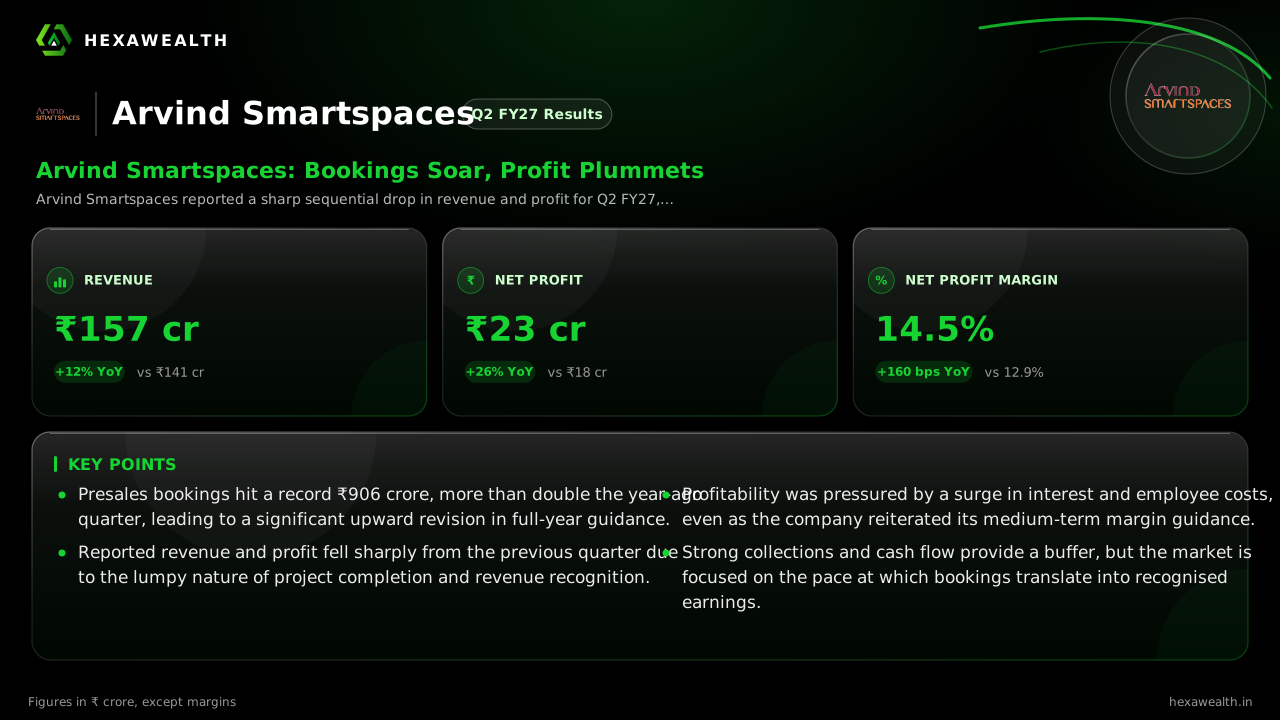
The numbers show a company operating on two different timelines. Revenue of ₹157.4 crore and profit of ₹22.75 crore were up 12% and 26% from a year ago. Yet they fell 51% and 77% from the previous quarter, when a major project completion drove exceptional results.
Revenue & profit
Revenue (₹ Cr)
Profit (₹ Cr)
Net Profit Margin
| Metric | CurrentQ2 FY27 | PreviousQ1 FY27 | Same quarter LYQ2 FY26 |
|---|---|---|---|
| Revenue (₹ Cr) | 157.36YoY +12% | 317.63 | 140.51 |
| Profit (₹ Cr) | 22.75YoY +26% | 97.39 | 18.07 |
| Net Profit Margin | 14.5%YoY +12% | 30.7% | 12.9% |
Why Bookings and Profit Tell Different Stories
The headline story is a presales surge. According to Ventura Securities, quarterly bookings doubled year-on-year to ₹906 crore, led by the launch of Arvind Sylva in Bengaluru. This prompted management to raise its full-year bookings guidance to ₹2,600–2,700 crore.
Yet this future cash inflow does not immediately hit the income statement. Revenue is recognised only upon project completion and transfer of control. This accounting mismatch explains why booming sales coincided with a net profit margin that collapsed from 30.7% to 14.5% sequentially.
The Costs That Won’t Wait
While revenue recognition lags, costs do not. Employee costs nearly doubled year-on-year, and interest expense surged over 300% to ₹25.74 crore. The company told AlphaStreet that construction spending has more than doubled, driving the higher finance charges.
This rising cost base, against a lower revenue quarter, squeezed profitability. Management noted on the earnings call that the Q2 PAT margin of 14% is in line with its medium-term guidance of 22–25% for EBITDA, suggesting the outsized Q1 margin was the outlier.
Market Weighs Growth Against Margin Pressure
The stock fell nearly 4% following the results, as reported by Ventura Securities. Analysts are balancing the strong operational momentum against financial pressures. MarketsMojo reiterated a 'Hold' rating, citing expensive valuation and elevated leverage despite the quality of the business.
The key now is the conversion of its ₹4,550 crore of unrecognised revenue into cash. Net operating cash flow was a healthy ₹152 crore for the quarter, and net debt remains manageable at ₹200 crore.
Key Points
- Presales bookings hit a record ₹906 crore, more than double the year-ago quarter, leading to a significant upward revision in full-year guidance.
- Reported revenue and profit fell sharply from the previous quarter due to the lumpy nature of project completion and revenue recognition.
- Profitability was pressured by a surge in interest and employee costs, even as the company reiterated its medium-term margin guidance.
- Strong collections and cash flow provide a buffer, but the market is focused on the pace at which bookings translate into recognised earnings.
Hexa Perspective
This quarter lays bare the core dynamic of the business: presales are a leading indicator, but accounting profit is a laggard. The raised guidance signals strong underlying demand, particularly in Bengaluru. The challenge is the cost structure, which has inflated ahead of the revenue from new launches. Investors are weighing whether the current margin compression is a temporary phase as the company builds its pipeline, or a sign of a lasting profitability reset. The next few quarters will show if cash flows from record bookings can outpace the rising cost of capital.
Also read
Want this applied to your portfolio?
Talk to a HexaWealth advisor, or sync your mutual fund data for insights tailored to your holdings.