Acme India (ACMERAIL) Q2 FY27's Revenue Triples, But Profitability Hinges on H2 Execution
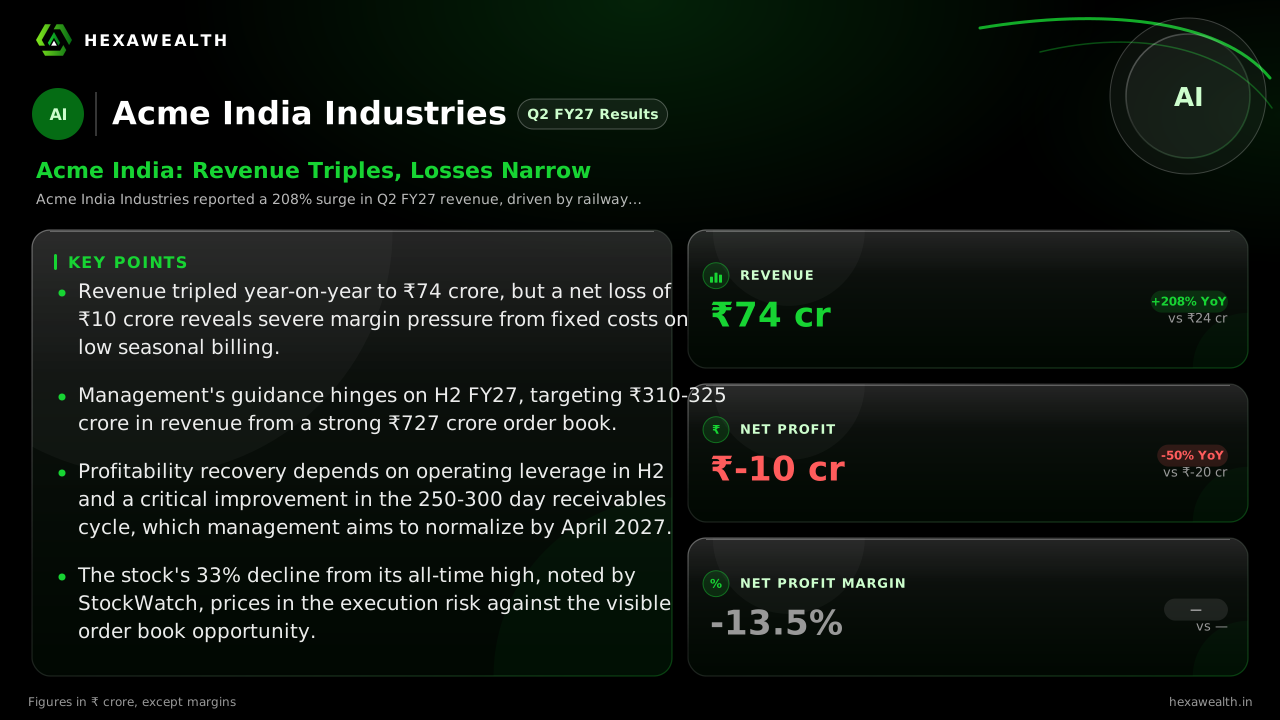
Acme India's Q2 revenue surged 208% year-on-year to ₹74 crore, but a net loss of ₹10 crore underscores the company's seasonal billing and high fixed costs.
Acme India Industries reported a 208% surge in Q2 FY27 revenue, driven by railway tenders. However, a net loss of ₹10 crore highlights the strain of fixed costs against low seasonal billing. Management's guidance for a 4x revenue jump in the second half now becomes the critical test.
For a railway coach supplier, the story is always about converting a massive order book into timely, profitable billings. Acme India's first post-IPO quarter delivered the classic tension: revenue tripled year-on-year to ₹74 crore, yet the company posted a ₹10 crore net loss. The numbers reflect a structural seasonality where most work is billed in the year's final months, leaving the first half to absorb full fixed costs.
Revenue & profit
Revenue (₹ Cr)
Profit (₹ Cr)
- Revenue (₹ Cr), Q2 FY26 (Sep 2025): 24.0
- Revenue (₹ Cr), Q2 FY27 (Sep 2026): 74.0
- Profit (₹ Cr), Q2 FY26 (Sep 2025): -20.0
- Profit (₹ Cr), Q2 FY27 (Sep 2026): -10.0
Revenue (₹ Cr)
- Revenue (₹ Cr), Q2 FY26 (Sep 2025): 24.0
- Revenue (₹ Cr), Q2 FY27 (Sep 2026): 74.0
Profit (₹ Cr)
- Profit (₹ Cr), Q2 FY26 (Sep 2025): -20.0
- Profit (₹ Cr), Q2 FY27 (Sep 2026): -10.0
| Metric | CurrentQ2 FY27 (Sep 2026) | PreviousQ2 FY26 (Sep 2025) |
|---|---|---|
| Revenue (₹ Cr) | 74.0 | 24.0 |
| Profit (₹ Cr) | -10.0 | -20.0 |
| Net Profit Margin (%) | -13.5 | — |
While the loss narrowed from ₹20 crore a year ago, the negative margin of 13.5% shows how far profitability lags behind top-line growth. Total expenses rose 87% year-on-year, with interest costs doubling to ₹8 crore, as reported by StockWatch.
The H2 Pivot Point
The entire investment case now rests on the second half. Management, in its earnings call, guided for H2 FY27 revenue between ₹310 and ₹325 crore—a more than four-fold jump from the first half. This target is anchored to a robust order book of ₹727 crore, which is 2.8 times last year's full revenue.
According to the transcript from MarketPing, 90-95% of this H2 turnover is expected from orders already in hand. The company also targets adding ₹1,200-1,500 crore of new orders over the next 12-15 months, providing multi-year visibility.
Live Chart
· ACMERAIL
(BSE)
ISIN: INE162701010
The Working Capital Trap
The credible order book is shadowed by a punishing working capital cycle. Receivables stretch 250 to 300 days, as payments are tied to final coach execution. This means the anticipated H2 revenue surge will create a significant cash drag well into the next fiscal year.
Management expects this cycle to normalize with monthly billing starting April 2027. Interest costs are also projected to fall, with full-year FY27 finance cost guided at ₹6-7 crore, down from ₹8 crore in H1, thanks to debt repayment from IPO proceeds.
Key Points
- Revenue tripled year-on-year to ₹74 crore, but a net loss of ₹10 crore reveals severe margin pressure from fixed costs on low seasonal billing.
- Management's guidance hinges on H2 FY27, targeting ₹310-325 crore in revenue from a strong ₹727 crore order book.
- Profitability recovery depends on operating leverage in H2 and a critical improvement in the 250-300 day receivables cycle, which management aims to normalize by April 2027.
- The stock's 33% decline from its all-time high, noted by StockWatch, prices in the execution risk against the visible order book opportunity.
Hexa Perspective
The quarter sets up a clear binary outcome. The order book visibility is tangible and government-backed, offering a credible path to the guided 4x revenue ramp. If executed, operating leverage should sharply improve margins from the current -13.5%.
The entire thesis, however, is contingent on two factors: flawless conversion of H2 billings and the promised normalization of the payment cycle by next April. The market's skepticism, reflected in the share price, is a rational discount for these execution and working capital risks. The next quarter's billing realization will be the first concrete signal of whether the guidance is achievable.
Also read
Want this applied to your portfolio?
Talk to a HexaWealth advisor, or sync your mutual fund data for insights tailored to your holdings.