Updater Services is heading to court after receiving a goods and services tax demand for nearly ₹3 crore. The facilities management firm, which just posted a sharp 62% jump in quarterly profit, says the order is without merit and expects no financial impact as it prepares an appeal.
According to the NSE filing, the order from the Deputy Commissioner in Chennai cites issues with tax rate verification, credit notes, and input tax credit. The company states the order was passed without considering its submitted response. As reported by Blacklitt.com, the demand of ₹2.98 crore is equivalent to about 9% of the company's net profit last quarter.
The Path of Appeal
The company is exploring all legal options, including filing an appeal before the Appellate Authority. Legal advisors like Viswanathan & Associates note that such a first appeal must be filed within three months of the order. If the appeal is filed, a pre-deposit of the admitted tax plus 10% of the disputed amount is typically required, which stays recovery of the balance.
This legal challenge arrives as Updater Services is enjoying a margin recovery. Its net profit margin expanded to 4.0% last quarter, supported by a debt-free balance sheet with significant cash reserves. The company's strong financial position provides a buffer as it navigates this dispute.
Key Points
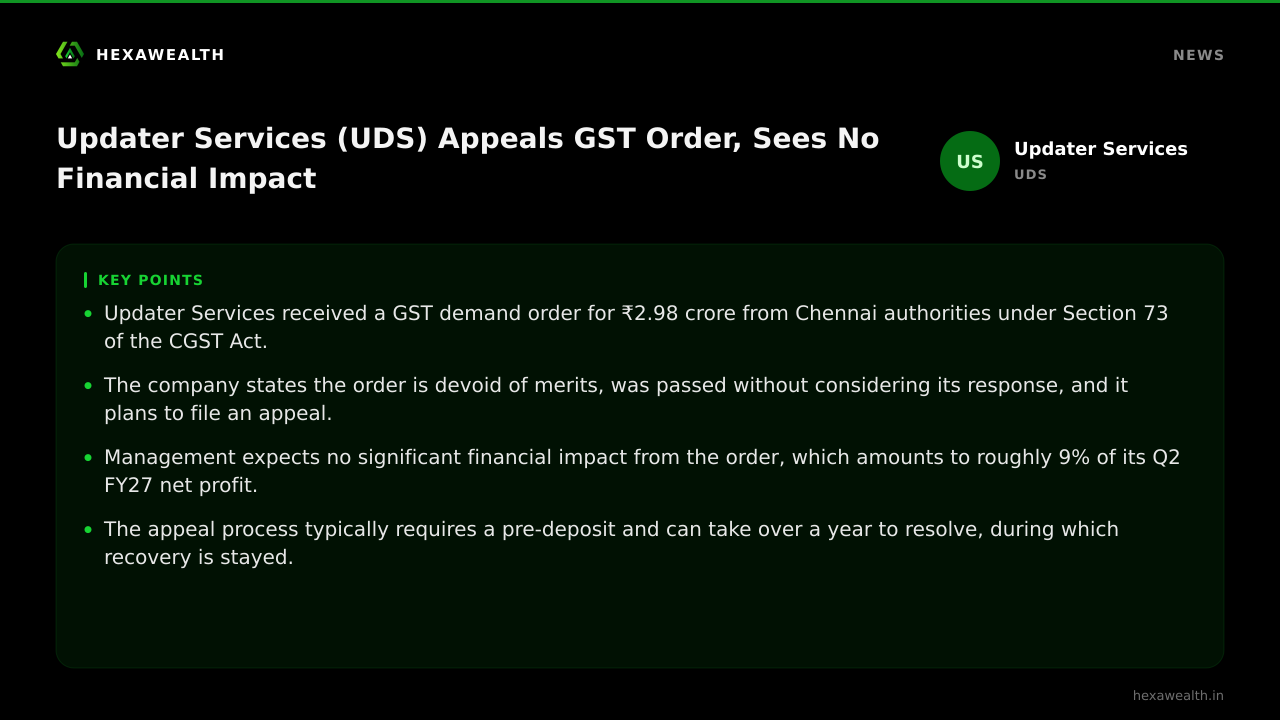
- Updater Services received a GST demand order for ₹2.98 crore from Chennai authorities under Section 73 of the CGST Act.
- The company states the order is devoid of merits, was passed without considering its response, and it plans to file an appeal.
- Management expects no significant financial impact from the order, which amounts to roughly 9% of its Q2 FY27 net profit.
- The appeal process typically requires a pre-deposit and can take over a year to resolve, during which recovery is stayed.
Hexa Perspective
The immediate risk appears contained. The company’s assessment of nil financial impact is a firm management position, and similar contested demands are typically disclosed as contingent liabilities, not immediate expenses. The real test is procedural.
For the impact to stay nil, the appeal must succeed on grounds that the order exceeded the notice's scope or failed to consider the company's evidence—common successful appeal arguments noted in recent GSTAT rulings. The company's robust profitability and clean balance sheet mean it can afford the pre-deposit and a prolonged dispute without straining operations. This episode is a compliance skirmish, not a threat to the business, provided the legal arguments hold.