Fine Organic Industries is channeling its robust profitability into building the future. The company has invested ₹50 crore in its wholly-owned subsidiary to fund a new manufacturing unit, a critical step to relieve capacity constraints that have capped its recent growth.
The capital comes via 1% Non-Convertible, Non-Cumulative, Redeemable Preference Shares, as reported by stockk.trade. This follows a ₹55 crore infusion into the same subsidiary during the last quarter, part of a board-approved total investment limit of ₹420 crore for the project. The subsidiary, Fine Organic Industries SEZ Private Limited, was incorporated in 2023 and has a net worth of ₹90.29 crore but has not yet begun operations.
Funding the Next Growth Phase
This investment is not a surprise but an execution of a stated plan. The quarterly article noted the company's cash reserves fell as it funded investments in subsidiaries, with this SEZ project being the centerpiece. The new plant in the JNPA SEZ is intended to manufacture the company's core oleochemical-based additives for global markets, supporting export-led growth. According to sahi.com, the capital injection is directed at the ongoing construction of this greenfield facility.
The immediate market reaction was muted, with the stock closing at ₹5,582.50 on the day of the filing, down 0.35%, as per data from emkayglobal.com. Investors are focused on the execution timeline, with the project expected to commission in the second half of the 2028 financial year.
Key Points
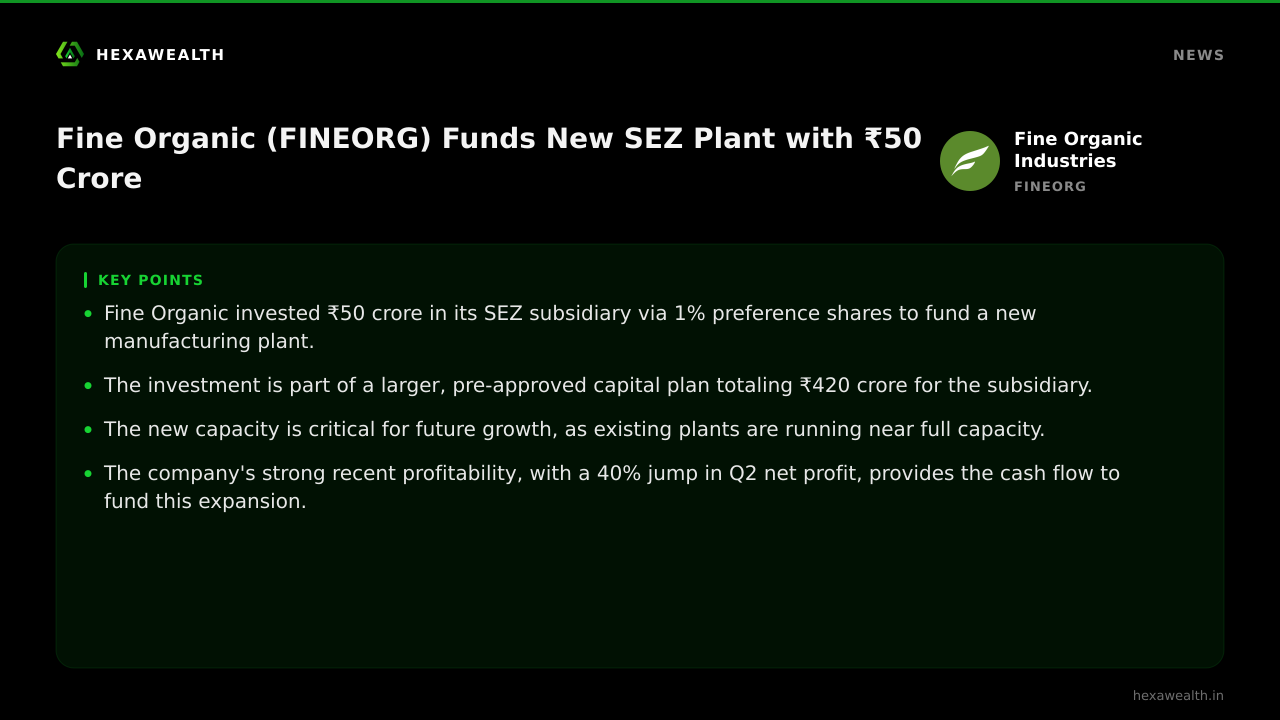
- Fine Organic invested ₹50 crore in its SEZ subsidiary via 1% preference shares to fund a new manufacturing plant.
- The investment is part of a larger, pre-approved capital plan totaling ₹420 crore for the subsidiary.
- The new capacity is critical for future growth, as existing plants are running near full capacity.
- The company's strong recent profitability, with a 40% jump in Q2 net profit, provides the cash flow to fund this expansion.
Hexa Perspective
This filing confirms Fine Organic is actively deploying capital from its period of high margin strength into its long-term capacity story. The terms are favorable for the parent company—the 1% coupon on the preference shares is a low-cost way to fund the subsidiary, preserving cash for other needs.
The bet is clear: today's operational excellence must finance tomorrow's scale. For this to pay off, the company's pricing power and margin resilience, evidenced by its 20.9% net profit margin last quarter, must hold long enough to see the new plant online. Any significant delay in the project's H2 FY28 timeline or a stumble in current profitability would pressure the investment thesis. For now, the company is using its financial strength exactly as promised.