Anand Rathi Wealth has taken a formal step to expand beyond wealth distribution into the higher-margin business of manufacturing investment products. The company’s shareholders have approved an amendment to its charter, authorizing it to act as a sponsor, asset manager, and trustee for mutual funds, REITs, and alternative investment funds, according to the NSE filing.
This legal change is a prerequisite for the company to apply for the necessary licenses from regulators like SEBI. As explained by Taxmann.com, running a mutual fund requires a three-tier structure of sponsor, trustee, and asset management company, each with strict governance and experience requirements. The filing notes the expansion is subject to obtaining these approvals.
For a firm that just reported record client inflows, this move is about capturing more value from its growing asset base. The company’s revenue grew 16% year-on-year last quarter, but its reported profit fell sharply due to volatile one-off items. Building an in-house asset management capability could create a more predictable, fee-based revenue stream, aligning with an industry trend where firms seek to become full-service financial quarterbacks, as noted by The Economic Times.
Key Points
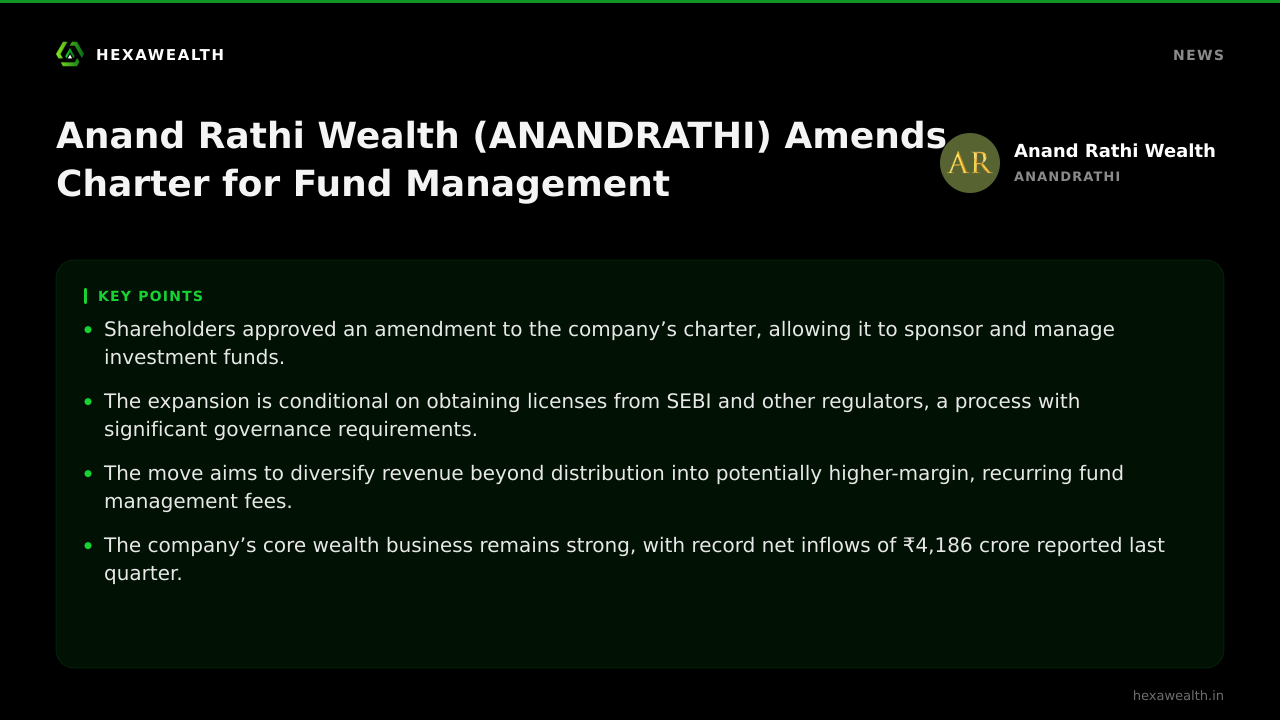
- Shareholders approved an amendment to the company’s charter, allowing it to sponsor and manage investment funds.
- The expansion is conditional on obtaining licenses from SEBI and other regulators, a process with significant governance requirements.
- The move aims to diversify revenue beyond distribution into potentially higher-margin, recurring fund management fees.
- The company’s core wealth business remains strong, with record net inflows of ₹4,186 crore reported last quarter.
Hexa Perspective
The amendment is a logical, long-term strategic play for a wealth manager swimming in client assets. It addresses a core tension in Anand Rathi’s story: how to convert impressive asset gathering into more stable, high-quality earnings less prone to the quarterly volatility of mark-to-market gains. Success, however, is not guaranteed by a charter change. It hinges on securing regulatory approvals, building a credible investment team, and competing in a crowded asset management field where even brokerages like Angel One are making similar moves, as Reuters reported. For the company’s premium valuation to be justified, this foray must eventually demonstrate it can manufacture products as effectively as it distributes them. The path from distributor to manufacturer is now officially open, but the real work begins.