Aarti Industries is moving to strengthen its financial position after a period of rapid, capital-intensive growth. The company has secured shareholder approval to raise up to ₹1,000 crore, with the primary goal of repaying borrowings and reducing its debt burden.
The Terms of the Raise
According to filings reviewed by Alfafinder and Stockfin AI, shareholders approved the special resolution at an Extraordinary General Meeting on October 31, 2026. The funds can be raised through methods including a qualified institutional placement (QIP), private placement, or preferential allotment. The NSE filing states the primary object is the repayment or prepayment of certain outstanding borrowings, which will lower leverage and interest costs.
This move follows a quarter where revenue surged but profitability was constrained by a cost-pass-through model. As reported by MarketPing, net debt had risen above ₹4,650 crore due to stretched working capital needs from elevated raw material prices. The company's debt-to-equity ratio stands at 0.83.
Key Points
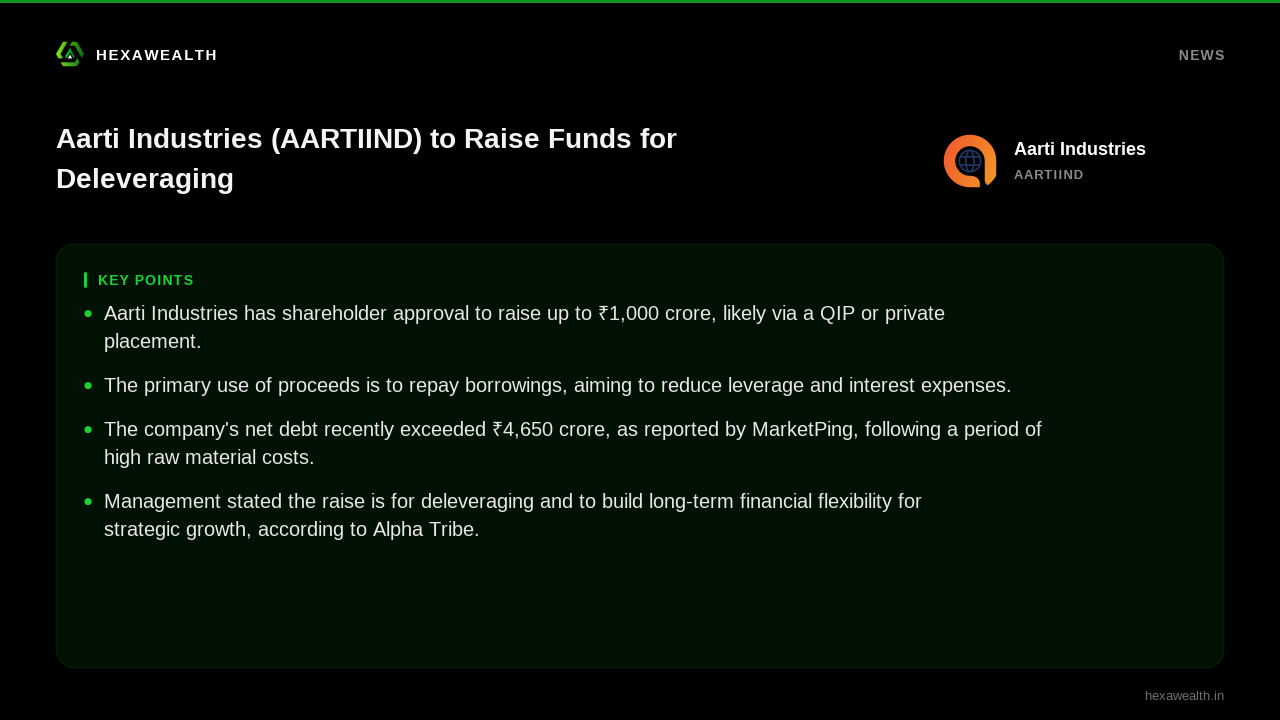
- Aarti Industries has shareholder approval to raise up to ₹1,000 crore, likely via a QIP or private placement.
- The primary use of proceeds is to repay borrowings, aiming to reduce leverage and interest expenses.
- The company's net debt recently exceeded ₹4,650 crore, as reported by MarketPing, following a period of high raw material costs.
- Management stated the raise is for deleveraging and to build long-term financial flexibility for strategic growth, according to Alpha Tribe.
Hexa Perspective
The fund raise is a logical step for a company navigating the trade-offs of its recent expansion. Aarti Industries delivered record revenue by prioritizing volume growth and passing on input costs, a strategy that protected earnings but limited margin expansion and increased working capital needs.
Reducing debt is now the clear priority. Success hinges on executing the capital raise efficiently and using it to meaningfully improve the balance sheet. For the strategy to pay off, the company must demonstrate that lower interest costs and a stronger equity base can support its ambitious growth plans—including new capacity like Zone IV—without recurring strain on working capital. The move signals a shift from aggressive expansion to financial consolidation, a necessary phase for sustainable long-term value.