Yamini Investments (YAMNINV) Q2 FY27 Profit Jumps 600% QoQ But Revenue Remains Weak
Yamini Investments posted a sharp sequential recovery in Q2 FY27, yet its revenue fell 42% year-on-year, highlighting a volatile and structurally challenged business model.
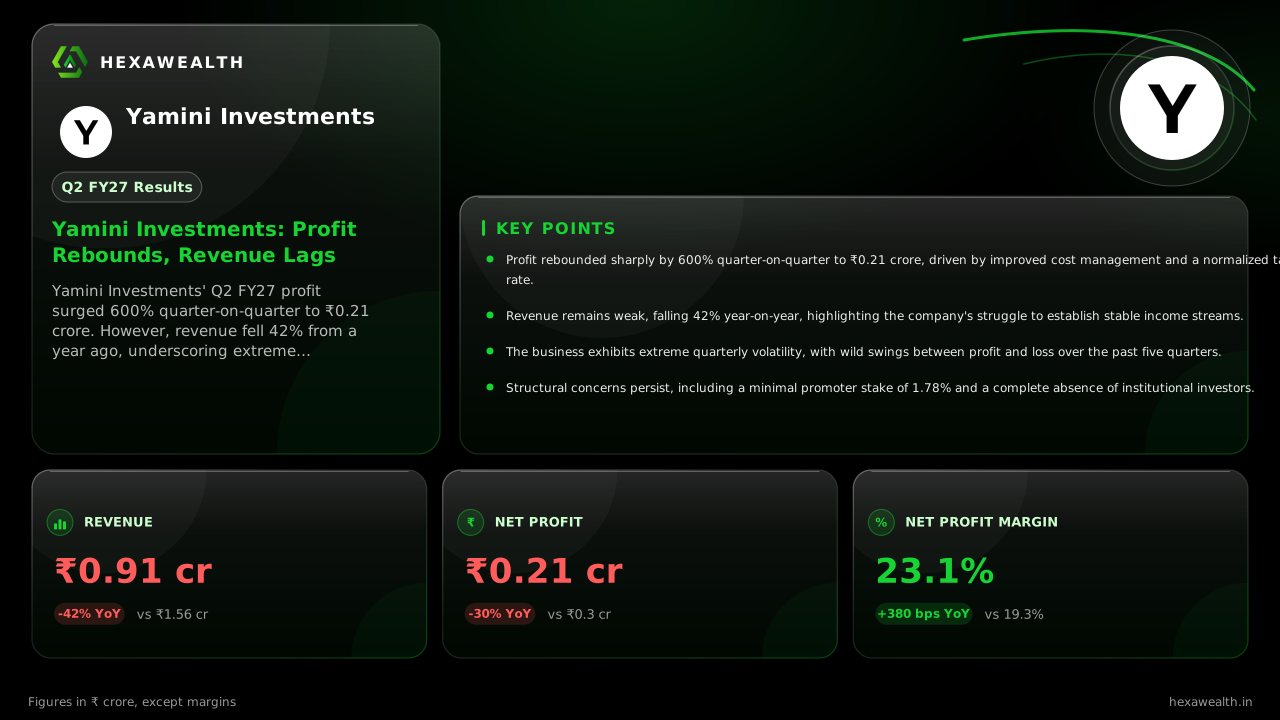
Yamini Investments' Q2 FY27 profit surged 600% quarter-on-quarter to ₹0.21 crore. However, revenue fell 42% from a year ago, underscoring extreme volatility and weak underlying business streams.
For a micro-cap NBFC like Yamini Investments, stability is the true measure of health. The September quarter delivered a sharp sequential bounce, but the year-on-year comparisons tell a story of a business struggling to find its footing.
Revenue for Q2 FY27 was ₹0.91 crore, a 146% jump from the previous quarter's low base of ₹0.37 crore. Yet it remained 42% lower than the ₹1.56 crore earned in the same period last year. Net profit followed a similar volatile path, surging 600% sequentially to ₹0.21 crore but still down 30% year-on-year.
Revenue & profit
Revenue (₹ Cr)
Profit (₹ Cr)
- Revenue (₹ Cr), Q2 FY26 (Sep 2025): 1.56
- Revenue (₹ Cr), Q3 FY26 (Dec 2025): 0.32
- Revenue (₹ Cr), Q4 FY26 (Mar 2026): 1.43
- Revenue (₹ Cr), Q1 FY27 (Jun 2026): 0.37
- Revenue (₹ Cr), Q2 FY27 (Sep 2026): 0.91
- Profit (₹ Cr), Q2 FY26 (Sep 2025): 0.30
- Profit (₹ Cr), Q3 FY26 (Dec 2025): 0.08
- Profit (₹ Cr), Q4 FY26 (Mar 2026): -0.36
- Profit (₹ Cr), Q1 FY27 (Jun 2026): 0.03
- Profit (₹ Cr), Q2 FY27 (Sep 2026): 0.21
Revenue (₹ Cr)
- Revenue (₹ Cr), Q2 FY26 (Sep 2025): 1.56
- Revenue (₹ Cr), Q3 FY26 (Dec 2025): 0.32
- Revenue (₹ Cr), Q4 FY26 (Mar 2026): 1.43
- Revenue (₹ Cr), Q1 FY27 (Jun 2026): 0.37
- Revenue (₹ Cr), Q2 FY27 (Sep 2026): 0.91
Profit (₹ Cr)
- Profit (₹ Cr), Q2 FY26 (Sep 2025): 0.30
- Profit (₹ Cr), Q3 FY26 (Dec 2025): 0.08
- Profit (₹ Cr), Q4 FY26 (Mar 2026): -0.36
- Profit (₹ Cr), Q1 FY27 (Jun 2026): 0.03
- Profit (₹ Cr), Q2 FY27 (Sep 2026): 0.21
Net Profit Margin
- Net Profit Margin, Q2 FY26 (Sep 2025): 19.3%
- Net Profit Margin, Q3 FY26 (Dec 2025): 25.6%
- Net Profit Margin, Q4 FY26 (Mar 2026): -25.5%
- Net Profit Margin, Q1 FY27 (Jun 2026): 7.0%
- Net Profit Margin, Q2 FY27 (Sep 2026): 23.1%
| Metric | CurrentQ2 FY27 (Sep 2026) | PreviousQ1 FY27 (Jun 2026) |
|---|---|---|
| Revenue (₹ Cr) | 0.91 | 0.37 |
| Profit (₹ Cr) | 0.21 | 0.03 |
| Net Profit Margin | 23.1% | 7.0% |
The volatile path to profitability
The dramatic margin expansion, with net profit margin rising to 23.1% from 7.0% last quarter, was driven by cost control. According to MarketsMojo, employee costs were minimal and interest expense fell to zero. This helped profit outpace revenue growth sequentially.
However, this improvement comes against a backdrop of extreme quarterly volatility. The company has posted wild swings from profit to loss over the past five quarters, as shown in the table. This pattern, noted by MarketsMojo, reflects a fundamental challenge in establishing stable revenue streams.
A business model under scrutiny
The year-on-year revenue decline points to deeper issues. Research suggests the company's asset base is a concern, with reports indicating zero fixed assets and zero investments as of March 2026. This raises questions about how it generates income.
Live Chart
· YAMNINV
(BSE)
ISIN: INE457N01025
The lack of institutional investor confidence is another red flag. Promoter holding is a minimal 1.78%, and there is zero FII or mutual fund ownership, according to shareholding data. This creates a governance and credibility vacuum that amplifies risk.
Key Points
- Profit rebounded sharply by 600% quarter-on-quarter to ₹0.21 crore, driven by improved cost management and a normalized tax rate.
- Revenue remains weak, falling 42% year-on-year, highlighting the company's struggle to establish stable income streams.
- The business exhibits extreme quarterly volatility, with wild swings between profit and loss over the past five quarters.
- Structural concerns persist, including a minimal promoter stake of 1.78% and a complete absence of institutional investors.
Hexa Perspective
This quarter's profit recovery is a tactical bounce within a structurally challenged framework. The improvement is welcome but built on a very low base, and the year-on-year declines in both revenue and profit are the more telling metrics.
The path forward depends on demonstrating revenue stability above ₹1 crore per quarter with consistent year-on-year growth. Until then, the extreme volatility and poor capital efficiency, evidenced by a near-zero return on equity, suggest this remains a high-risk proposition for investors.
Also read
Want this applied to your portfolio?
Talk to a HexaWealth advisor, or sync your mutual fund data for insights tailored to your holdings.