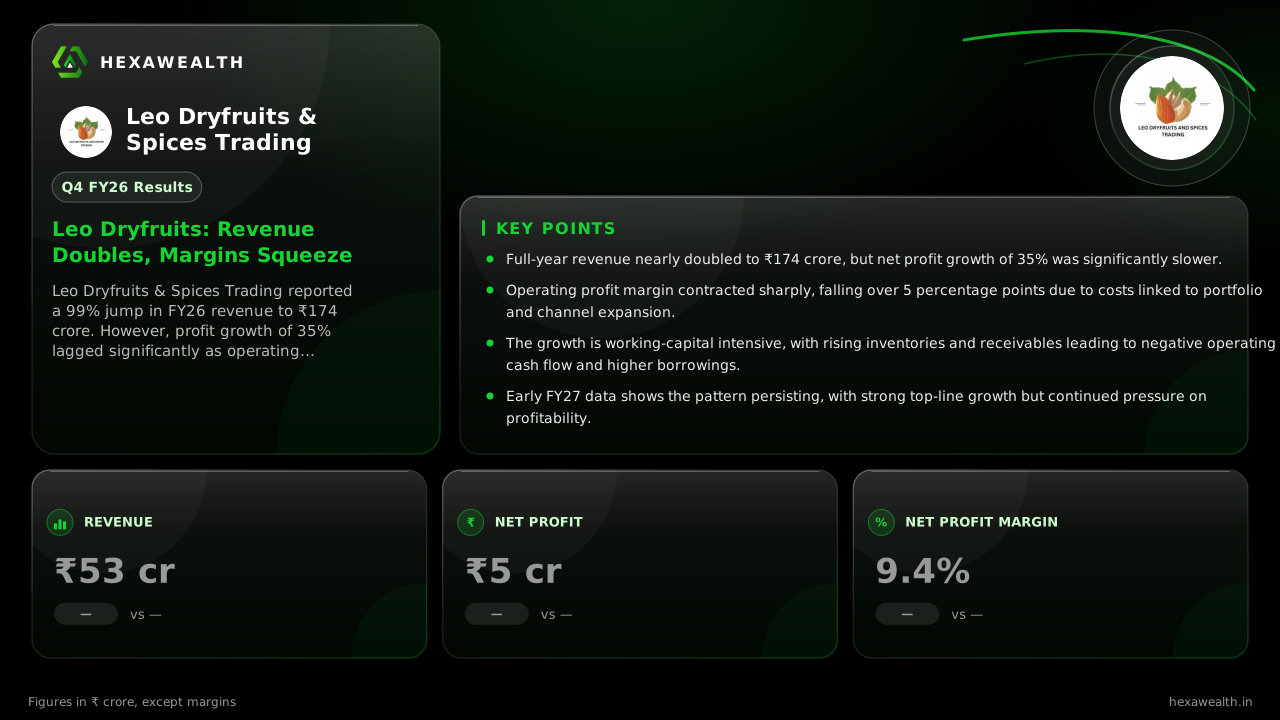
Leo Dryfruits & Spices Trading reported a 99% jump in FY26 revenue to ₹174 crore. However, profit growth of 35% lagged significantly as operating margins fell over 5 percentage points, pressured by expansion costs.
For a fast-growing food processor, the test is whether the top line can pull profitability along. Leo Dryfruits & Spices Trading closed FY26 with revenue nearly doubling, but the cost of that expansion left a clear mark on the bottom line.
The full-year numbers show a business scaling rapidly. Revenue surged 99.3% to ₹174 crore, while net profit grew 34.7% to ₹11 crore. The gap between the two rates tells the story of a margin squeeze that began as the year progressed.
Revenue & profit
Revenue (₹ Cr.)
Profit (₹ Cr.)
Revenue (₹ Cr.), FY25: 87.3
Revenue (₹ Cr.), FY26: 174.0
Profit (₹ Cr.), FY25: 8.2
Profit (₹ Cr.), FY26: 11.0
Revenue (₹ Cr.)
Revenue (₹ Cr.), FY25: 87.3
Revenue (₹ Cr.), FY26: 174.0
Profit (₹ Cr.)
Profit (₹ Cr.), FY25: 8.2
Profit (₹ Cr.), FY26: 11.0
Net Profit Margin
Net Profit Margin, FY25: 9.4%
Net Profit Margin, FY26: 6.3%
Metric
CurrentFY26
PreviousFY25
Revenue (₹ Cr.)
174.0
87.3
Profit (₹ Cr.)
11.0
8.2
Net Profit Margin
6.3%
9.4%
The cost of chasing growth
Profit growth lagged because expenses rose faster than sales. Total expenses jumped 118% year-on-year, according to the annual analysis. This was driven by heavy investment in stock to support new product lines and a foray into quick commerce.
Reports from ScanX Trade and Multibagg.ai note the operating profit margin fell to 11.4% from 17.0% a year earlier. The company’s strategic moves—acquiring a stake in a makhana brand, securing IRCTC empanelment, and entering channels like Zepto—fuelled sales but compressed margins.
A cash-intensive expansion
This growth phase is capital hungry. Finance costs more than doubled, and the company’s operating cash flow remained negative as inventories and receivables swelled to support sales. Borrowings have risen to fund this working capital cycle.
Live Chart
· VANDU
(BSE)
ISIN: INE0RH001011
The strain is visible in the most recent half-year. For H1 FY27, MCapital reports revenue grew 82% but net profit was up only 29%, with the pre-tax margin falling to 8.9%. The margin pressure that defined FY26 has continued into the new fiscal year.
Key Points
Full-year revenue nearly doubled to ₹174 crore, but net profit growth of 35% was significantly slower.
Operating profit margin contracted sharply, falling over 5 percentage points due to costs linked to portfolio and channel expansion.
The growth is working-capital intensive, with rising inventories and receivables leading to negative operating cash flow and higher borrowings.
Early FY27 data shows the pattern persisting, with strong top-line growth but continued pressure on profitability.
“
Hexa Perspective
The quarter confirms Leo Dryfruits is in a classic scaling phase: sacrificing near-term margins for market presence and revenue base. The 99% sales jump validates the demand for its products, but the 560-basis-point EBITDA margin drop shows the price.
The next few quarters hinge on whether this sales momentum can be sustained long enough for operating leverage to kick in. With the dry fruits industry facing a potential slowdown due to high global prices, maintaining this growth rate will be the key challenge. Investors are weighing rapid scale against thinning margins and a valuation that already prices in much of the uncertainty.
Talk to a HexaWealth advisor, or sync your mutual fund data for insights tailored to your holdings.
Frequently asked questions
What were Leo Dryfruits & Spices Trading's FY26 results?
Leo Dryfruits & Spices Trading reported revenue of ₹174 crore for the financial year ended March 2026, a 99.3% increase from the previous year. Net profit for FY26 was ₹11 crore, representing a growth of 34.7% year-on-year.
What was Leo Dryfruits & Spices Trading's Q4 FY26 profit?
Leo Dryfruits & Spices Trading reported a net profit of ₹5 crore for the quarter ended March 2026 (Q4 FY26). Revenue for the same quarter stood at ₹53 crore, according to the company's standalone financials.
Why did Leo Dryfruits' profit growth lag behind its revenue growth in FY26?
Leo Dryfruits' profit growth of 35% lagged its 99% revenue surge due to a significant margin squeeze. Reports from ScanX Trade and Multibagg.ai indicate the operating profit margin fell to 11.4% from 17.0%, pressured by costs from new product lines, channel expansion, and higher interest expenses.
What caused Leo Dryfruits' total expenses to rise 118% in FY26?
Leo Dryfruits' total expenses rose 118% in FY26 primarily due to a massive buildup in inventory to support new product categories and expanded distribution. The company also faced higher finance costs as borrowings increased to fund this rapid working-capital intensive growth phase.
What is Leo Dryfruits & Spices Trading's expansion plan for FY27?
For FY27, Leo Dryfruits plans to set up two 80%-owned trading subsidiaries in Dubai by February 2027 to expand in the Middle East. The board has given in-principle approval, though the investment size is yet to be fixed, as reported by MCapital.
What is Leo Dryfruits & Spices Trading's cash flow situation?
Leo Dryfruits' cash flow from operations was negative in FY26, as reported by ScanX Trade. Rapid growth led to a significant increase in inventories and receivables, which consumed cash. This was funded by a rise in borrowings, indicating a working-capital intensive expansion.
What is the demand outlook for the dry fruits industry?
The dry fruits industry outlook has softened. The Nuts and Dry Fruits Council of India expects growth to slow to 1-4% in FY27 from 10-15% previously, as reported by Businessworld. Sharp price increases in items like pistachios and almonds are affecting consumer demand and trader inventories.
Why is Leo Dryfruits' PE ratio trading at a discount to the industry?
Leo Dryfruits trades at a P/E of 9.3, a significant discount to the industry average of 44.9. This discount likely reflects the market's caution regarding the company's margin compression, working capital intensity, and its smaller scale compared to larger FMCG peers.
Have institutional investors changed their stake in Leo Dryfruits recently?
Institutional holding in Leo Dryfruits has decreased recently. Data from StockFin.ai shows combined FII and DII holding fell from 3.1% in Q2 FY26 to 0.9% by Q4 FY26, indicating reduced institutional interest during the period of rapid but margin-pressured growth.
What was Leo Dryfruits & Spices Trading's dividend for FY26?
Leo Dryfruits & Spices Trading declared a final dividend for FY26. The ex-date was September 29, 2026. Data from Newboard.in shows the dividend payout ratio for the year was 8% of its net profit.
Leo Dryfruits & Spices Trading FY26 revenue
Leo Dryfruits & Spices Trading's revenue for the financial year ended March 2026 (FY26) was ₹174 crore. This represents a near-doubling, or 99.3% growth, from the ₹87.31 crore revenue reported in FY25.
Leo Dryfruits FY26 results
Leo Dryfruits' FY26 results, for the year ended March 2026, showed revenue doubling to ₹174 crore. Net profit grew 34.7% to ₹11 crore. The results were marked by strong top-line growth but a sharp contraction in operating margins due to expansion costs.