SKF India (SKFINDIA) Q2 FY27 Profit Dips 16% as Input Costs Pinch Margins
The bearings maker posted a sequential profit drop despite steady revenue, as rising material costs squeezed margins in the September quarter.
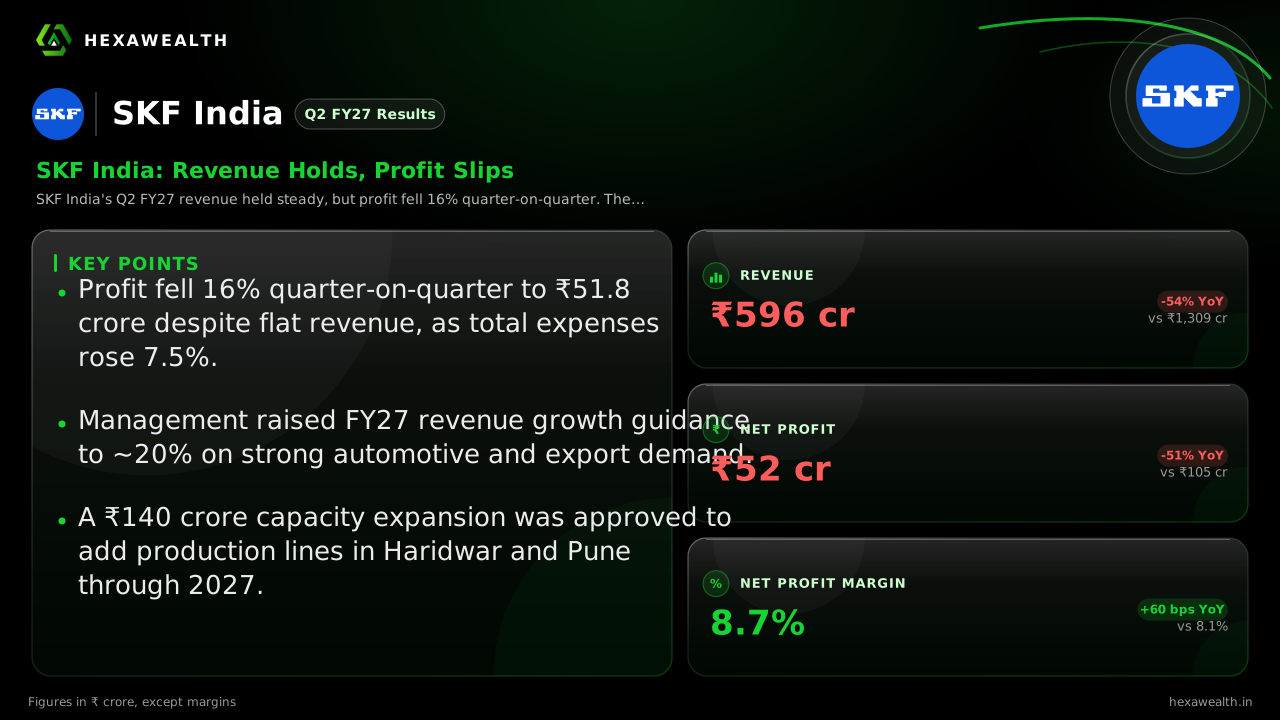
SKF India's Q2 FY27 revenue held steady, but profit fell 16% quarter-on-quarter. The decline was driven by higher input costs, which pressured margins even as automotive demand remained strong.
For SKF India, the September quarter was a test of its new shape as a pure-play automotive bearings company after last year's demerger. The headline numbers show a business holding its top line but struggling to defend its bottom line against rising costs.
Revenue was nearly flat at ₹595.8 crore, a 1.4% increase from the June quarter. Profit, however, fell 16.3% sequentially to ₹51.8 crore. The net profit margin contracted by 180 basis points to 8.7%.
Revenue & profit
Revenue (₹ Cr)
Profit (₹ Cr)
Net Profit Margin (%)
| Metric | CurrentQ2 FY27 (Sep 2026) | PreviousQ1 FY27 (Jun 2026) |
|---|---|---|
| Revenue (₹ Cr) | 595.81 | 587.79 |
| Profit (₹ Cr) | 51.81 | 61.92 |
| Net Profit Margin (%) | 8.7 | 10.5 |
The costs that will not fall soon
The profit drop was driven by a 7.5% sequential rise in total expenses. According to CNBC-TV18, CFO Mayank Holani cited inflationary pressure from steel prices and higher value-addition costs from suppliers. The company is negotiating price revisions with customers, but these have not been fully implemented.
This cost pressure overshadowed a strong 135% jump in other income, which helped total income grow 4.1% to ₹624.9 crore. On a comparable basis, the demerger makes year-on-year figures misleading, but on a like-for-like automotive business basis, Autocar Professional reported standalone revenue grew 20.1%.
A confident outlook on demand
Management's confidence in future growth is clear. The company raised its full-year revenue growth guidance to around 20%, up from 12% earlier, CNBC-TV18 reported. Demand is broad-based across two-wheelers, three-wheelers, passenger and commercial vehicles, with exports also showing double-digit growth.
To meet this demand, the board approved a ₹140 crore capacity expansion. As per Autocar Professional, this will add production lines at its Haridwar and Pune plants between December 2026 and July 2027.
The market's muted reaction
The stock closed 1.2% higher on the results day, a tepid response reflecting the margin disappointment against a backdrop of steady operations. The company trades at a P/E of 26.3, a significant discount to the industry average of 41.6.
Key Points
- Profit fell 16% quarter-on-quarter to ₹51.8 crore despite flat revenue, as total expenses rose 7.5%.
- Management raised FY27 revenue growth guidance to ~20% on strong automotive and export demand.
- A ₹140 crore capacity expansion was approved to add production lines in Haridwar and Pune through 2027.
Hexa Perspective
The quarter underscores a transition phase. SKF India is successfully navigating its post-demerger identity with robust demand, but near-term profitability is hostage to input cost inflation. The raised revenue guidance signals management's conviction in volume growth, yet hitting the retained 17% margin target depends entirely on passing cost increases to customers. The next few quarters will reveal whether pricing power can catch up to cost pressure, or if strong sales will continue to come at the expense of margins.
Also read
Want this applied to your portfolio?
Talk to a HexaWealth advisor, or sync your mutual fund data for insights tailored to your holdings.