Saffron Industries (SAFFRON) Q2 FY27 Profit Plunges 75% as Costs Surge
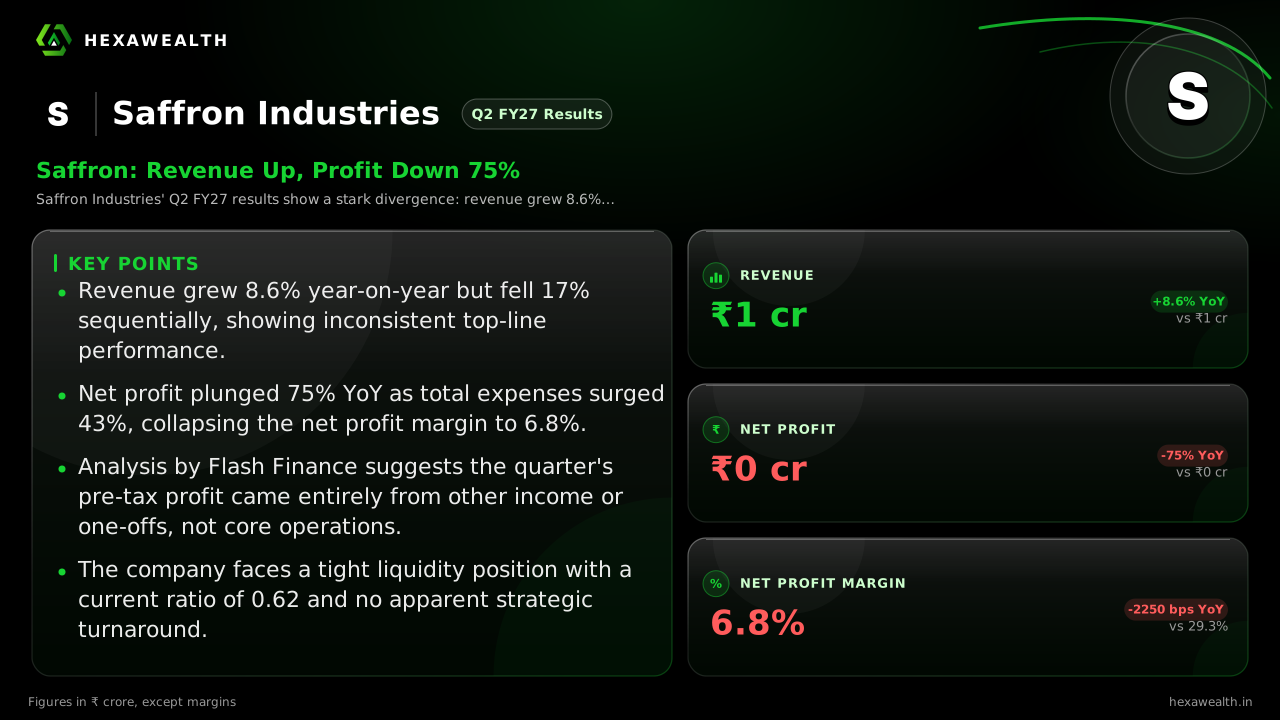
Saffron Industries reported an 8.6% rise in September quarter revenue, but net profit collapsed 75% year-on-year as expenses soared 43%.
Saffron Industries' Q2 FY27 results show a stark divergence: revenue grew 8.6% year-on-year, but net profit fell 75%. The collapse was driven by a 43% surge in total expenses, squeezing the net profit margin to just 6.8%.
For Saffron Industries, a paper manufacturer, the September quarter delivered a top-line gain but a punishing squeeze on the bottom line. Revenue grew 8.6% year-on-year to ₹0.88 crore, yet net profit collapsed 75% to just ₹0.06 crore.
The numbers reveal a business under severe pressure. Sequentially, revenue fell 17% from the June quarter, and profit halved. The net profit margin, once a robust 29.3% a year ago, has now collapsed to 6.8%.
Revenue & profit
Revenue (₹ Cr)
Profit (₹ Cr)
Net Profit Margin (%)
| Metric | CurrentQ2 FY27 (Sep 2026) | PreviousQ1 FY27 (Jun 2026) |
|---|---|---|
| Revenue (₹ Cr) | 0.88 | 1.06 |
| Profit (₹ Cr) | 0.06 | 0.12 |
| Net Profit Margin (%) | 6.8 | 11.4 |
The cost surge that erased profits
The primary driver was a 43% year-on-year surge in total expenses, which far outpaced the modest revenue growth. According to a Flash Finance analysis, the company's pre-tax profit came entirely from other income or one-off items, with its core business contributing nothing. This suggests the reported profit of ₹5.88 lakh is not from ongoing operations.
An industry under pressure
The broader paper industry context is challenging. A report by Storyboard18 notes newsprint costs have surged 20-25% recently due to coal supply issues, higher freight, and a stronger dollar. While this buoyed prices for some producers, Saffron's financials indicate it could not pass on its own rising input costs, leading to the margin collapse.
A fragile financial position
The company's balance sheet offers little buffer. Its current ratio stands at 0.62, indicating potential liquidity strain. StockFin.ai reports negligible institutional holdings, with promoters holding a steady 60.5% stake but no fresh capital infusion or strategic shift evident. Management provided no forward-looking guidance in available filings.
Key Points
- Revenue grew 8.6% year-on-year but fell 17% sequentially, showing inconsistent top-line performance.
- Net profit plunged 75% YoY as total expenses surged 43%, collapsing the net profit margin to 6.8%.
- Analysis by Flash Finance suggests the quarter's pre-tax profit came entirely from other income or one-offs, not core operations.
- The company faces a tight liquidity position with a current ratio of 0.62 and no apparent strategic turnaround.
Hexa Perspective
This quarter underscores a business in operational distress. The widening gap between revenue and profit, coupled with research indicating non-core earnings, points to a fundamental profitability challenge. The surge in expenses, likely linked to industry-wide input cost inflation, appears structural rather than temporary. With negative reserves, minimal institutional interest, and no management guidance, the path to recovery is unclear. Investors are weighing a micro-cap stock whose trailing profitability is collapsing, against a valuation that trades at a steep 80% discount to its industry peers—a discount that reflects the severe operational and financial risks currently on display.
Also read
Want this applied to your portfolio?
Talk to a HexaWealth advisor, or sync your mutual fund data for insights tailored to your holdings.