Reetech International (REETECH) Q4 FY26 Posts Profit on Other Income as Coal Trading Stops
The coal trader reported zero operational revenue for Q4 FY26 but turned a profit, supported by a surge in other income as it pivots to real estate.
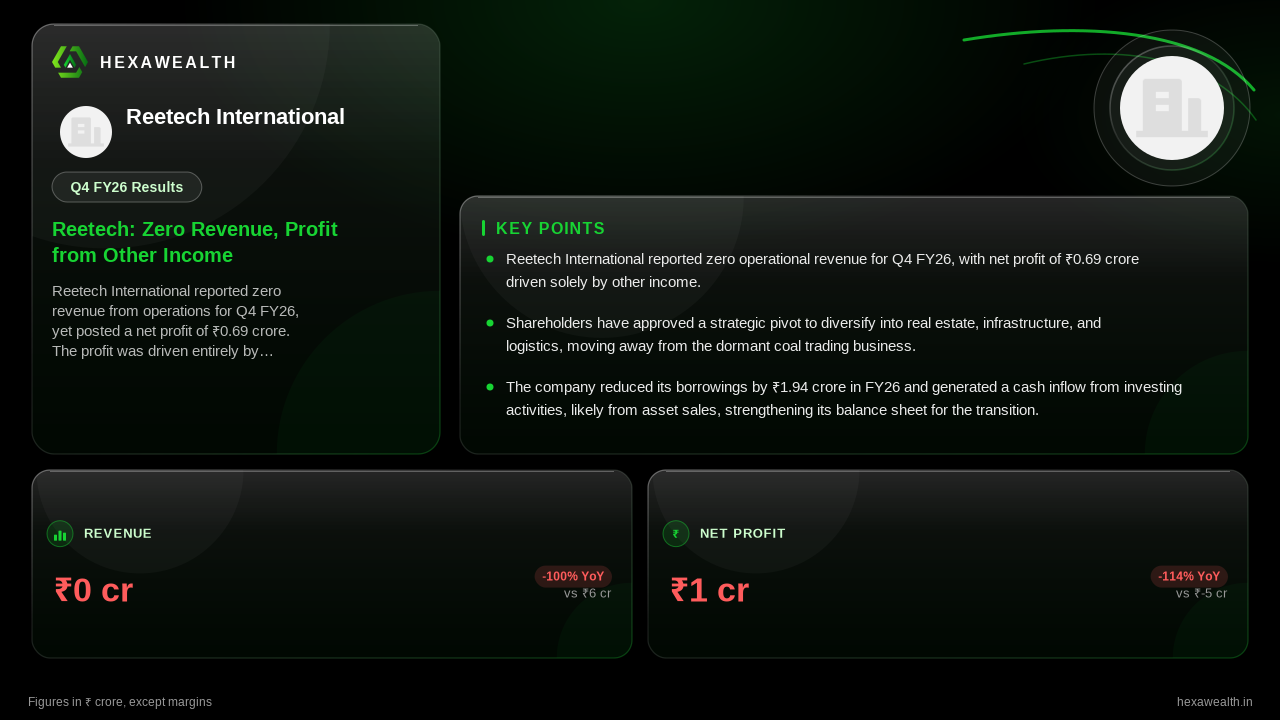
Reetech International reported zero revenue from operations for Q4 FY26, yet posted a net profit of ₹0.69 crore. The profit was driven entirely by other income, as the company seeks shareholder approval to diversify into real estate and infrastructure.
For a coal trading company, zero revenue from operations signals a business in transition. Reetech International's March quarter results confirm the pivot, with a profit arriving only from other income as it seeks a future in real estate.
The quarter saw revenue from operations at ₹0 crore, down from ₹6.11 crore a year ago. A ₹0.69 crore net profit was entirely supported by other income, which surged 169% year-on-year to ₹1.56 crore.
Revenue & profit
Revenue (₹ Cr)
Net Profit (₹ Cr)
- Revenue (₹ Cr), Q4 FY24: 19.89
- Revenue (₹ Cr), Q2 FY25: 5.82
- Revenue (₹ Cr), Q4 FY25: 6.11
- Revenue (₹ Cr), Q2 FY26: 0.00
- Revenue (₹ Cr), Q4 FY26: 0.00
- Net Profit (₹ Cr), Q4 FY24: 0.93
- Net Profit (₹ Cr), Q2 FY25: 0.71
- Net Profit (₹ Cr), Q4 FY25: -5.05
- Net Profit (₹ Cr), Q2 FY26: -0.28
- Net Profit (₹ Cr), Q4 FY26: 0.69
Revenue (₹ Cr)
- Revenue (₹ Cr), Q4 FY24: 19.89
- Revenue (₹ Cr), Q2 FY25: 5.82
- Revenue (₹ Cr), Q4 FY25: 6.11
- Revenue (₹ Cr), Q2 FY26: 0.00
- Revenue (₹ Cr), Q4 FY26: 0.00
Net Profit (₹ Cr)
- Net Profit (₹ Cr), Q4 FY24: 0.93
- Net Profit (₹ Cr), Q2 FY25: 0.71
- Net Profit (₹ Cr), Q4 FY25: -5.05
- Net Profit (₹ Cr), Q2 FY26: -0.28
- Net Profit (₹ Cr), Q4 FY26: 0.69
| Metric | CurrentQ4 FY26 | Same quarter LYQ4 FY25 |
|---|---|---|
| Revenue (₹ Cr) | 0.00YoY -100% | 6.11 |
| Net Profit (₹ Cr) | 0.69YoY +114% | -5.05 |
The Pivot from Coal to Real Estate
Management has represented that the company is exploring a new line of business in real estate, according to a report by ScanX. This follows a year where the core coal trading business generated no revenue.
Shareholders unanimously approved the strategic shift at the 18th Annual General Meeting in September 2026. The vote authorized an alteration to the company's object clause to include real estate, infrastructure, and logistics.
A Balance Sheet in Waiting
The annual cash flow statement shows a ₹3.21 crore inflow from investing activities, which data from Investing.com AU suggests included asset sales. Borrowings also fell by ₹1.94 crore during FY26, reducing the debt-to-equity ratio to 0.06.
Live Chart
· REETECH
(BSE)
ISIN: INE0MKO01015
This financial cleanup provides a lean balance sheet for the proposed diversification. However, the path forward relies on executing related-party transactions now approved by shareholders.
Key Points
- Reetech International reported zero operational revenue for Q4 FY26, with net profit of ₹0.69 crore driven solely by other income.
- Shareholders have approved a strategic pivot to diversify into real estate, infrastructure, and logistics, moving away from the dormant coal trading business.
- The company reduced its borrowings by ₹1.94 crore in FY26 and generated a cash inflow from investing activities, likely from asset sales, strengthening its balance sheet for the transition.
Hexa Perspective
This quarter closes the chapter on Reetech's coal trading operations, which have seen revenue decline at a 64% CAGR over five years. The reported profit is a accounting outcome, not an operating one.
The investment case now hinges entirely on the execution of its real estate foray. While shareholder approval provides a mandate, the company starts with no operational revenue, no track record in the new sector, and the inherent execution risks of a strategic pivot.
Also read
Want this applied to your portfolio?
Talk to a HexaWealth advisor, or sync your mutual fund data for insights tailored to your holdings.