Reetech International (REETECH) Q2 FY27's Profit Drops 67% as Costs Swallow Sales Return
The coal trader saw revenue return after two dormant quarters, but a surge in operating expenses left profit sharply lower and cash flow negative.
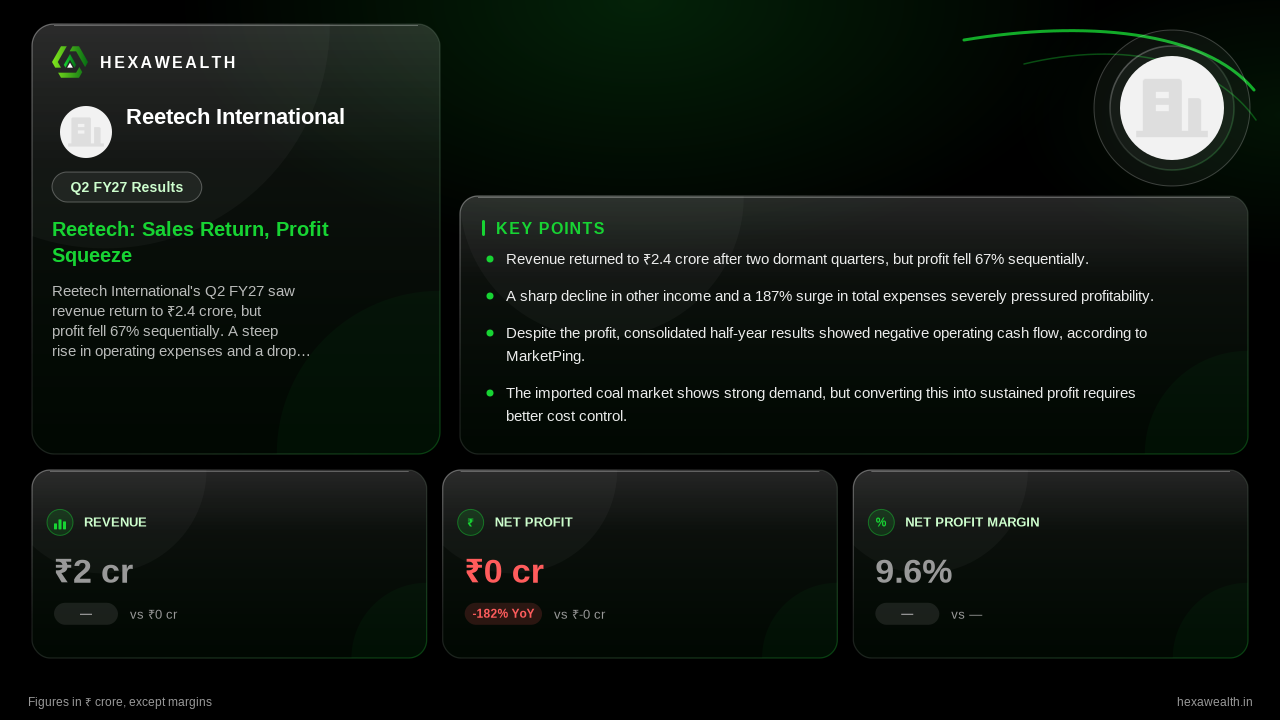
Reetech International's Q2 FY27 saw revenue return to ₹2.4 crore, but profit fell 67% sequentially. A steep rise in operating expenses and a drop in other income squeezed margins, while cash flow remained negative.
For Reetech International, a return to its core coal trading business was the story investors were waiting for. The September quarter delivered that, but the accompanying surge in costs left profitability sharply weaker.
The numbers show a quarter of contradictions. Revenue was ₹2.4 crore, a return after two quarters of zero sales. Yet profit fell 66.7% from the March quarter to ₹0.23 crore. Total expenses jumped 187% sequentially, far outpacing the modest revenue base.
Revenue & profit
Revenue (₹ Cr)
Profit (₹ Cr)
- Revenue (₹ Cr), Q2 FY25: 5.82
- Revenue (₹ Cr), Q4 FY25: 6.11
- Revenue (₹ Cr), Q2 FY26: 0.00
- Revenue (₹ Cr), Q4 FY26: 0.00
- Revenue (₹ Cr), Q2 FY27: 2.40
- Profit (₹ Cr), Q2 FY25: 0.71
- Profit (₹ Cr), Q4 FY25: -5.05
- Profit (₹ Cr), Q2 FY26: -0.28
- Profit (₹ Cr), Q4 FY26: 0.69
- Profit (₹ Cr), Q2 FY27: 0.23
Revenue (₹ Cr)
- Revenue (₹ Cr), Q2 FY25: 5.82
- Revenue (₹ Cr), Q4 FY25: 6.11
- Revenue (₹ Cr), Q2 FY26: 0.00
- Revenue (₹ Cr), Q4 FY26: 0.00
- Revenue (₹ Cr), Q2 FY27: 2.40
Profit (₹ Cr)
- Profit (₹ Cr), Q2 FY25: 0.71
- Profit (₹ Cr), Q4 FY25: -5.05
- Profit (₹ Cr), Q2 FY26: -0.28
- Profit (₹ Cr), Q4 FY26: 0.69
- Profit (₹ Cr), Q2 FY27: 0.23
Net Profit Margin (%)
- Net Profit Margin (%), Q2 FY25: 12.2
- Net Profit Margin (%), Q4 FY25: —
- Net Profit Margin (%), Q2 FY26: —
- Net Profit Margin (%), Q4 FY26: —
- Net Profit Margin (%), Q2 FY27: 9.6
| Metric | CurrentQ2 FY27 | Same quarter LYQ2 FY26 |
|---|---|---|
| Period | Sep 2026 | Sep 2025 |
| Revenue (₹ Cr) | 2.40 | 0.00 |
| Profit (₹ Cr) | 0.23YoY +182% | -0.28 |
| Net Profit Margin (%) | 9.6 | — |
Why the profit fell despite sales
The profit squeeze came from two sides. First, other income—a key profit driver in recent quarters—plunged 74% quarter-on-quarter to ₹0.41 crore, according to the analysis. Second, operating expenses ballooned as the company resumed trading activity.
MarketPing noted the consolidated half-year results showed a negative operating cash flow, a concern for a capital-intensive trading business. This suggests the revenue restart required significant working capital, pressuring cash generation even as the books showed a profit.
The coal market offers a tailwind
The broader environment is supportive. Argus Media reports India's thermal coal imports are set to rebound in October 2026, driven by record coal-fired power generation and strong post-monsoon industrial demand. This demand-supply gap creates opportunities for traders like Reetech.
Live Chart
· REETECH
(BSE)
ISIN: INE0MKO01015
However, the company's ability to capitalize depends on managing its cost structure. The current ratio of 2.43 indicates sufficient short-term liquidity, but the negative cash flow highlights an operational challenge.
Key Points
- Revenue returned to ₹2.4 crore after two dormant quarters, but profit fell 67% sequentially.
- A sharp decline in other income and a 187% surge in total expenses severely pressured profitability.
- Despite the profit, consolidated half-year results showed negative operating cash flow, according to MarketPing.
- The imported coal market shows strong demand, but converting this into sustained profit requires better cost control.
Hexa Perspective
This quarter confirms Reetech is back in the trading game, which is a fundamental positive. Yet the numbers reveal a business restarting from a near-standstill, incurring high initial costs for modest revenue.
The path forward hinges on operating leverage. If the company can scale revenue significantly in the robust import environment while keeping expense growth in check, margins should recover. Until cash flow turns positive, however, the operational turnaround remains incomplete.
Also read
Want this applied to your portfolio?
Talk to a HexaWealth advisor, or sync your mutual fund data for insights tailored to your holdings.