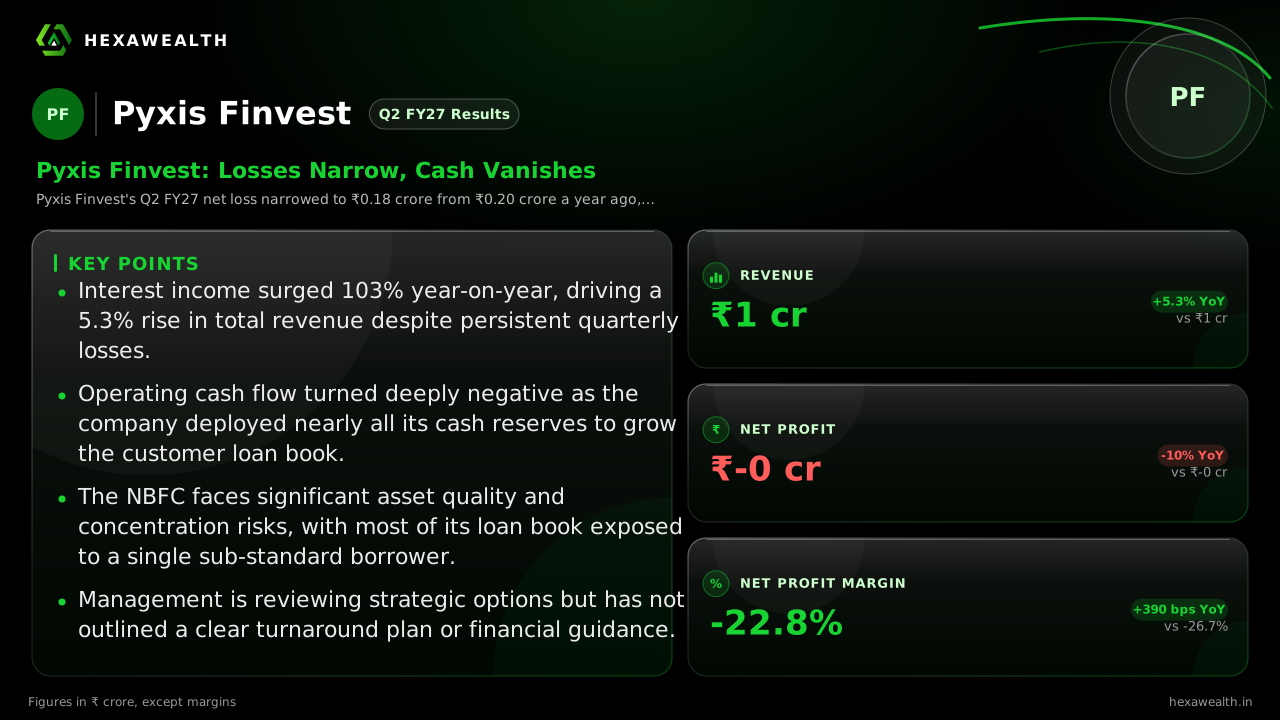
Pyxis Finvest (PYXISFIN) Q2 FY27's Losses Narrow as Loan Book Grows, But Cash Runs Dry
The NBFC's Q2 loss narrowed year-on-year as interest income surged, but a cash burn to fund loan growth raises sustainability questions.
Pyxis Finvest's Q2 FY27 net loss narrowed to ₹0.18 crore from ₹0.20 crore a year ago, aided by a 103% surge in interest income. However, operating cash flow turned deeply negative as cash reserves were deployed to expand the loan book.
For a small NBFC, the path to stability is a tightrope walk between growing the loan book and preserving cash. Pyxis Finvest's September quarter shows it leaning hard into the former, leaving the balance sheet stretched thin.
Revenue inched up 5.3% year-on-year to ₹0.79 crore, while the net loss narrowed slightly to ₹0.18 crore. The quarter-on-quarter picture is stark: a modest 1.3% revenue rise was paired with an 80% plunge in profit, though this follows an exceptionally high-loss March quarter.
Revenue & profit
Revenue (₹ Cr)
Profit (₹ Cr)
Net Profit Margin %
| Metric | CurrentQ2 FY27 | Same quarter LYQ2 FY26 |
|---|---|---|
| Period | Sep 2026 | Sep 2025 |
| Revenue (₹ Cr) | 0.79YoY +5.3% | 0.75 |
| Profit (₹ Cr) | -0.18YoY +10% | -0.20 |
| Net Profit Margin % | -22.8YoY +15% | -26.7 |
The interest income surge and its cash cost
The top-line growth was driven entirely by lending. According to a ScanX report, interest income more than doubled, jumping 103% year-on-year. This fueled a significant expansion of the customer loan book, which grew to ₹17.95 crore from ₹13.65 crore in March.
That growth came at a direct cost to liquidity. The same report notes cash reserves plummeted to just ₹0.50 lakh by September end, down from ₹3.90 crore in March. Operating cash flow was a negative ₹5.13 crore, almost entirely due to the outflow for new loans.
A balance sheet under strain
This aggressive, cash-funded lending amplifies existing risks. StockFin.ai analysis highlights the firm's vulnerability to asset quality shocks, given its lack of scale and diversification. A prior filing revealed a critical concentration risk, with over 70% of the loan book tied to a single sub-standard borrower.
Management, as noted in the annual report by StockFin.ai, is examining strategic alternatives but has provided no formal guidance. With zero institutional ownership and a promoter holding of 73.4%, the path forward relies heavily on internal decisions.
Key Points
- Interest income surged 103% year-on-year, driving a 5.3% rise in total revenue despite persistent quarterly losses.
- Operating cash flow turned deeply negative as the company deployed nearly all its cash reserves to grow the customer loan book.
- The NBFC faces significant asset quality and concentration risks, with most of its loan book exposed to a single sub-standard borrower.
- Management is reviewing strategic options but has not outlined a clear turnaround plan or financial guidance.
Hexa Perspective
The quarter presents a fundamental tension. Growing interest income is a positive, but funding it by exhausting cash is unsustainable for a loss-making entity with no external borrowing. The modestly improved net loss margin is a technical gain, not an operational one.
Investors are left weighing whether this loan book expansion will eventually yield profitable, high-quality assets or simply magnify eventual write-offs. With regulatory scrutiny on NBFCs intensifying, especially for Base Layer entities, the company's next move—be it restructuring, a strategic exit, or a capital infusion—will be more decisive than any single quarter's numbers.
Also read
Want this applied to your portfolio?
Talk to a HexaWealth advisor, or sync your mutual fund data for insights tailored to your holdings.