PMC Fincorp (PMCFIN) Q2 FY27 Profit Jumps 61% on Zero Borrowing Costs, But Revenue Slips
The small NBFC's Q2 profit soared as it eliminated all interest expenses, yet its core lending income dipped and revenue fell sequentially.
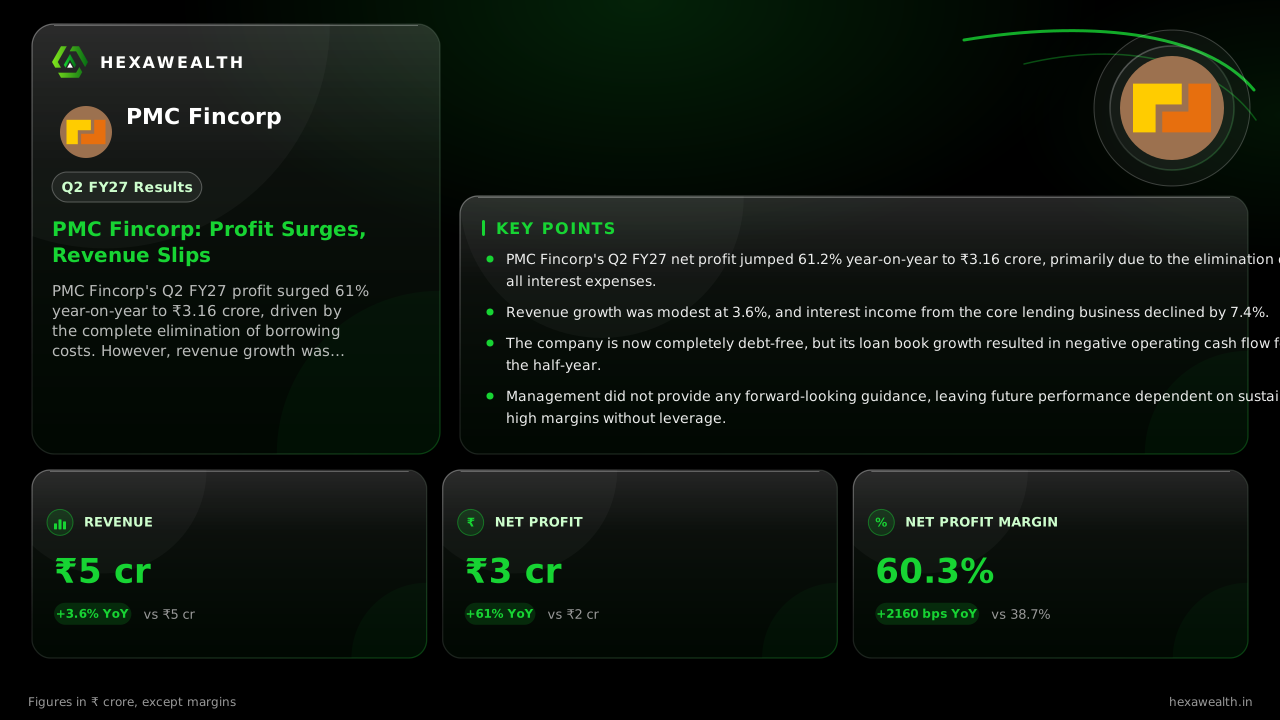
PMC Fincorp's Q2 FY27 profit surged 61% year-on-year to ₹3.16 crore, driven by the complete elimination of borrowing costs. However, revenue growth was muted at 3.6% and fell 18% from the previous quarter, highlighting a divergence between profitability and core business momentum.
For a small NBFC like PMC Fincorp, profitability often hinges on the cost of capital. This quarter, that equation shifted dramatically as the company reported a 61.2% yearly profit jump on barely any revenue growth, a story of costs collapsing faster than income.
The numbers show a clear split. Profit after tax reached ₹3.16 crore, up sharply from ₹1.96 crore a year ago. Revenue, however, inched up just 3.6% to ₹5.24 crore. Sequentially, both lines weakened, with revenue down 17.9% and profit down 26.9% from a strong Q1.
Revenue & profit
Revenue (₹ Cr)
Profit (₹ Cr)
- Revenue (₹ Cr), Q2 FY26: 5.06
- Revenue (₹ Cr), Q3 FY26: 4.83
- Revenue (₹ Cr), Q4 FY26: 3.78
- Revenue (₹ Cr), Q1 FY27: 6.38
- Revenue (₹ Cr), Q2 FY27: 5.24
- Profit (₹ Cr), Q2 FY26: 1.96
- Profit (₹ Cr), Q3 FY26: 0.52
- Profit (₹ Cr), Q4 FY26: -0.41
- Profit (₹ Cr), Q1 FY27: 4.32
- Profit (₹ Cr), Q2 FY27: 3.16
Revenue (₹ Cr)
- Revenue (₹ Cr), Q2 FY26: 5.06
- Revenue (₹ Cr), Q3 FY26: 4.83
- Revenue (₹ Cr), Q4 FY26: 3.78
- Revenue (₹ Cr), Q1 FY27: 6.38
- Revenue (₹ Cr), Q2 FY27: 5.24
Profit (₹ Cr)
- Profit (₹ Cr), Q2 FY26: 1.96
- Profit (₹ Cr), Q3 FY26: 0.52
- Profit (₹ Cr), Q4 FY26: -0.41
- Profit (₹ Cr), Q1 FY27: 4.32
- Profit (₹ Cr), Q2 FY27: 3.16
Net Profit Margin
- Net Profit Margin, Q2 FY26: 38.7%
- Net Profit Margin, Q3 FY26: 10.8%
- Net Profit Margin, Q4 FY26: -10.8%
- Net Profit Margin, Q1 FY27: 67.7%
- Net Profit Margin, Q2 FY27: 60.3%
| Metric | CurrentQ2 FY27 | PreviousQ1 FY27 | Same quarter LYQ2 FY26 |
|---|---|---|---|
| Revenue (₹ Cr) | 5.24YoY +3.6% | 6.38 | 5.06 |
| Profit (₹ Cr) | 3.16YoY +61% | 4.32 | 1.96 |
| Net Profit Margin | 60.3%YoY +56% | 67.7% | 38.7% |
Why Profit Soared Without Stronger Sales
The engine behind the profit surge was a near-total wipeout of finance costs. According to a scanx.trade report, the company recorded zero finance costs this quarter, down from ₹0.88 crore a year ago. This reflects its shift to a completely debt-free balance sheet.
Total expenses plunged 76.4% year-on-year. The move turbocharged the net profit margin to 60.3%, more than 21 percentage points higher than last September. Yet, this margin boost did not come from a thriving core business.
The Core Business Tells a Different Story
A scanx.trade analysis notes a key divergence: interest income actually fell 7.4% year-on-year. The profit jump was “not driven by core lending volume growth but rather by the elimination of finance costs and non-operating gains.”
Live Chart
· PMCFIN
(BSE)
ISIN: INE793G01035
The loan book did grow to ₹173.98 crore by September end, up from ₹161.07 crore in March. However, this deployment consumed cash, leading to a negative operating cash flow of ₹2.04 crore for the half-year, as reported by marketsmojo.com.
A Quiet Outlook in a Changing Landscape
Management provided no formal guidance on loan growth or margins with this filing, as noted by univest.in. The company operates in a regulatory environment that is easing for small, debt-free NBFCs like itself.
Recent RBI amendments create a path for 'Unregistered Type I NBFCs' with assets under ₹1,000 crore and no public funds. PMC Fincorp, with assets of ₹201.63 crore and zero borrowings, fits this profile, potentially simplifying its compliance burden going forward.
The stock showed a muted reaction, inching up 0.54% to ₹1.85 following the results announcement, per marketsmojo.com. With no institutional holdings and a trailing P/E of 20.6, the market is still weighing this unusual profit story against volatile quarterly performance.
Key Points
- PMC Fincorp's Q2 FY27 net profit jumped 61.2% year-on-year to ₹3.16 crore, primarily due to the elimination of all interest expenses.
- Revenue growth was modest at 3.6%, and interest income from the core lending business declined by 7.4%.
- The company is now completely debt-free, but its loan book growth resulted in negative operating cash flow for the half-year.
- Management did not provide any forward-looking guidance, leaving future performance dependent on sustaining high margins without leverage.
Hexa Perspective
The quarter presents a profitability paradox. Surging margins from zero borrowing costs are impressive, but they mask a softer core revenue trend. The sustainability of this model is now the central question.
Profitability is currently artificially high and may normalize if the company resumes borrowing to fund growth. Investors must watch if the growing loan book can soon generate enough interest income to replace this one-off cost benefit, or if margins will inevitably compress.
Also read
Want this applied to your portfolio?
Talk to a HexaWealth advisor, or sync your mutual fund data for insights tailored to your holdings.