Citichem India (CITICHEM) Q2 FY27 Profit Rises on Debt Paydown as Revenue Plunges
Citichem India's Q2 profit rose 34% sequentially despite a steep revenue drop, as a sharp cut in interest costs from debt repayment lifted margins.
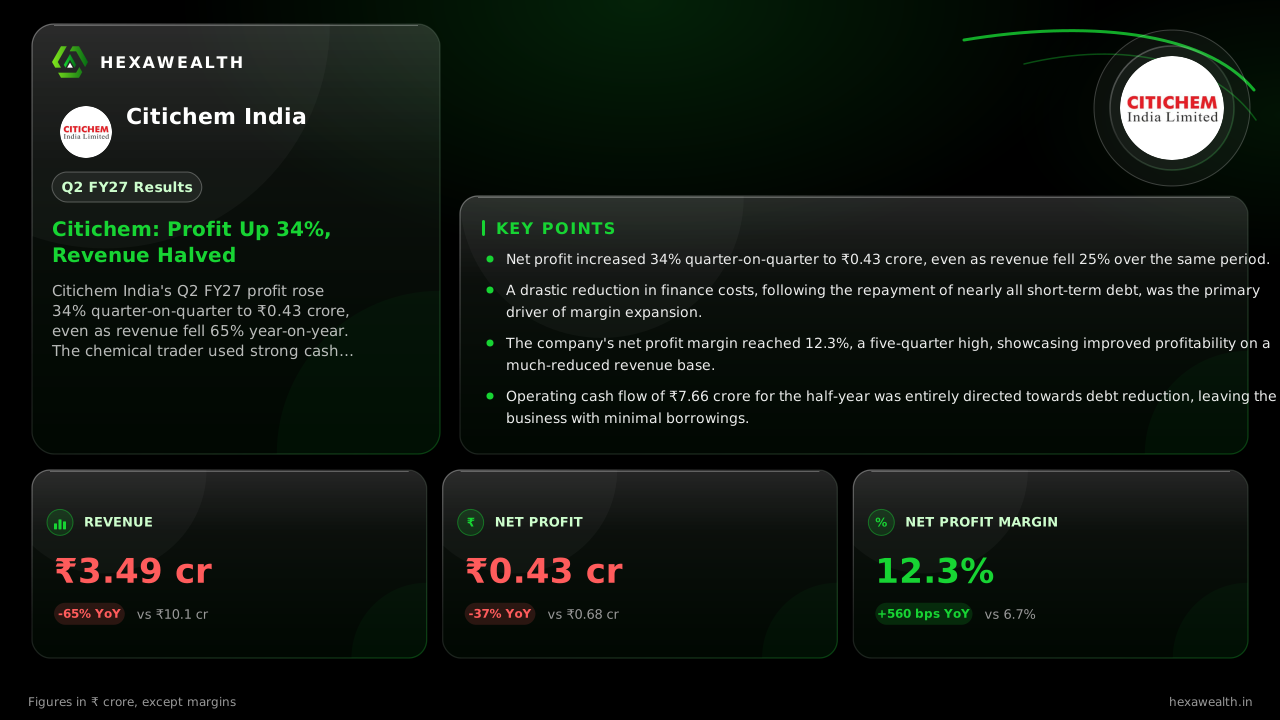
Citichem India's Q2 FY27 profit rose 34% quarter-on-quarter to ₹0.43 crore, even as revenue fell 65% year-on-year. The chemical trader used strong cash flow to repay debt, slashing interest costs and boosting its net profit margin to a five-quarter high.
For a chemical trader, a steep drop in sales is usually a direct hit to the bottom line. Citichem India’s September quarter turned that logic on its head, delivering a profit rise on a sharply smaller top line.
The numbers show a business in transition. Revenue fell 65% from a year ago and 25% from the prior quarter to ₹3.49 crore. Yet net profit rose 34% sequentially to ₹0.43 crore, pushing the net profit margin to 12.3%—its highest in five quarters.
Revenue & profit
Revenue (₹ Cr)
Profit (₹ Cr)
- Revenue (₹ Cr), Q2 FY25: 1.67
- Revenue (₹ Cr), Q4 FY25: 52.70
- Revenue (₹ Cr), Q2 FY26: 10.10
- Revenue (₹ Cr), Q4 FY26: 4.68
- Revenue (₹ Cr), Q2 FY27: 3.49
- Profit (₹ Cr), Q2 FY25: 0.12
- Profit (₹ Cr), Q4 FY25: 1.11
- Profit (₹ Cr), Q2 FY26: 0.68
- Profit (₹ Cr), Q4 FY26: 0.32
- Profit (₹ Cr), Q2 FY27: 0.43
Revenue (₹ Cr)
- Revenue (₹ Cr), Q2 FY25: 1.67
- Revenue (₹ Cr), Q4 FY25: 52.70
- Revenue (₹ Cr), Q2 FY26: 10.10
- Revenue (₹ Cr), Q4 FY26: 4.68
- Revenue (₹ Cr), Q2 FY27: 3.49
Profit (₹ Cr)
- Profit (₹ Cr), Q2 FY25: 0.12
- Profit (₹ Cr), Q4 FY25: 1.11
- Profit (₹ Cr), Q2 FY26: 0.68
- Profit (₹ Cr), Q4 FY26: 0.32
- Profit (₹ Cr), Q2 FY27: 0.43
Net Profit Margin (%)
- Net Profit Margin (%), Q2 FY25: 7.2
- Net Profit Margin (%), Q4 FY25: 2.1
- Net Profit Margin (%), Q2 FY26: 6.7
- Net Profit Margin (%), Q4 FY26: 6.8
- Net Profit Margin (%), Q2 FY27: 12.3
| Metric | CurrentQ2 FY27 | Same quarter LYQ2 FY26 |
|---|---|---|
| Revenue (₹ Cr) | 3.49YoY -65% | 10.10 |
| Profit (₹ Cr) | 0.43YoY -37% | 0.68 |
| Net Profit Margin (%) | 12.3YoY +84% | 6.7 |
The cost cut that saved the quarter
Profitability improved because costs fell faster than revenue. Total expenses dropped 70% year-on-year, according to the analysis. A key driver was the near-elimination of finance costs, which plunged 89% to just ₹0.03 crore.
This stemmed from a strategic clean-up. Reports from MarketPing and mCapital.in note the company used ₹7.66 crore in operating cash flow to repay short-term borrowings, cutting debt from ₹7.72 crore in March to nearly zero by September. The interest saving directly padded the bottom line.
A shrinking business with a cleaner balance sheet
The trade-off is a dramatically smaller scale. The revenue decline suggests a major slowdown in trading activity. Other income, which was ₹0.67 crore a year ago, also collapsed to ₹0.01 crore, removing another buffer.
Live Chart
· CITICHEM
(BSE)
ISIN: INE0A8401016
Management did not provide specific guidance in the filings reviewed. The outlook, therefore, hinges on whether this quarter represents a controlled wind-down or a temporary lull. The debt repayment strengthens the balance sheet but does not signal a return to growth.
Key Points
- Net profit increased 34% quarter-on-quarter to ₹0.43 crore, even as revenue fell 25% over the same period.
- A drastic reduction in finance costs, following the repayment of nearly all short-term debt, was the primary driver of margin expansion.
- The company's net profit margin reached 12.3%, a five-quarter high, showcasing improved profitability on a much-reduced revenue base.
- Operating cash flow of ₹7.66 crore for the half-year was entirely directed towards debt reduction, leaving the business with minimal borrowings.
Hexa Perspective
This quarter presents a paradox of improving health in a shrinking operation. The surge in profitability is almost entirely attributable to a one-time financial engineering feat—using collected receivables to extinguish debt. The core trading business appears to have contracted severely.
The path forward is unclear without management commentary. Investors are left weighing a stronger, debt-free balance sheet against a revenue stream that has fallen to a fraction of its former size. The valuation, at a P/E of 9.5 against an industry average of 36.4, reflects deep skepticism about the sustainability or return of growth.
Also read
Want this applied to your portfolio?
Talk to a HexaWealth advisor, or sync your mutual fund data for insights tailored to your holdings.