NAPS Global (NAPSGLOBAL) Q2 FY27 Profit Doubles on Subsidiary Boost, But Cash Evaporates
NAPS Global India's Q2 FY27 profit jumped 100% year-on-year, but a severe operating cash outflow drained its cash reserves to near zero.
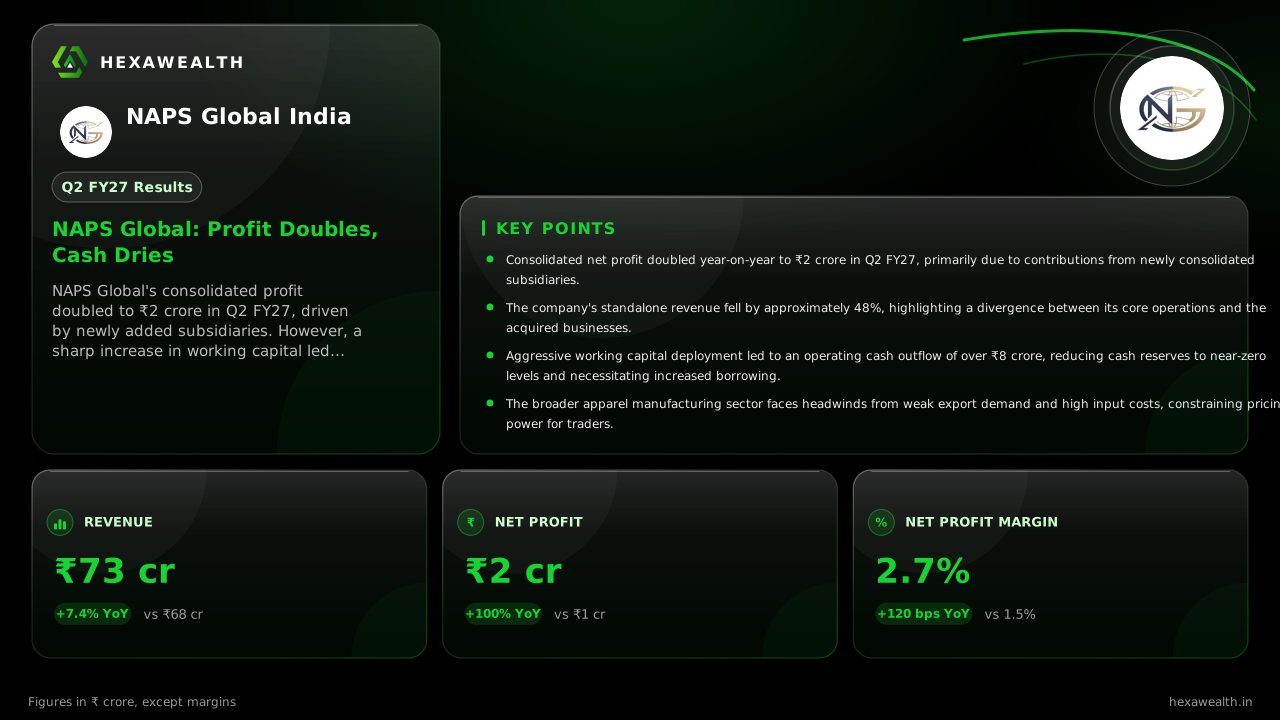
NAPS Global's consolidated profit doubled to ₹2 crore in Q2 FY27, driven by newly added subsidiaries. However, a sharp increase in working capital led to an operating cash outflow of over ₹8 crore, leaving minimal cash on hand.
For a textile trading firm like NAPS Global, growth is a double-edged sword. It requires more working capital to hold inventory and extend credit, which can quickly consume cash even when profits rise. The September quarter delivered exactly that tension, with consolidated profit doubling but cash reserves nearly evaporating.
The numbers show a clear recovery from a weak prior quarter. Revenue rose 7.4% year-on-year to ₹73 crore, while net profit jumped 100% to ₹2 crore. Sequentially, the improvement was sharper, with revenue up 32.7% and the net profit margin expanding 270 basis points.
Revenue & profit
Revenue (₹ Cr)
Profit (₹ Cr)
Net Profit Margin (%)
| Metric | CurrentQ2 FY27 | Same quarter LYQ2 FY26 |
|---|---|---|
| Revenue (₹ Cr) | 73.0YoY +7.4% | 68.0 |
| Profit (₹ Cr) | 2.0YoY +100% | 1.0 |
| Net Profit Margin (%) | 2.7YoY +80% | 1.5 |
The Subsidiary-Driven Turnaround
The profit surge was not from its core standalone business, which saw revenue halve. According to reports from Multibagg.ai and Scanx.trade, the consolidated strength came from newly added subsidiaries—Mercaze, Purple Impex, and Naps Global HK. This lifted group revenue and profit, masking a sharp 48% decline in standalone sales.
A Costly Growth Spurt
This growth came at a high cash cost. A report by Multibagg.ai details an operating cash outflow of ₹8.16 crore for the half-year. Money was tied up in rising trade receivables, inventories, and short-term loans to related parties. To fund this, the company took on over ₹5 crore in new borrowings.
By the end of September, cash and bank balances had dwindled to just ₹16.75 lakh. With minimal fixed assets, the company's model depends entirely on supplier credit and external funding to finance its trading cycle.
An Industry Under Pressure
The backdrop remains challenging. Data cited by The Economic Times shows India's apparel production contracted 5.6% in the first half of FY27, weighed down by weak US demand and high input costs. For a price-taking trader like NAPS Global, this limits its ability to pass on cost increases and protect its thin margins.
Management, as noted in an analysis by StockFin.ai, provided no forward guidance or commentary on strategic initiatives in its latest filings. The focus was solely on reviewing the half-year results.
Key Points
- Consolidated net profit doubled year-on-year to ₹2 crore in Q2 FY27, primarily due to contributions from newly consolidated subsidiaries.
- The company's standalone revenue fell by approximately 48%, highlighting a divergence between its core operations and the acquired businesses.
- Aggressive working capital deployment led to an operating cash outflow of over ₹8 crore, reducing cash reserves to near-zero levels and necessitating increased borrowing.
- The broader apparel manufacturing sector faces headwinds from weak export demand and high input costs, constraining pricing power for traders.
Hexa Perspective
The quarter reveals a business caught between two stories. The consolidated profit jump offers a superficial recovery, but the severe cash burn exposes the fundamental strain of its capital-intensive trading model. The sustainability of this profit hinges on the subsidiaries' performance and the company's ability to manage working capital more efficiently.
With minimal cash and rising debt, the balance sheet is now funding growth. In a sector where margins are perpetually thin and dictated by global prices, that leverage adds risk. Investors are left weighing the promise of a larger consolidated entity against the reality of a cash-strapped core operation.
Also read
Want this applied to your portfolio?
Talk to a HexaWealth advisor, or sync your mutual fund data for insights tailored to your holdings.