IFCI Q2 FY27's Q2 Profit Surge Masks a Still-Stressed Core Loan Book
A 436% quarterly profit jump was driven by subsidiaries and cost cuts, but the standalone business shows a 99% NPA ratio and negative capital adequacy.
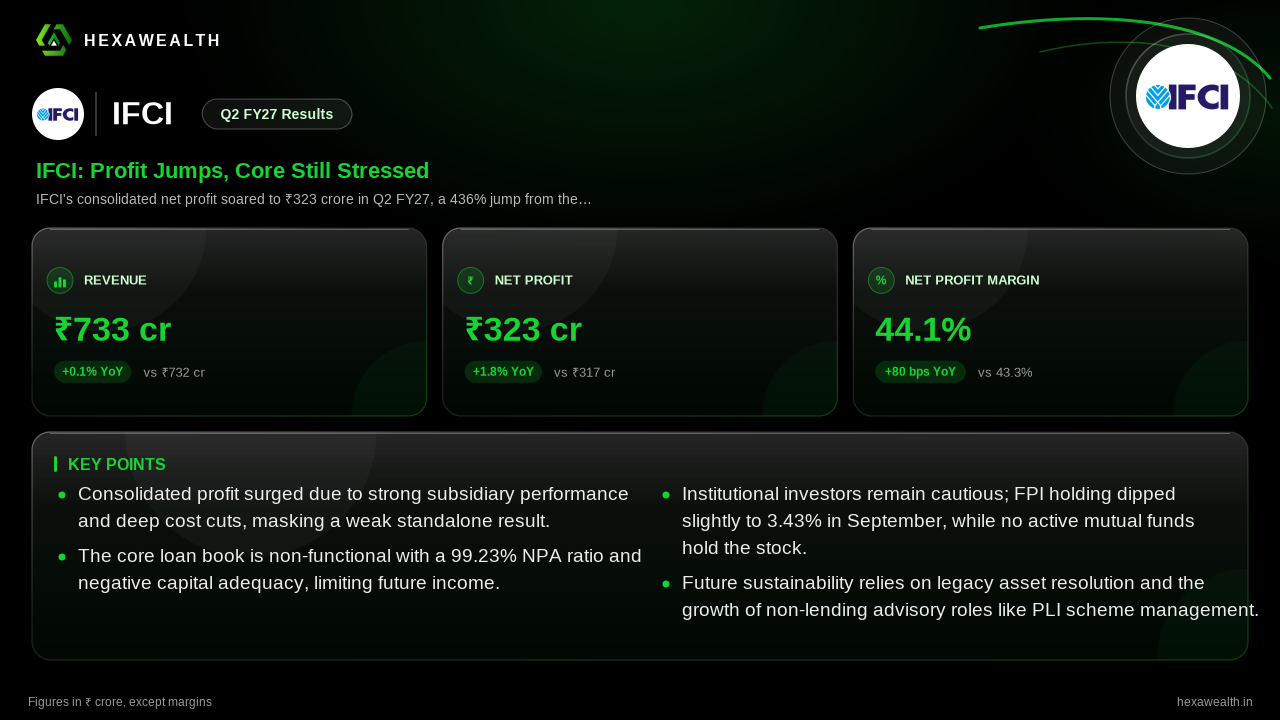
IFCI's consolidated net profit soared to ₹323 crore in Q2 FY27, a 436% jump from the previous quarter. This surge, however, contrasts sharply with a standalone NPA ratio of 99.23% and a capital adequacy deep in negative territory.
For IFCI, the story is two different companies in one set of results. The consolidated picture shows a dramatic recovery, while the standalone entity reveals the unresolved stress in its legacy loan book. The September quarter delivered a headline profit surge, but the underlying financial health remains precarious.
Revenue & profit
Revenue (₹ Cr)
Profit (₹ Cr)
- Revenue (₹ Cr), Q4 FY26: 470.4
- Revenue (₹ Cr), Q1 FY26: 407.2
- Revenue (₹ Cr), Q2 FY26: 732.3
- Revenue (₹ Cr), Q1 FY27: 327.1
- Revenue (₹ Cr), Q2 FY27: 733.0
- Profit (₹ Cr), Q4 FY26: 34.1
- Profit (₹ Cr), Q1 FY26: 39.9
- Profit (₹ Cr), Q2 FY26: 317.4
- Profit (₹ Cr), Q1 FY27: 60.3
- Profit (₹ Cr), Q2 FY27: 323.0
Revenue (₹ Cr)
- Revenue (₹ Cr), Q4 FY26: 470.4
- Revenue (₹ Cr), Q1 FY26: 407.2
- Revenue (₹ Cr), Q2 FY26: 732.3
- Revenue (₹ Cr), Q1 FY27: 327.1
- Revenue (₹ Cr), Q2 FY27: 733.0
Profit (₹ Cr)
- Profit (₹ Cr), Q4 FY26: 34.1
- Profit (₹ Cr), Q1 FY26: 39.9
- Profit (₹ Cr), Q2 FY26: 317.4
- Profit (₹ Cr), Q1 FY27: 60.3
- Profit (₹ Cr), Q2 FY27: 323.0
Net Profit Margin
- Net Profit Margin, Q4 FY26: 7.2%
- Net Profit Margin, Q1 FY26: 9.8%
- Net Profit Margin, Q2 FY26: 43.3%
- Net Profit Margin, Q1 FY27: 18.4%
- Net Profit Margin, Q2 FY27: 44.1%
| Metric | CurrentQ2 FY27 | PreviousQ1 FY27 | Same quarter LYQ2 FY26 |
|---|---|---|---|
| Revenue (₹ Cr) | 733.0YoY +0.1% | 327.1 | 732.3 |
| Profit (₹ Cr) | 323.0YoY +1.8% | 60.3 | 317.4 |
| Net Profit Margin | 44.1%YoY +1.8% | 18.4% | 43.3% |
Consolidated profit leapt 436% from a weak June quarter, while revenue returned to its year-ago level. The net profit margin expanded sharply to 44.1%, but this strength is not what it seems.
The subsidiary shield
Nearly all the profit came from outside the parent company. Standalone net profit was just ₹12.2 crore, down 24% year-on-year, according to a MarketMojo alert. The massive gap of over ₹311 crore is profit from subsidiaries, primarily Stock Holding Corporation of India.
This reliance explains the volatility. Other income, often from treasury marks, collapsed 95% year-on-year to just ₹1.1 crore. The profit jump was instead powered by a 43% year-on-year drop in total expenses, with employee and finance costs both falling.
Live Chart
· IFCI
(BSE)
ISIN: INE039A01010
A core book in runoff
IFCI's core lending business is effectively frozen. The company stated it has not taken fresh loan exposure, as reported by Blacklitt. This has led to a shocking gross NPA ratio of 99.23%, up from 95.79% in March.
With nearly the entire loan book impaired, future interest income is severely limited. The capital adequacy ratio (CRAR) stands at -18.42%, far below the 15% regulatory minimum flagged by auditors.
The outlook hinges on resolution
Management's focus, per an Economic Times interview, is on strategic direction rather than capital infusion. The new revenue stream as Project Management Advisor for government PLI schemes provides visibility but is not yet a major profit driver.
The path forward depends on resolving legacy assets. Without a capital infusion or a strategic merger, the standalone entity's negative net worth remains a structural overhang on the group.
Key Points
- Consolidated profit surged due to strong subsidiary performance and deep cost cuts, masking a weak standalone result.
- The core loan book is non-functional with a 99.23% NPA ratio and negative capital adequacy, limiting future income.
- Institutional investors remain cautious; FPI holding dipped slightly to 3.43% in September, while no active mutual funds hold the stock.
- Future sustainability relies on legacy asset resolution and the growth of non-lending advisory roles like PLI scheme management.
Hexa Perspective
The quarter highlights IFCI's fundamental tension: a profitable group built on subsidiaries sits atop a hollowed-out core. The 436% profit jump is a rebound from an abnormally low base, not a sign of renewed lending vigor.
Investors are weighing the value of the subsidiaries against the capital hole in the parent. Until the CRAR breach is addressed, either by government action or internal accruals, the stock's premium valuation—trading at 71 times earnings—rests on speculative hope rather than the core business's earnings power. The story remains one of asset resolution, not growth.
Also read
Want this applied to your portfolio?
Talk to a HexaWealth advisor, or sync your mutual fund data for insights tailored to your holdings.