Hind Commerce (HCLTD) Q2 FY27 Profit Slips to Loss Despite Revenue Tripling
The cotton yarn exporter's sales jumped 193% year-on-year, but a collapse in other income and soaring costs pushed it into a net loss.
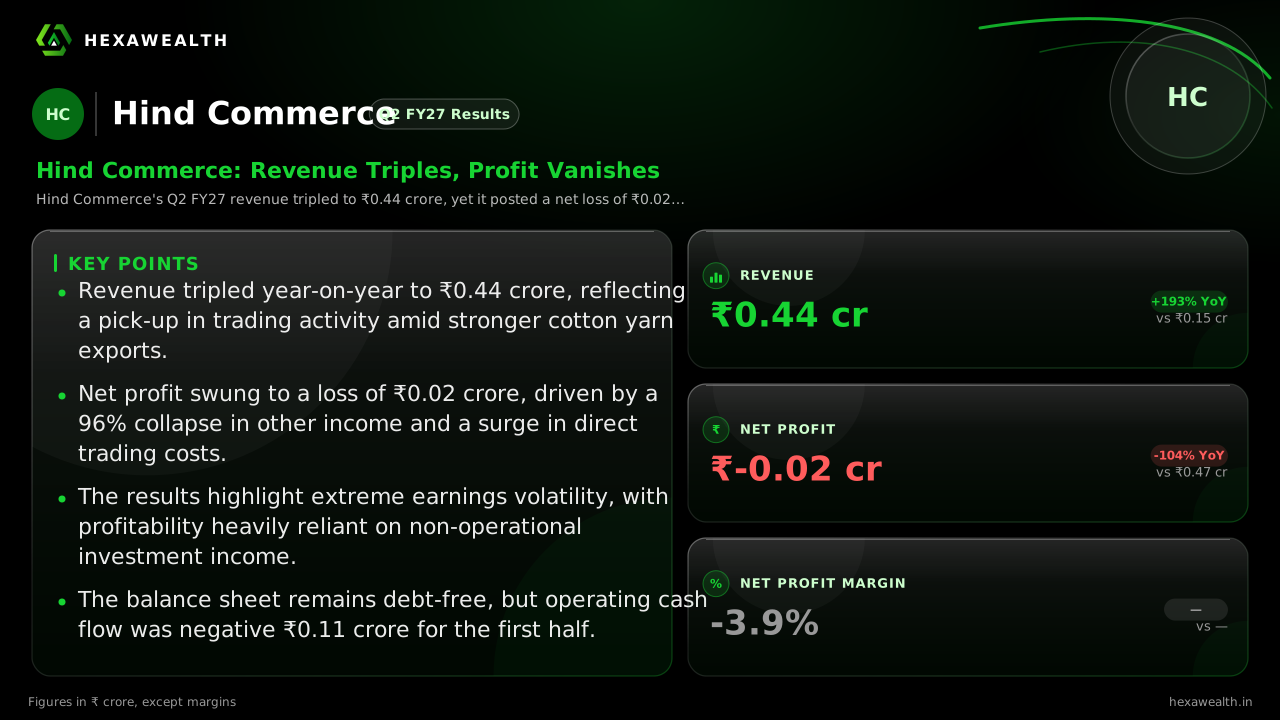
Hind Commerce's Q2 FY27 revenue tripled to ₹0.44 crore, yet it posted a net loss of ₹0.02 crore. The swing was driven by a 96% drop in other income and a massive rise in total expenses, highlighting volatility in its trading model.
For a small cotton yarn trader like Hind Commerce, quarterly results often hinge on a handful of deals and the timing of investment income. The September quarter delivered a stark split: operating revenue tripled, but the bottom line vanished into a loss.
The numbers tell a story of two opposing forces. Revenue from operations surged 193% year-on-year to ₹0.44 crore. Sequentially, it more than doubled from ₹0.19 crore in Q1. Yet, the company reported a net loss of ₹0.02 crore, a sharp reversal from a profit of ₹0.47 crore a year ago and ₹0.28 crore last quarter.
Revenue & profit
Revenue (₹ Cr)
Profit (₹ Cr)
- Revenue (₹ Cr), Q2 FY26: 0.15
- Revenue (₹ Cr), Q3 FY26: 0.33
- Revenue (₹ Cr), Q4 FY26: 0.02
- Revenue (₹ Cr), Q1 FY27: 0.19
- Revenue (₹ Cr), Q2 FY27: 0.44
- Profit (₹ Cr), Q2 FY26: 0.47
- Profit (₹ Cr), Q3 FY26: 0.21
- Profit (₹ Cr), Q4 FY26: -0.27
- Profit (₹ Cr), Q1 FY27: 0.28
- Profit (₹ Cr), Q2 FY27: -0.02
Revenue (₹ Cr)
- Revenue (₹ Cr), Q2 FY26: 0.15
- Revenue (₹ Cr), Q3 FY26: 0.33
- Revenue (₹ Cr), Q4 FY26: 0.02
- Revenue (₹ Cr), Q1 FY27: 0.19
- Revenue (₹ Cr), Q2 FY27: 0.44
Profit (₹ Cr)
- Profit (₹ Cr), Q2 FY26: 0.47
- Profit (₹ Cr), Q3 FY26: 0.21
- Profit (₹ Cr), Q4 FY26: -0.27
- Profit (₹ Cr), Q1 FY27: 0.28
- Profit (₹ Cr), Q2 FY27: -0.02
| Metric | CurrentQ2 FY27 | PreviousQ1 FY27 | Same quarter LYQ2 FY26 |
|---|---|---|---|
| Revenue (₹ Cr) | 0.44YoY +193% | 0.19 | 0.15 |
| Profit (₹ Cr) | -0.02YoY -104% | 0.28 | 0.47 |
The Collapse in Other Income
The primary culprit for the profit loss was a near-total evaporation of other income. It fell 96% year-on-year to just ₹0.02 crore, down from ₹0.47 crore in Q2 FY26, as reported by MarketPing. This line, which likely includes returns from investments, had provided a substantial cushion in past quarters, masking the thin margins of the core trading business. Its absence this quarter laid the operational reality bare.
Simultaneously, total expenses exploded by over 1,400% year-on-year to ₹0.47 crore. MarketPing's breakdown shows ₹0.42 crore was cost of materials consumed, a direct pass-through for a trader, compared to zero in the year-ago quarter. This confirms the revenue jump was driven by executing trades, not one-off gains.
A Volatile Core Business
This quarter underscores the company's dependence on sporadic trading deals and non-operational income. The revenue surge aligns with a broader sector trend; government data cited by MarketPing shows India's cotton yarn exports grew nearly 21% in September 2026. For a micro-cap trader, capturing even a sliver of this demand can cause wild revenue swings.
Live Chart
· HCLTD
(BSE)
ISIN: INE691J01019
However, the model offers little operating leverage. The gross margin on traded goods is inherently thin, and without the buffer of other income, even a tripling of sales can result in a loss. The half-year picture shows the strain, with profit before tax down 65% year-on-year, according to an mcapital.in analysis.
Key Points
- Revenue tripled year-on-year to ₹0.44 crore, reflecting a pick-up in trading activity amid stronger cotton yarn exports.
- Net profit swung to a loss of ₹0.02 crore, driven by a 96% collapse in other income and a surge in direct trading costs.
- The results highlight extreme earnings volatility, with profitability heavily reliant on non-operational investment income.
- The balance sheet remains debt-free, but operating cash flow was negative ₹0.11 crore for the first half.
Hexa Perspective
The quarter reveals a business whose earnings power is decoupled from its trading operations. The core activity generates revenue but not consistent profit, which has historically come from other income. Investors are effectively weighing the value of a debt-free investment portfolio against an erratic, low-margin trading arm.
The path to sustainable earnings is narrow. It would require the trading business to achieve both scale and pricing power—a tall order in a commoditized export market—or for other income to return reliably. Until one of those conditions is met, quarterly results will likely continue their volatile pattern, swinging between profit and loss on the strength of a few transactions.
Also read
Want this applied to your portfolio?
Talk to a HexaWealth advisor, or sync your mutual fund data for insights tailored to your holdings.