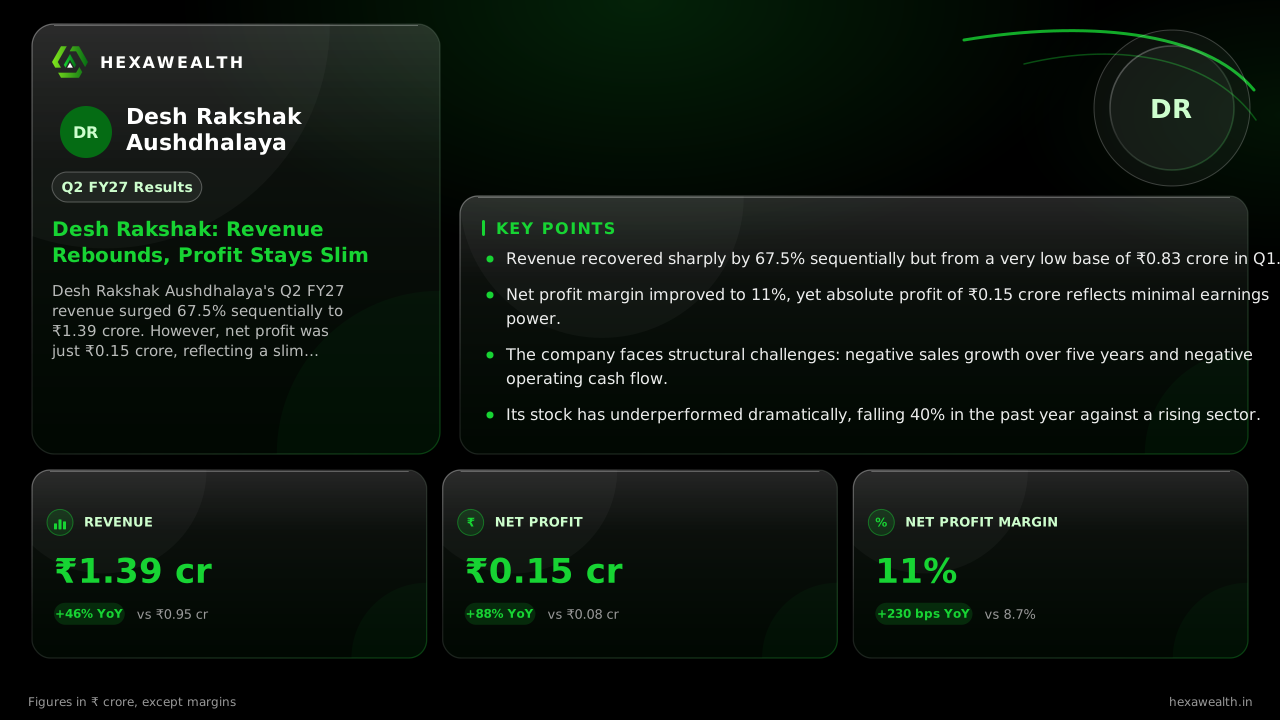
Desh Rakshak (DESHRAK) Q2 FY27's Q2 Revenue Jumps 67%, But Profit Remains Thin
The 125-year-old Ayurvedic firm saw a sharp sequential sales recovery, yet its net profit margin of 11% underscores persistent profitability challenges.
Desh Rakshak Aushdhalaya's Q2 FY27 revenue surged 67.5% sequentially to ₹1.39 crore. However, net profit was just ₹0.15 crore, reflecting a slim 11% margin that highlights the company's struggle to convert top-line growth into meaningful earnings.
For a heritage Ayurvedic firm like Desh Rakshak, the story is about translating a century-old brand into consistent, profitable growth. The September quarter delivered a sharp rebound in sales, but the bottom line remains stubbornly thin, revealing the scale challenge at its core.
Revenue for Q2 FY27 stood at ₹1.39 crore, a 67.5% jump from the previous quarter and 46.3% higher than a year ago. Net profit reached ₹0.15 crore, doubling from last year but still representing a modest 11% net profit margin. The sequential improvement came from a recovery after a weak Q1, but the absolute numbers remain small.
Revenue & profit
Revenue (₹ Cr)
Profit (₹ Cr)
- Revenue (₹ Cr), Q2 FY26: 0.95
- Revenue (₹ Cr), Q3 FY26: 1.40
- Revenue (₹ Cr), Q4 FY26: 3.45
- Revenue (₹ Cr), Q1 FY27: 0.83
- Revenue (₹ Cr), Q2 FY27: 1.39
- Profit (₹ Cr), Q2 FY26: 0.08
- Profit (₹ Cr), Q3 FY26: 0.09
- Profit (₹ Cr), Q4 FY26: 0.29
- Profit (₹ Cr), Q1 FY27: 0.08
- Profit (₹ Cr), Q2 FY27: 0.15
Revenue (₹ Cr)
- Revenue (₹ Cr), Q2 FY26: 0.95
- Revenue (₹ Cr), Q3 FY26: 1.40
- Revenue (₹ Cr), Q4 FY26: 3.45
- Revenue (₹ Cr), Q1 FY27: 0.83
- Revenue (₹ Cr), Q2 FY27: 1.39
Profit (₹ Cr)
- Profit (₹ Cr), Q2 FY26: 0.08
- Profit (₹ Cr), Q3 FY26: 0.09
- Profit (₹ Cr), Q4 FY26: 0.29
- Profit (₹ Cr), Q1 FY27: 0.08
- Profit (₹ Cr), Q2 FY27: 0.15
Net Profit Margin
- Net Profit Margin, Q2 FY26: 8.7%
- Net Profit Margin, Q3 FY26: 6.7%
- Net Profit Margin, Q4 FY26: 8.5%
- Net Profit Margin, Q1 FY27: 9.7%
- Net Profit Margin, Q2 FY27: 11.0%
| Metric | CurrentQ2 FY27 | PreviousQ1 FY27 | Same quarter LYQ2 FY26 |
|---|---|---|---|
| Revenue (₹ Cr) | 1.39YoY +46% | 0.83 | 0.95 |
| Profit (₹ Cr) | 0.15YoY +87% | 0.08 | 0.08 |
| Net Profit Margin | 11.0%YoY +26% | 9.7% | 8.7% |
Why the profit didn't keep pace
A MarketsMojo report notes the company's operating margin contracted sequentially to 23%. High fixed costs, including employee expenses at 19% of revenue and significant depreciation, consumed much of the operating profit. Interest costs fell 22% year-on-year, providing some relief, but the core issue is a lack of operating leverage at this revenue scale.
The margin squeeze is structural. Research from MarketsMojo points to a five-year sales CAGR of -0.42%, meaning the company has shrunk while the broader Ayurvedic market grew at double-digit rates. It competes with giants like Dabur and Patanjali without their pricing power or distribution reach.
The cash flow conundrum
Financial sustainability is a growing question. The company's cash flow from operations was negative ₹1 crore in FY26, according to MarketsMojo. While it raised ₹2.77 crore for working capital via a preferential issue, a high proportion of current assets suggests inefficient cash conversion. This cash burn alongside thin profits raises flags about long-term self-sufficiency without external funding.
Live Chart
· DESHRAK
(BSE)
ISIN: INE971E01016
Key Points
- Revenue recovered sharply by 67.5% sequentially but from a very low base of ₹0.83 crore in Q1.
- Net profit margin improved to 11%, yet absolute profit of ₹0.15 crore reflects minimal earnings power.
- The company faces structural challenges: negative sales growth over five years and negative operating cash flow.
- Its stock has underperformed dramatically, falling 40% in the past year against a rising sector.
Hexa Perspective
The quarter shows a business caught between its legacy and market realities. The revenue rebound is a positive step, but it merely offsets prior weakness rather than signaling a new growth phase. For the improved margin to hold, Desh Rakshak needs sustained quarterly revenue well above ₹1.5 crore—a level it has rarely achieved. The valuation at a 58% discount to the industry P/E reflects these deep-seated challenges more than a hidden opportunity. Investors are weighing whether a 125-year-old brand can find a path to relevance in a crowded, modern market.
Also read
Want this applied to your portfolio?
Talk to a HexaWealth advisor, or sync your mutual fund data for insights tailored to your holdings.