Dar Credit & Capital (DCCL) Q2 FY27's Revenue Doubles, But Profit Margin Squeeze Persists
The lender's Q2 revenue more than doubled year-on-year, but a rising cost of funds kept net profit margins 500 bps below last year's level.
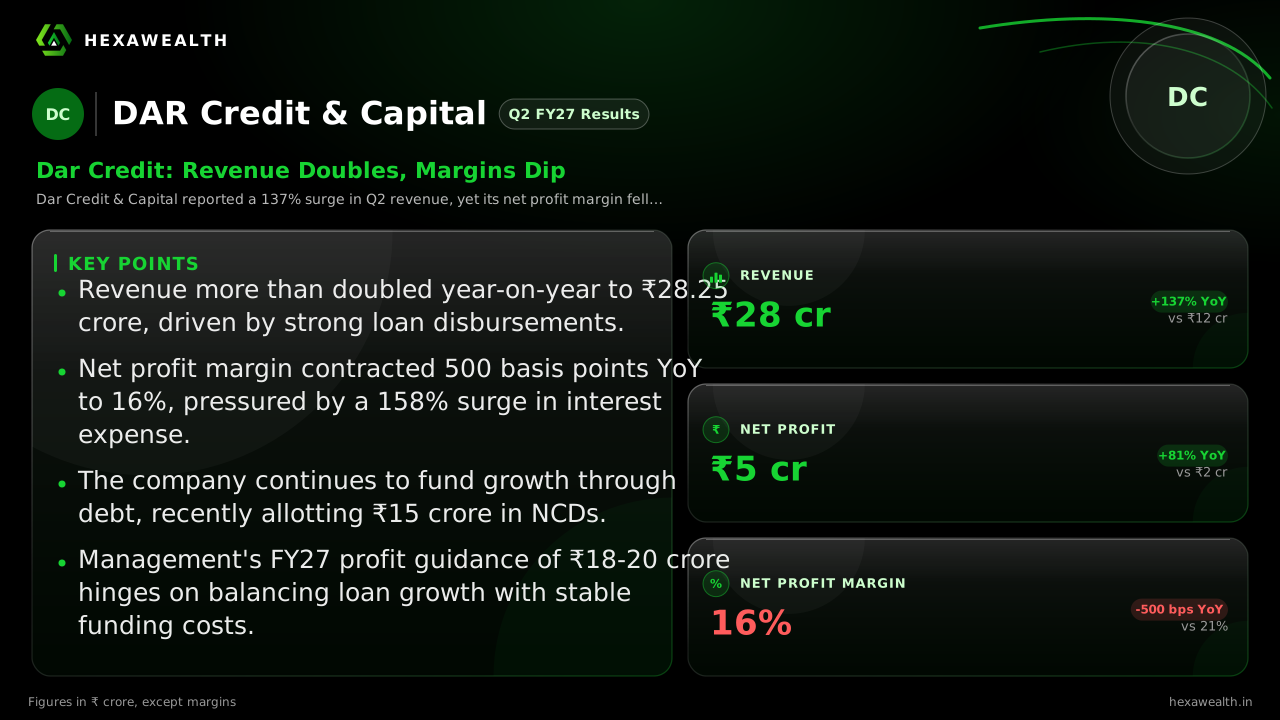
Dar Credit & Capital reported a 137% surge in Q2 revenue, yet its net profit margin fell sharply. The gap highlights the pressure from rising borrowing costs as the company funds rapid loan growth.
For a lender like Dar Credit & Capital, the story is told in the gap between what it earns on loans and what it pays for funds. This quarter, that spread narrowed even as business boomed. Revenue more than doubled year-on-year, yet profitability weakened significantly, revealing the cost of rapid expansion.
The numbers show a business in overdrive. Revenue jumped to ₹28.25 crore, up 137% from a year ago and 113% from the previous quarter. Profit followed, rising 81% YoY to ₹4.53 crore.
Revenue & profit
Revenue (₹ Cr)
Profit (₹ Cr)
- Revenue (₹ Cr), Q2 FY26: 11.90
- Revenue (₹ Cr), Q3 FY26: 12.56
- Revenue (₹ Cr), Q4 FY26: 14.49
- Revenue (₹ Cr), Q1 FY27: 13.28
- Revenue (₹ Cr), Q2 FY27: 28.25
- Profit (₹ Cr), Q2 FY26: 2.50
- Profit (₹ Cr), Q3 FY26: 2.52
- Profit (₹ Cr), Q4 FY26: 3.07
- Profit (₹ Cr), Q1 FY27: 2.05
- Profit (₹ Cr), Q2 FY27: 4.53
Revenue (₹ Cr)
- Revenue (₹ Cr), Q2 FY26: 11.90
- Revenue (₹ Cr), Q3 FY26: 12.56
- Revenue (₹ Cr), Q4 FY26: 14.49
- Revenue (₹ Cr), Q1 FY27: 13.28
- Revenue (₹ Cr), Q2 FY27: 28.25
Profit (₹ Cr)
- Profit (₹ Cr), Q2 FY26: 2.50
- Profit (₹ Cr), Q3 FY26: 2.52
- Profit (₹ Cr), Q4 FY26: 3.07
- Profit (₹ Cr), Q1 FY27: 2.05
- Profit (₹ Cr), Q2 FY27: 4.53
Net Profit Margin
- Net Profit Margin, Q2 FY26: 21.0%
- Net Profit Margin, Q3 FY26: 20.1%
- Net Profit Margin, Q4 FY26: 21.2%
- Net Profit Margin, Q1 FY27: 15.4%
- Net Profit Margin, Q2 FY27: 16.0%
| Metric | CurrentQ2 FY27 | PreviousQ1 FY27 | Same quarter LYQ2 FY26 |
|---|---|---|---|
| Revenue (₹ Cr) | 28.25YoY +137% | 13.28 | 11.90 |
| Profit (₹ Cr) | 4.53YoY +81% | 2.05 | 2.50 |
| Net Profit Margin | 16.0%YoY -24% | 15.4% | 21.0% |
Why the profit didn't keep up
The surge in revenue was powered by loan growth, particularly in secured MSME lending. According to Inve, management has made this segment its primary growth focus. However, funding that growth came at a price.
Interest expense soared 158% from last year, outpacing revenue growth. Reports from Newboard indicate the company's average cost of funds rose to around 14% in FY26, up from 11.5% the year before. This rising cost is the main reason the net profit margin fell 500 basis points year-on-year to 16%.
The funding challenge ahead
To sustain growth, Dar Credit needs more capital. It recently allotted ₹15 crore in non-convertible debentures, as noted by Zerodha. The company borrows from a network of banks and NBFCs, with borrowings at ₹184.5 crore at the last fiscal year-end.
Live Chart
· DCCL
(BSE)
ISIN: INE04Q901010
Management, according to Arthneeti, has guided for a net profit of ₹18-20 crore for FY27. Hitting that target depends on controlling funding costs while its loan book, targeted at ₹270-280 crore, expands.
Key Points
- Revenue more than doubled year-on-year to ₹28.25 crore, driven by strong loan disbursements.
- Net profit margin contracted 500 basis points YoY to 16%, pressured by a 158% surge in interest expense.
- The company continues to fund growth through debt, recently allotting ₹15 crore in NCDs.
- Management's FY27 profit guidance of ₹18-20 crore hinges on balancing loan growth with stable funding costs.
Hexa Perspective
This quarter confirms Dar Credit's ability to grow its loan book rapidly in its niche of municipal and small business lending. The catch is that this growth is currently debt-funded at a rising cost, compressing margins.
The path to the guided profit relies on two factors: securing stable, lower-cost funding lines, and the continued ramp-up of higher-margin secured loans. If funding costs plateau and asset quality holds, the margin pressure could ease. If not, strong top-line growth may continue to deliver thinner bottom-line rewards.
Also read
Want this applied to your portfolio?
Talk to a HexaWealth advisor, or sync your mutual fund data for insights tailored to your holdings.