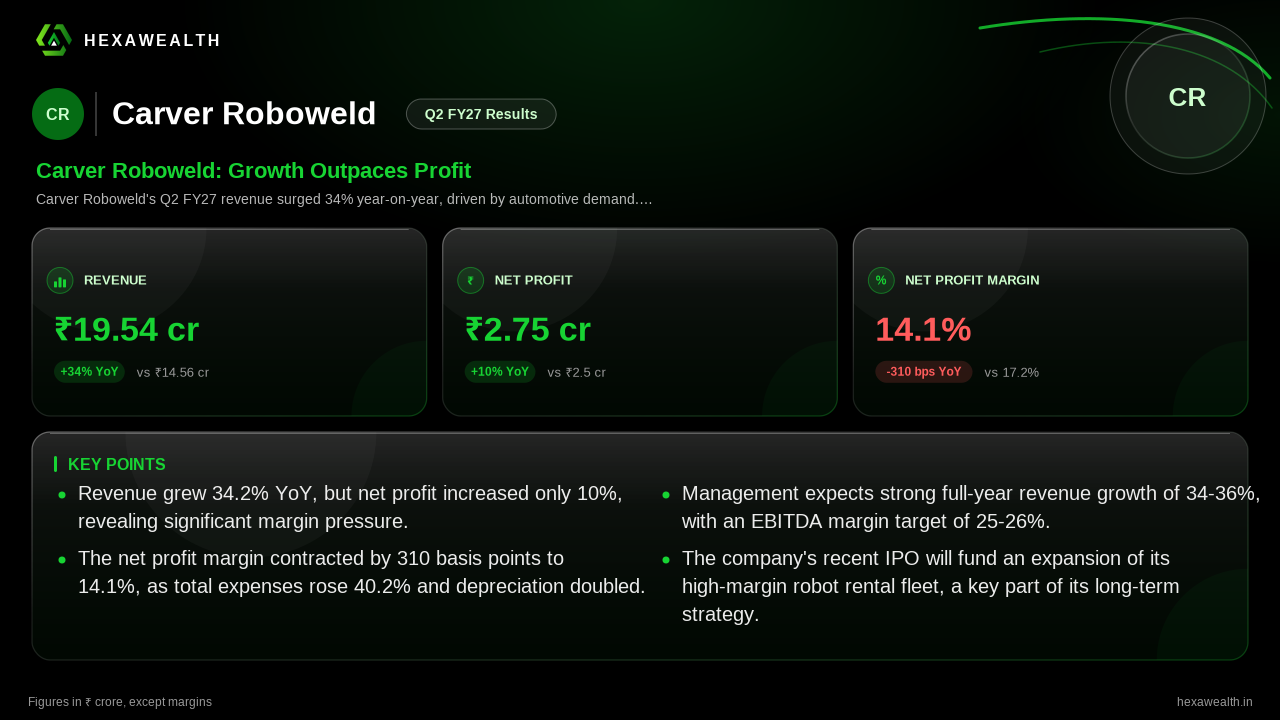
Carver Roboweld (CRL) Q2 FY27 Profit Growth Lags Behind 34% Revenue Jump
The welding wire and robot rental firm saw strong top-line growth, but profit margins contracted sharply due to rising costs and depreciation.
Carver Roboweld's Q2 FY27 revenue surged 34% year-on-year, driven by automotive demand. However, net profit grew only 10% as expenses and depreciation rose faster, squeezing the net profit margin by 310 basis points.
For Carver Roboweld, a model built on selling welding wire to customers who rent its robots, the September quarter brought a surge in demand. The top line grew at a pace that would normally signal strong execution, but the bottom line told a story of costs rising even faster.
Consolidated revenue for Q2 FY27 rose 34.2% year-on-year to ₹19.54 crore. Net profit increased 10% to ₹2.75 crore. The gap between these growth rates is the quarter's headline, as the net profit margin fell to 14.1% from 17.2% a year ago.
Revenue & profit
Revenue (₹ Cr)
Profit (₹ Cr)
- Revenue (₹ Cr), Q2 FY26 (Sep 2025): 14.56
- Revenue (₹ Cr), Q2 FY27 (Sep 2026): 19.54
- Profit (₹ Cr), Q2 FY26 (Sep 2025): 2.50
- Profit (₹ Cr), Q2 FY27 (Sep 2026): 2.75
Revenue (₹ Cr)
- Revenue (₹ Cr), Q2 FY26 (Sep 2025): 14.56
- Revenue (₹ Cr), Q2 FY27 (Sep 2026): 19.54
Profit (₹ Cr)
- Profit (₹ Cr), Q2 FY26 (Sep 2025): 2.50
- Profit (₹ Cr), Q2 FY27 (Sep 2026): 2.75
Net Profit Margin (%)
- Net Profit Margin (%), Q2 FY26 (Sep 2025): 17.2
- Net Profit Margin (%), Q2 FY27 (Sep 2026): 14.1
| Metric | CurrentQ2 FY27 (Sep 2026) | PreviousQ2 FY26 (Sep 2025) |
|---|---|---|
| Revenue (₹ Cr) | 19.54 | 14.56 |
| Profit (₹ Cr) | 2.75 | 2.50 |
| Net Profit Margin (%) | 14.1 | 17.2 |
Why Profit Couldn't Keep Up
Management, cited by MarketsMojo, said the 34% revenue jump was driven by about 35% volume growth in automotive and higher commodity prices. Yet total expenses grew 40.2%, outpacing sales. A key driver was a 100% year-on-year increase in depreciation, which doubled to ₹1.22 crore.
This sharp rise points to recent capital expenditure. The company, according to a Multibagg.ai report, plans a major expansion of its robot rental fleet from 12 to 39 units, funded partly by its recent IPO. The higher depreciation from these new assets is now hitting the income statement.
The Outlook and Market Read
Looking ahead, the company has provided guidance. MarketsMojo reported Carver Roboweld targets FY27 revenue growth of 34-36% with an EBITDA margin of 25-26%. For the second half, it expects revenue growth of 30-35%.
Live Chart
· CRL
(BSE)
ISIN: INE1FY301017
The stock listed on the BSE SME platform on November 4, 2026, after the quarter ended. With a P/E of 25.7, it trades at a discount to the industry average of 42.4, as per the payload data. The quarter shows a business scaling up, but investors are weighing the cost of that growth against the promised future margins.
Key Points
- Revenue grew 34.2% YoY, but net profit increased only 10%, revealing significant margin pressure.
- The net profit margin contracted by 310 basis points to 14.1%, as total expenses rose 40.2% and depreciation doubled.
- Management expects strong full-year revenue growth of 34-36%, with an EBITDA margin target of 25-26%.
- The company's recent IPO will fund an expansion of its high-margin robot rental fleet, a key part of its long-term strategy.
Hexa Perspective
The quarter frames Carver Roboweld's transition from a small manufacturer to a scaling rental business. The revenue momentum is clear, and the guidance suggests management sees it continuing. The catch is that the margin squeeze from depreciation and other costs is not a one-off; it's the cost of the expansion plan now materialising on the P&L.
The investment case hinges on whether the new robot fleet can be deployed and rented out quickly enough to restore operating leverage. The promised FY27 EBITDA margin of 25-26% implies a significant improvement from current levels. Until that materialises, the stock's discount to the sector may persist, reflecting the execution risk embedded in the growth plan.
Also read
Want this applied to your portfolio?
Talk to a HexaWealth advisor, or sync your mutual fund data for insights tailored to your holdings.