Chothani Foods (CHOTHANI) Q4 FY26 Profit Vanishes in Q4 as Costs Outpace Sales
The spice maker's quarterly profit turned negative despite a sequential sales bump, as a shift to manufacturing and higher expenses squeezed margins.
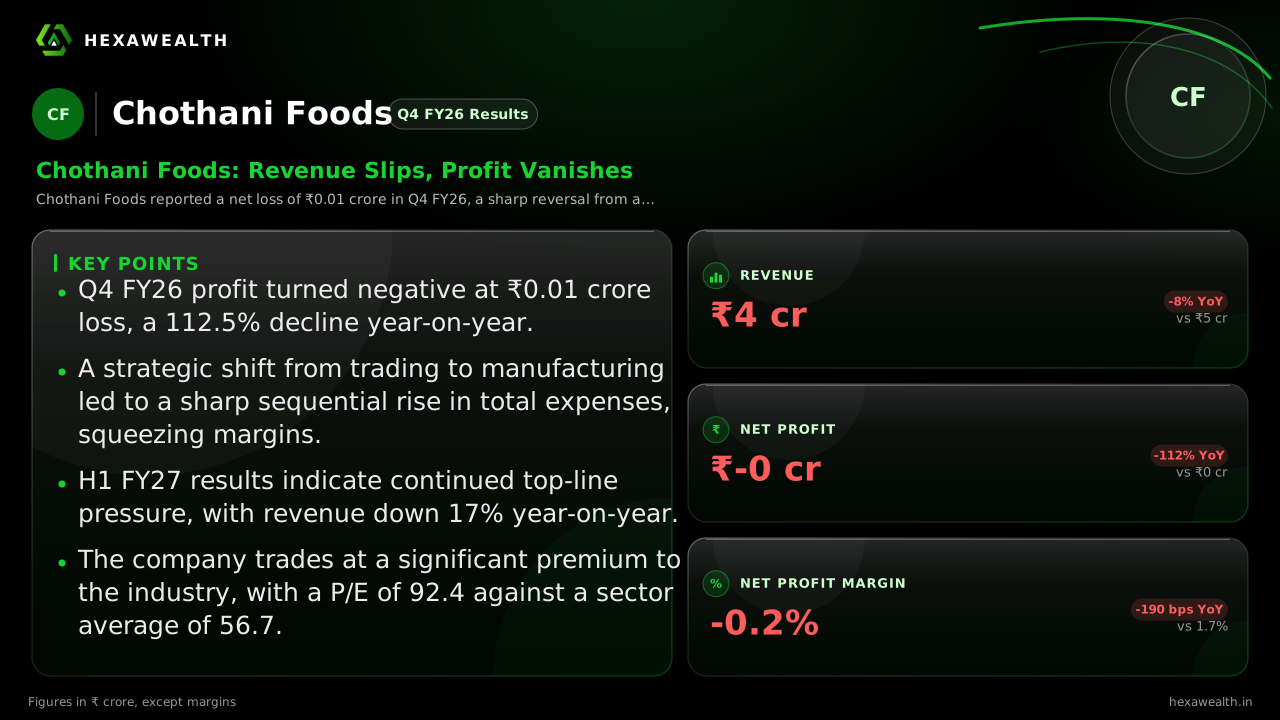
Chothani Foods reported a net loss of ₹0.01 crore in Q4 FY26, a sharp reversal from a profit a year ago. Revenue fell 8% year-on-year, highlighting pressure in a competitive spices market.
For a small packaged foods company, a strategic shift can be a double-edged sword. Chothani Foods' move from trading to manufacturing, detailed in a MarketPing analysis, defined its FY26 but culminated in a difficult final quarter where costs overwhelmed sales.
The March quarter saw revenue of ₹4.38 crore, down 8% from a year earlier. Sequentially, sales rose 11%, but profit swung to a loss of ₹0.01 crore. This pushed the net profit margin to -0.2%, a 350 basis point drop from the September quarter.
Revenue & profit
Revenue (₹ Cr)
Profit (₹ Cr)
- Revenue (₹ Cr), Q2 FY25: 3.24
- Revenue (₹ Cr), Q4 FY25: 4.76
- Revenue (₹ Cr), Q2 FY26: 3.95
- Revenue (₹ Cr), Q4 FY26: 4.38
- Profit (₹ Cr), Q2 FY25: 0.06
- Profit (₹ Cr), Q4 FY25: 0.08
- Profit (₹ Cr), Q2 FY26: 0.13
- Profit (₹ Cr), Q4 FY26: -0.01
Revenue (₹ Cr)
- Revenue (₹ Cr), Q2 FY25: 3.24
- Revenue (₹ Cr), Q4 FY25: 4.76
- Revenue (₹ Cr), Q2 FY26: 3.95
- Revenue (₹ Cr), Q4 FY26: 4.38
Profit (₹ Cr)
- Profit (₹ Cr), Q2 FY25: 0.06
- Profit (₹ Cr), Q4 FY25: 0.08
- Profit (₹ Cr), Q2 FY26: 0.13
- Profit (₹ Cr), Q4 FY26: -0.01
| Metric | CurrentQ4 FY26 | Same quarter LYQ4 FY25 |
|---|---|---|
| Revenue (₹ Cr) | 4.38YoY -8% | 4.76 |
| Profit (₹ Cr) | -0.01YoY -112% | 0.08 |
| Net Margin (%) | -0.2YoY -112% | 1.7 |
Why the bottom line disappeared
Total expenses jumped 16.4% sequentially to ₹4.41 crore, far outpacing the quarter's sales growth. MarketPing notes the company's shift to manufacturing saw purchases of stock-in-trade fall to zero, while the cost of materials consumed surged. This operational transition appears to have disrupted cost efficiency at a critical time.
Interest expense, while down slightly from the prior quarter, remained elevated at ₹0.11 crore. This structural cost, coupled with the operating expense surge, erased the profitability seen in the first half of the fiscal year.
A weak handoff to the new year
The pressure did not ease after March. According to an mCapital report, revenue for the first half of FY27 fell 17% year-on-year to ₹3.27 crore. The report estimates this points to an 8% lower full-year revenue and a 36% lower net profit for FY27.
Live Chart
· CHOTHANI
(BSE)
ISIN: INE344X01016
Working capital remains a strain, with the cash conversion cycle stretching to over 660 days. The same mCapital analysis notes inventories and receivables rose in the September 2026 half-year, partly funded by higher short-term borrowings.
Key Points
- Q4 FY26 profit turned negative at ₹0.01 crore loss, a 112.5% decline year-on-year.
- A strategic shift from trading to manufacturing led to a sharp sequential rise in total expenses, squeezing margins.
- H1 FY27 results indicate continued top-line pressure, with revenue down 17% year-on-year.
- The company trades at a significant premium to the industry, with a P/E of 92.4 against a sector average of 56.7.
Hexa Perspective
The quarter underscores the execution risks for micro-cap companies undergoing business model transitions. While the shift to manufacturing may promise better long-term control, the immediate effect has been a severe profitability shock.
The weak start to FY27 suggests these pressures are not transient. With the stock commanding a high valuation premium despite declining earnings, the market appears to be pricing in a rapid turnaround that the operating numbers have yet to confirm.
Also read
Want this applied to your portfolio?
Talk to a HexaWealth advisor, or sync your mutual fund data for insights tailored to your holdings.