BN Agrochem (BNAGROCHEM) Q1 FY27 Profit Plunges 85% as Costs Overwhelm Sales Growth
The edible oil trader posted a 27% revenue jump in Q1 FY27, but a 40% surge in expenses crushed its net profit margin to just 1.2%.
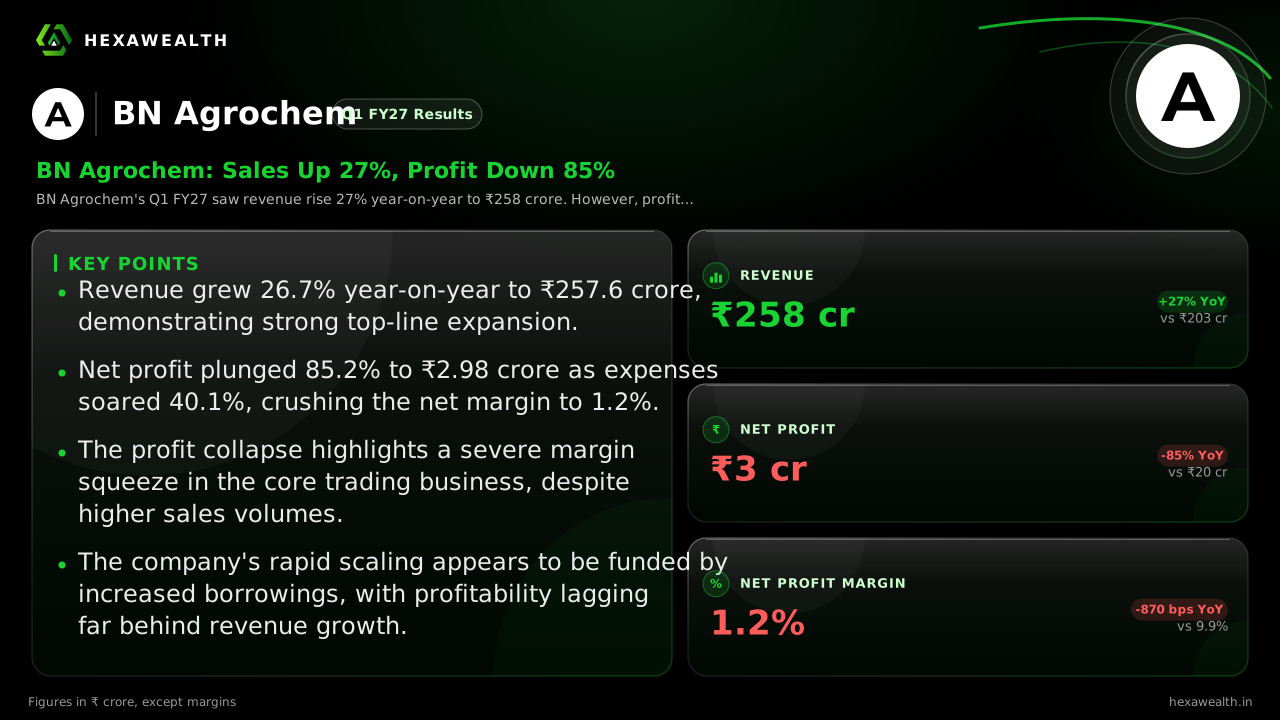
BN Agrochem's Q1 FY27 saw revenue rise 27% year-on-year to ₹258 crore. However, profit collapsed 85% to just ₹3 crore as a 40% jump in expenses led to wafer-thin margins, highlighting a challenging trading environment.
For a company built on trading edible oils, scale is the game. BN Agrochem's first quarter showed it can move volumes, with revenue climbing 27% year-on-year. Yet the bottom line told a harsher story, as profit collapsed by 85% to just ₹3 crore.
The numbers reveal a stark squeeze. Revenue reached ₹257.6 crore, but total expenses surged 40% to ₹252.4 crore. This left a net profit margin of just 1.2%, a staggering 870 basis points lower than the 9.9% margin from a year ago.
Revenue & profit
Revenue (₹ Cr)
Profit (₹ Cr)
| Metric | CurrentQ1 FY27 (Jun 2026) | PreviousQ4 FY26 (Mar 2026) |
|---|---|---|
| Revenue (₹ Cr) | 257.61 | 261.36 |
| Profit (₹ Cr) | 2.98 | 2.95 |
| Net Margin | 1.2% | 1.1% |
Why the growth didn't reach the bottom line
The 40% year-on-year expense jump, far outpacing sales growth, was the primary culprit. Reports from Kotak Neo and Business Standard confirm this cost surge eroded profitability. The company's operating profit fell 75% to ₹5.9 crore, indicating the core trading business is generating much thinner spreads.
This margin pressure is not a one-quarter blip. Analysis from MCapital suggests the company's aggressive scaling, including subsidiary contributions, is happening at "wafer-thin trading margins." Higher borrowings are funding working capital for this growth, but profits are not keeping pace.
The outlook: scale over margins?
The immediate industry context offers little relief. While The Economic Times notes edible oil prices have eased, spurring dealer stocking, broader inflation persists. Reports on peers like Patanjali Foods cite rising input costs for commodities like wheat and sugar, which can pressure all food-related businesses.
For BN Agrochem, the path ahead seems defined by this trade-off. The company is dramatically expanding its revenue base, but the current model shows that growth is coming at the expense of profitability. Investors are left weighing whether this scale will eventually lead to operating leverage or if thin margins are the new normal.
Key Points
- Revenue grew 26.7% year-on-year to ₹257.6 crore, demonstrating strong top-line expansion.
- Net profit plunged 85.2% to ₹2.98 crore as expenses soared 40.1%, crushing the net margin to 1.2%.
- The profit collapse highlights a severe margin squeeze in the core trading business, despite higher sales volumes.
- The company's rapid scaling appears to be funded by increased borrowings, with profitability lagging far behind revenue growth.
Hexa Perspective
This quarter frames BN Agrochem's central dilemma: it can generate sales, but cannot currently convert them into earnings. The 870-basis-point margin compression is too severe to dismiss as volatility; it points to a structurally weaker profit profile in its current phase of expansion.
The key question is duration. If this is the cost of gaining market share, investors need evidence that margins can stabilise and eventually improve. Until then, the stock's premium valuation—trading at a P/E of 62.3 against an industry average of 44.9—rests on faith in a future turnaround that these numbers do not yet support.
Also read
Want this applied to your portfolio?
Talk to a HexaWealth advisor, or sync your mutual fund data for insights tailored to your holdings.