Asgard Alcobev (ASGARD) Q2 FY27 Profit Doubles Year-on-Year Despite Sequential Sales Dip
The company's brewing pivot shows strong margin improvement and operational leverage, even as quarterly revenue softened from the prior quarter.
Asgard Alcobev's Q2 FY27 profit surged over 13-fold year-on-year to ₹2.54 crore, with margins expanding sharply. Revenue more than doubled from last year but dipped 7.7% sequentially, highlighting a quarter of operational efficiency gains.
For Asgard Alcobev, the September quarter was the first real look at the business it has become. The former paper company, now a brewer, posted results that reflect a full quarter of operations from its acquired subsidiary, CMJ Breweries. The year-on-year numbers are a story of transformation, while the sequential comparison reveals the operational tune-up now underway.
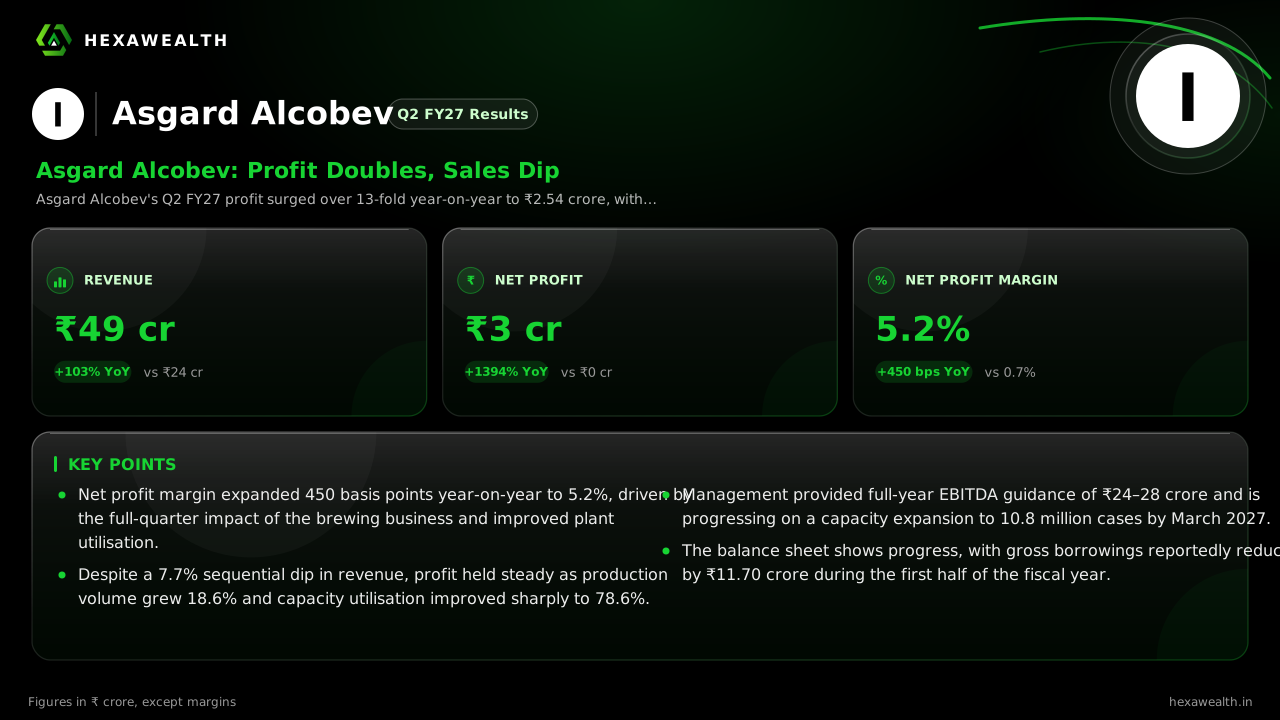
Revenue more than doubled from a year ago to ₹48.93 crore, while net profit soared to ₹2.54 crore from a base of just ₹0.17 crore. Sequentially, revenue eased 7.7%, but profit held flat at ₹2.54 crore, pointing to stronger underlying profitability. The net profit margin expanded to 5.2%, a significant leap from 0.7% a year ago and 4.8% last quarter.
Revenue & profit
Revenue (₹ Cr)
Profit (₹ Cr)
Net Profit Margin (%)
| Metric | CurrentQ2 FY27 | PreviousQ1 FY27 | Same quarter LYQ2 FY26 |
|---|---|---|---|
| Period | Quarter ended September 2026 | Quarter ended June 2026 | Quarter ended September 2025 |
| Revenue (₹ Cr) | 48.93YoY +103% | 53.04 | 24.12 |
| Profit (₹ Cr) | 2.54YoY +1394% | 2.54 | 0.17 |
| Net Profit Margin (%) | 5.2YoY +643% | 4.8 | 0.7 |
Efficiency Outweighs a Sales Dip
The quarter's paradox—lower sales but stable profit—was solved by a sharp improvement in plant utilisation. According to reports from Tribuneindia.com and FinTech BizNews, production volume rose 18.6% sequentially to 13.82 lakh cases. Capacity utilisation jumped to 78.6% from 63.1% in the prior quarter, driving significant operating leverage.
This higher throughput allowed the company to absorb a rise in fixed costs. Finance costs increased to ₹1.85 crore, and depreciation rose to ₹2.39 crore, largely due to the consolidation of CMJ Breweries and accounting corrections noted by Blacklitt.com. Yet, disciplined cost management saw other expenses fall, leading to a 42.3% sequential jump in EBITDA to ₹7.33 crore, as per management commentary.
The Roadmap from Regional Brewer
Management, cited in the Tribuneindia.com release, is targeting EBITDA of ₹24–28 crore for the full year. The near-term plan is to expand annual capacity from 8.4 million cases to 10.8 million by March 2027. The long-term vision, outlined in a Multibagg.ai report, is a four-plant, pan-India platform with 48 million cases of capacity.
The business model provides a stable foundation. It earns a conversion fee per case from five partner brands, including United Breweries and Carlsberg, while they shoulder marketing and demand risk. This contract revenue is supplemented by seven owned labels, which offer potential for higher margins.
Key Points
- Net profit margin expanded 450 basis points year-on-year to 5.2%, driven by the full-quarter impact of the brewing business and improved plant utilisation.
- Despite a 7.7% sequential dip in revenue, profit held steady as production volume grew 18.6% and capacity utilisation improved sharply to 78.6%.
- Management provided full-year EBITDA guidance of ₹24–28 crore and is progressing on a capacity expansion to 10.8 million cases by March 2027.
- The balance sheet shows progress, with gross borrowings reportedly reduced by ₹11.70 crore during the first half of the fiscal year.
Hexa Perspective
Asgard Alcobev's quarter confirms the operational potential of its brewing pivot. The margin expansion story is credible, built on higher utilisation rather than just sales growth. The immediate test is whether it can reignite top-line momentum while maintaining these new efficiency levels.
The guidance hinges on continued high utilisation and the successful execution of the capacity expansion. Investors are weighing the promise of a scalable contract manufacturing platform against the capital needs of its ambitious long-term plan and the customer concentration inherent in serving five main partners.
Also read
Want this applied to your portfolio?
Talk to a HexaWealth advisor, or sync your mutual fund data for insights tailored to your holdings.