The Reserve Bank of India has cleared a path for SBI Mutual Fund to become a significant shareholder in South Indian Bank. This regulatory approval arrives as the bank demonstrates strong earnings momentum, with profit growing 21.3% year-on-year last quarter.
The Terms of the Approval
The RBI’s approval, received on November 23, 2026, allows SBI Mutual Fund to acquire an aggregate holding of up to 9.99% of the bank’s paid-up share capital or voting rights. According to the NSE filing, it is subject to compliance with the Banking Regulation Act, the Foreign Exchange Management Act, and SEBI regulations. The Hindu BusinessLine reports that mutual funds collectively already held a 15.13% stake in the bank as of September 2026, with SBI’s own Banking & Financial Services Fund holding 2.90%.
This is a permission to buy, not a confirmation of purchase. Analysis from MF Analyser notes the approval clears a key regulatory threshold but does not specify timing, price, or which specific schemes might invest.
A Vote of Confidence in Momentum
For South Indian Bank, the nod represents a vote of institutional confidence. It follows a quarter where the bank’s operating profit surged 36.7% and its net profit margin improved to 15.2%. The potential for a large, stable institutional buyer could influence the shareholder mix and liquidity.
The approval itself is a procedural step under RBI directions for commercial banks. GreyOak Capital characterized market sentiment around the news as positive.
Key Points
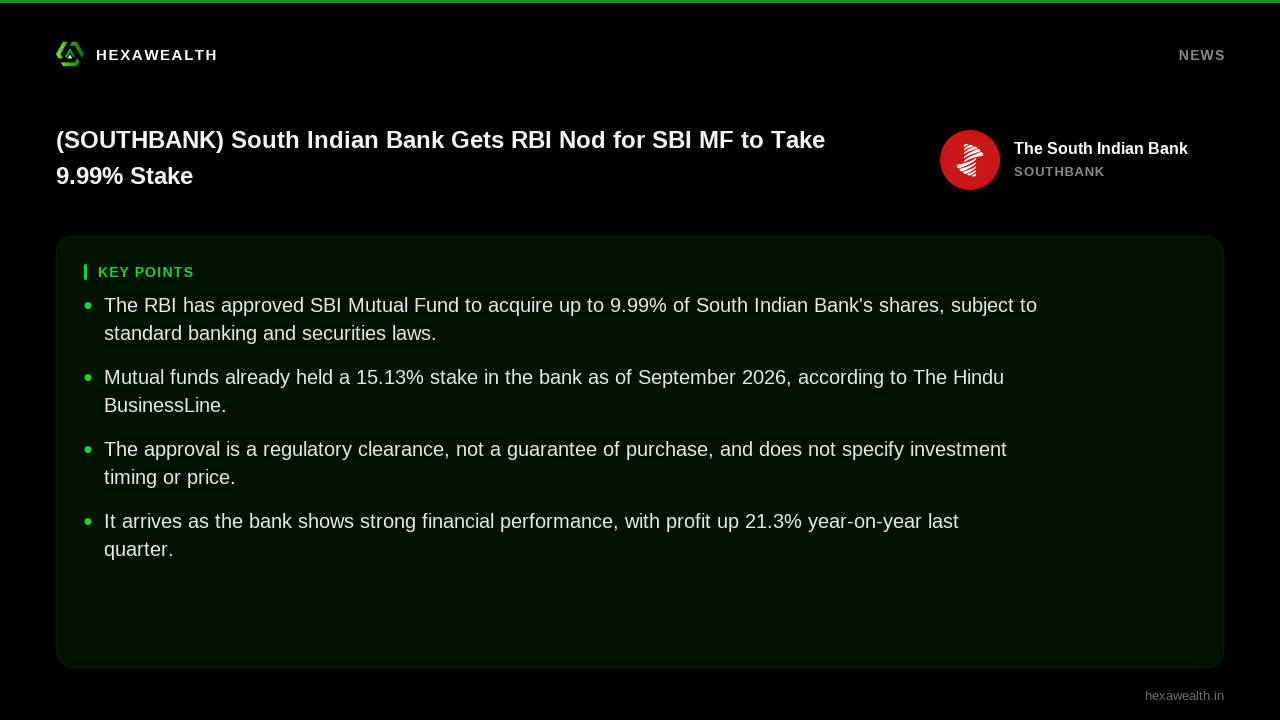
- The RBI has approved SBI Mutual Fund to acquire up to 9.99% of South Indian Bank's shares, subject to standard banking and securities laws.
- Mutual funds already held a 15.13% stake in the bank as of September 2026, according to The Hindu BusinessLine.
- The approval is a regulatory clearance, not a guarantee of purchase, and does not specify investment timing or price.
- It arrives as the bank shows strong financial performance, with profit up 21.3% year-on-year last quarter.
Hexa Perspective
The RBI’s approval is a formal endorsement of SBI Mutual Fund’s capacity to hold a near-10% stake, aligning with the bank’s recent trajectory of cleaner books and expanding margins. For South Indian Bank, the significance lies less in immediate capital and more in the signal it sends—a major fund house sees value enough to secure regulatory permission for a substantial position.
The bank’s ability to sustain its improved asset quality and net interest margin expansion, as seen in the last quarter, is what must stay true to justify such institutional interest. If the operational momentum holds, this regulatory event could pave the way for a more stable, long-term shareholder base. If execution falters, the permission remains just that—a formality with no capital attached.