Flair Writing Industries' promoters have completed a planned sale of their shares, a move that brings the company into full compliance with stock market rules. The sale, executed to meet the Minimum Public Shareholding requirement, shifts a larger portion of ownership to public investors without affecting the company's capital or operations.
Promoters Khubilal and Vimalchand Rathod sold a total of 38 lakh shares, representing 3.61% of the company's equity, between November 17 and 27, according to the NSE filing. This reduces the promoters' aggregate holding from 78.59% to 74.98%, just above the 75% threshold. The sale was part of a pre-announced plan detailed in a BSE filing on November 13, as reported by Groundamentals.com and Stockfin.ai.
A Regulatory Milestone
The transaction ensures the company's public shareholding now meets the SEBI requirement of at least 25%. This compliance removes a regulatory overhang. The sales were conducted entirely through the open market, which, as Sahi.com notes, expands trading liquidity for other market participants.
Key Points
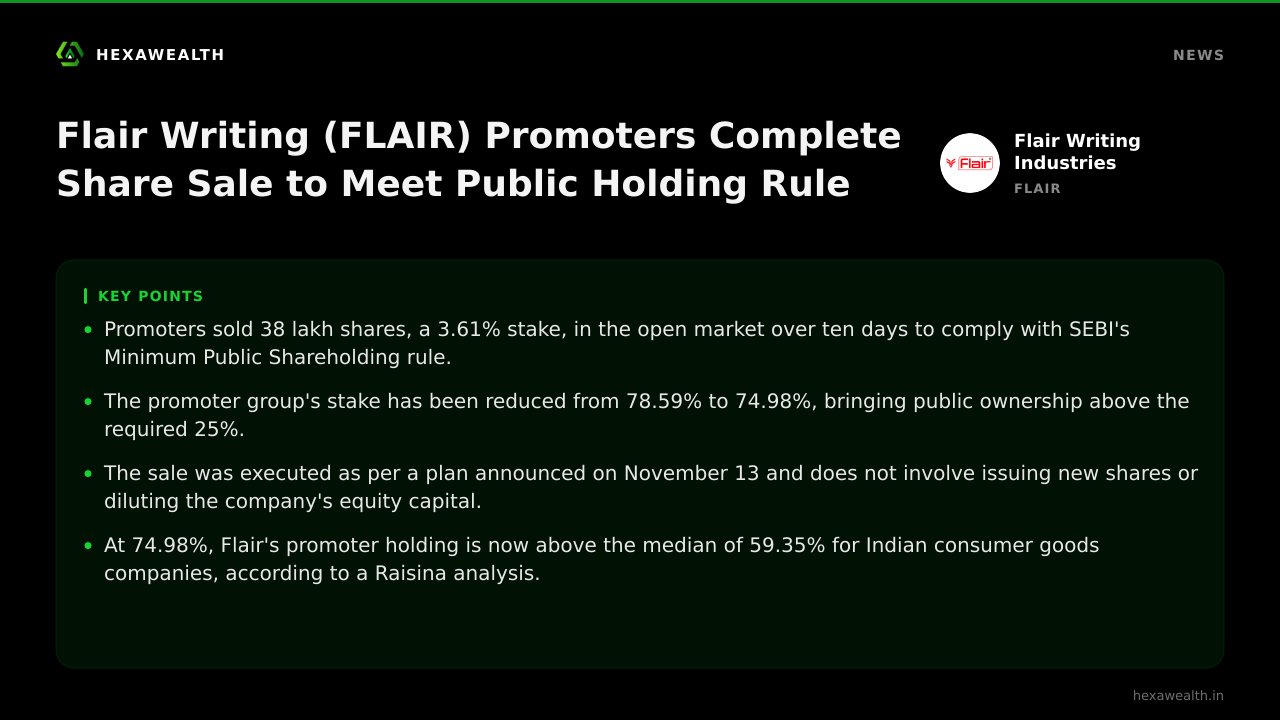
- Promoters sold 38 lakh shares, a 3.61% stake, in the open market over ten days to comply with SEBI's Minimum Public Shareholding rule.
- The promoter group's stake has been reduced from 78.59% to 74.98%, bringing public ownership above the required 25%.
- The sale was executed as per a plan announced on November 13 and does not involve issuing new shares or diluting the company's equity capital.
- At 74.98%, Flair's promoter holding is now above the median of 59.35% for Indian consumer goods companies, according to a Raisina analysis.
Hexa Perspective
For Flair Writing, this is a necessary corporate governance step that aligns its structure with listed peers, but it does not change the fundamental business challenge. The company is in the midst of a costly growth phase, where revenue gains are being pressured by input costs, as seen in its recent quarterly margin squeeze.
The completion of the sale removes a regulatory distraction, allowing investor focus to return squarely to execution. The key question remains whether the company's new capacity and expansion can deliver the operating leverage needed to improve profitability. If Flair can stabilize its margins while growing sales, this regulatory compliance will be seen as a footnote to a larger turnaround story. If cost pressures persist, the broader ownership base will be watching a company where top-line ambition continues to outpace bottom-line delivery.