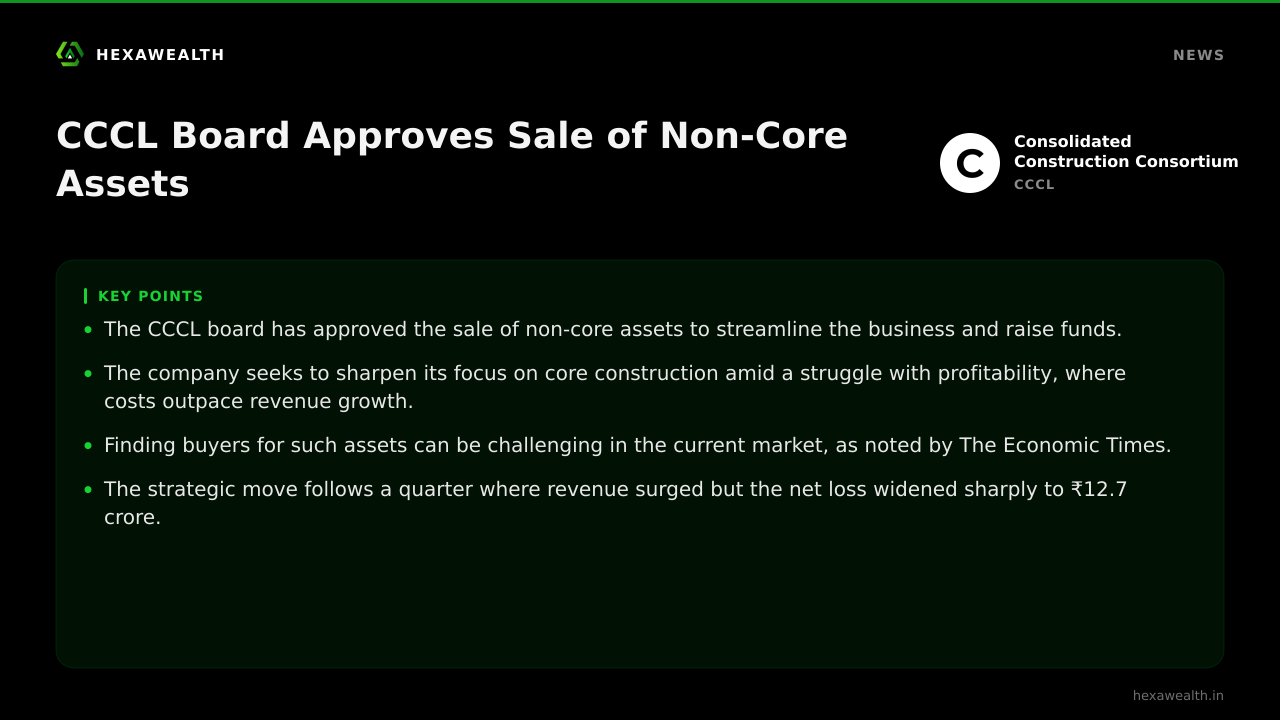
Consolidated Construction Consortium's board has approved the sale of non-core assets, a move to streamline the business and raise funds. This strategic pivot, first reported by ScanX, aims to sharpen the company's focus on its core construction activities as it battles a persistent profitability challenge.
A Financial Cushion
The sale could provide a much-needed financial buffer. The company operates with a debt-free balance sheet, but data from Yahoo Finance cited by HexaWealth shows it had negative operating cash flow over the past year, meaning its core business consumes cash. While the specific assets and their value were not disclosed in the NSE filing, the proceeds are intended to support operations.
However, finding buyers may not be straightforward. A report in The Economic Times highlighted that infrastructure companies like Hindustan Construction Company have found it challenging to find buyers for such assets in the current market environment.
The Core Challenge Remains
The asset sale is a response to a clear financial pressure. In the latest quarter, revenue grew 91% year-on-year to ₹126.34 crore, yet the net loss deepened to ₹12.7 crore. The company's costs have been rising faster than its sales. This move does not, by itself, fix that core operational issue.
Key Points
- The CCCL board has approved the sale of non-core assets to streamline the business and raise funds.
- The company seeks to sharpen its focus on core construction amid a struggle with profitability, where costs outpace revenue growth.
- Finding buyers for such assets can be challenging in the current market, as noted by The Economic Times.
- The strategic move follows a quarter where revenue surged but the net loss widened sharply to ₹12.7 crore.
Hexa Perspective
The asset sale is a logical, defensive step for a company generating sales but not profits. With a clean balance sheet, CCCL has the runway to be strategic rather than desperate. The real test is whether any proceeds can be deployed to fix the core problem: costs rising faster than revenue. For this move to matter, the company must use the resulting liquidity and operational focus to achieve what has been elusive—sustainable project-level profitability. Until then, it remains a story of promising activity without consistent economic gain.