Virat Leasing (VLL) Q2 FY27 Profit Stalls as Expenses Jump 88%
The NBFC's net profit remained flat year-on-year despite a tax credit, as a sharp rise in operating expenses squeezed pre-tax earnings.
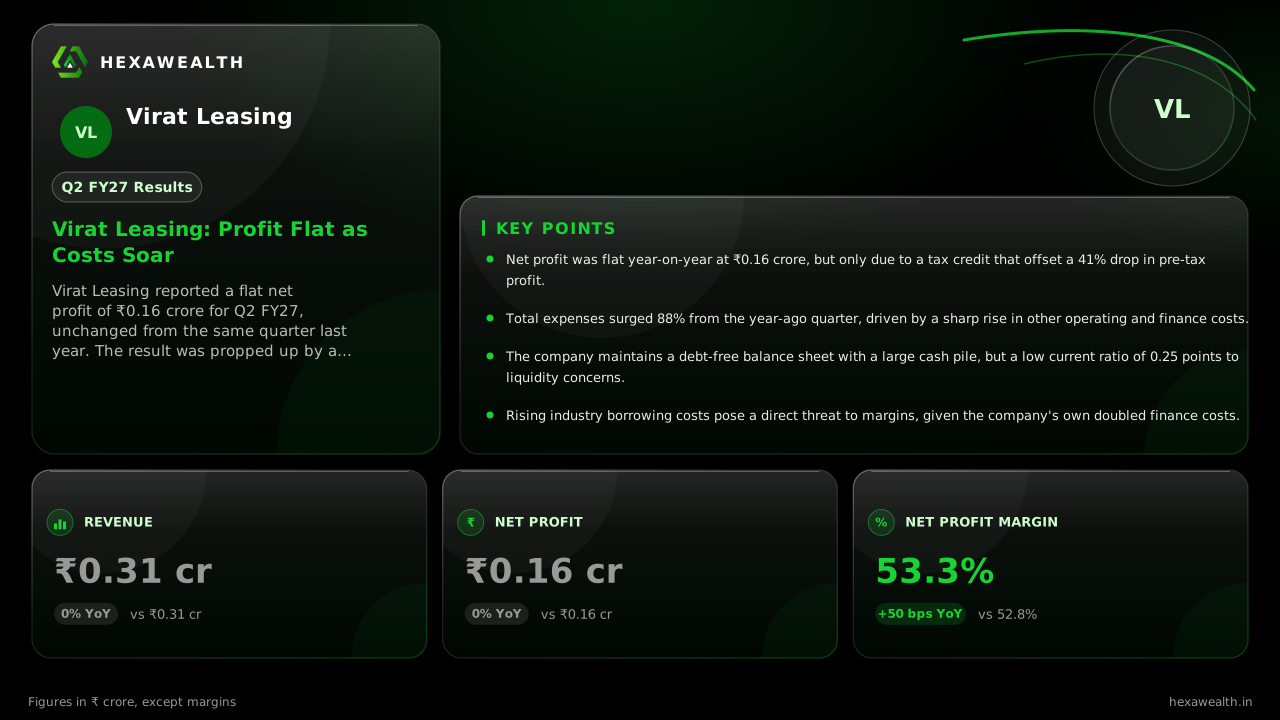
Virat Leasing reported a flat net profit of ₹0.16 crore for Q2 FY27, unchanged from the same quarter last year. The result was propped up by a tax credit, as a near-doubling of total expenses eroded pre-tax profit by 41%.
For a small NBFC, steady profit is often a sign of a stable loan book. Virat Leasing’s September quarter shows that stability is fragile when costs run ahead of income. The company posted a net profit of ₹0.16 crore, exactly matching its figure from a year ago, but that headline masks a sharp deterioration in its underlying earnings power.
Revenue & profit
Revenue (₹ Cr)
Net Profit (₹ Cr)
- Revenue (₹ Cr), Q2 FY26: 0.31
- Revenue (₹ Cr), Q3 FY26: 0.20
- Revenue (₹ Cr), Q4 FY26: 0.13
- Revenue (₹ Cr), Q1 FY27: 0.20
- Revenue (₹ Cr), Q2 FY27: 0.31
- Net Profit (₹ Cr), Q2 FY26: 0.16
- Net Profit (₹ Cr), Q3 FY26: -1.04
- Net Profit (₹ Cr), Q4 FY26: 0.11
- Net Profit (₹ Cr), Q1 FY27: 0.06
- Net Profit (₹ Cr), Q2 FY27: 0.16
Revenue (₹ Cr)
- Revenue (₹ Cr), Q2 FY26: 0.31
- Revenue (₹ Cr), Q3 FY26: 0.20
- Revenue (₹ Cr), Q4 FY26: 0.13
- Revenue (₹ Cr), Q1 FY27: 0.20
- Revenue (₹ Cr), Q2 FY27: 0.31
Net Profit (₹ Cr)
- Net Profit (₹ Cr), Q2 FY26: 0.16
- Net Profit (₹ Cr), Q3 FY26: -1.04
- Net Profit (₹ Cr), Q4 FY26: 0.11
- Net Profit (₹ Cr), Q1 FY27: 0.06
- Net Profit (₹ Cr), Q2 FY27: 0.16
| Metric | CurrentQ2 FY27 | PreviousQ1 FY27 | Same quarter LYQ2 FY26 |
|---|---|---|---|
| Revenue (₹ Cr) | 0.31YoY 0% | 0.20 | 0.31 |
| Net Profit (₹ Cr) | 0.16YoY 0% | 0.06 | 0.16 |
| PAT Margin (%) | 53.3YoY +0.9% | 32.2 | 52.8 |
Revenue was flat year-on-year at ₹0.31 crore. Sequentially, it rose 55% from a low base in the June quarter. The real story, however, is on the expense line.
The cost surge that erased profits
Total expenses ballooned to ₹0.17 crore, an 89% jump from the year-ago quarter. According to a report by MarketPing, this was driven by a 350% surge in ‘other expenses’ and a doubling of finance costs. Employee costs fell by half, but this saving was completely overwhelmed.
The result was a 41% drop in profit before tax to ₹0.13 crore. The flat net profit was only achieved because of a tax credit of ₹0.03 crore, compared to a tax provision a year ago. Without this one-off benefit, the bottom line would have fallen sharply.
Live Chart
· VLL
(BSE)
ISIN: INE347L01022
A balance sheet of extremes
This is a company of contrasts. Its balance sheet, as of September 2026, shows ₹17.61 crore in cash and equivalents against negligible borrowings, according to a MarketsMojo summary. Yet, its current ratio is a weak 0.25, indicating potential liquidity strain in meeting short-term obligations.
Its loan book is almost entirely unsecured, with a significant portion lent to related parties. This concentrated, high-risk lending profile makes income volatile and asset quality a constant watch.
A tougher road ahead
The broader environment is turning less favourable. Reports from ET CFO and Business Standard note that NBFCs are facing rising borrowing costs following recent RBI rate hikes, which could pressure margins further. For a small player like Virat Leasing, which saw finance costs double this quarter, this headwind is already here.
There was no specific growth guidance from management in the filings. The market reaction was muted, with the stock last trading at ₹54.58 before the results announcement.
Key Points
- Net profit was flat year-on-year at ₹0.16 crore, but only due to a tax credit that offset a 41% drop in pre-tax profit.
- Total expenses surged 88% from the year-ago quarter, driven by a sharp rise in other operating and finance costs.
- The company maintains a debt-free balance sheet with a large cash pile, but a low current ratio of 0.25 points to liquidity concerns.
- Rising industry borrowing costs pose a direct threat to margins, given the company's own doubled finance costs.
Hexa Perspective
This quarter underscores the vulnerability of a micro-NBFC with a thin operating margin. The flat profit is an accounting artefact, not an operational achievement. The core business is under clear pressure from runaway expenses.
The high cash balance provides a buffer, but it is not being deployed profitably. Until the company demonstrates it can grow its income faster than its costs—or at least control the latter—its earnings trajectory will remain precarious. Investors are left weighing a strong balance sheet against a struggling income statement.
Also read
Want this applied to your portfolio?
Talk to a HexaWealth advisor, or sync your mutual fund data for insights tailored to your holdings.